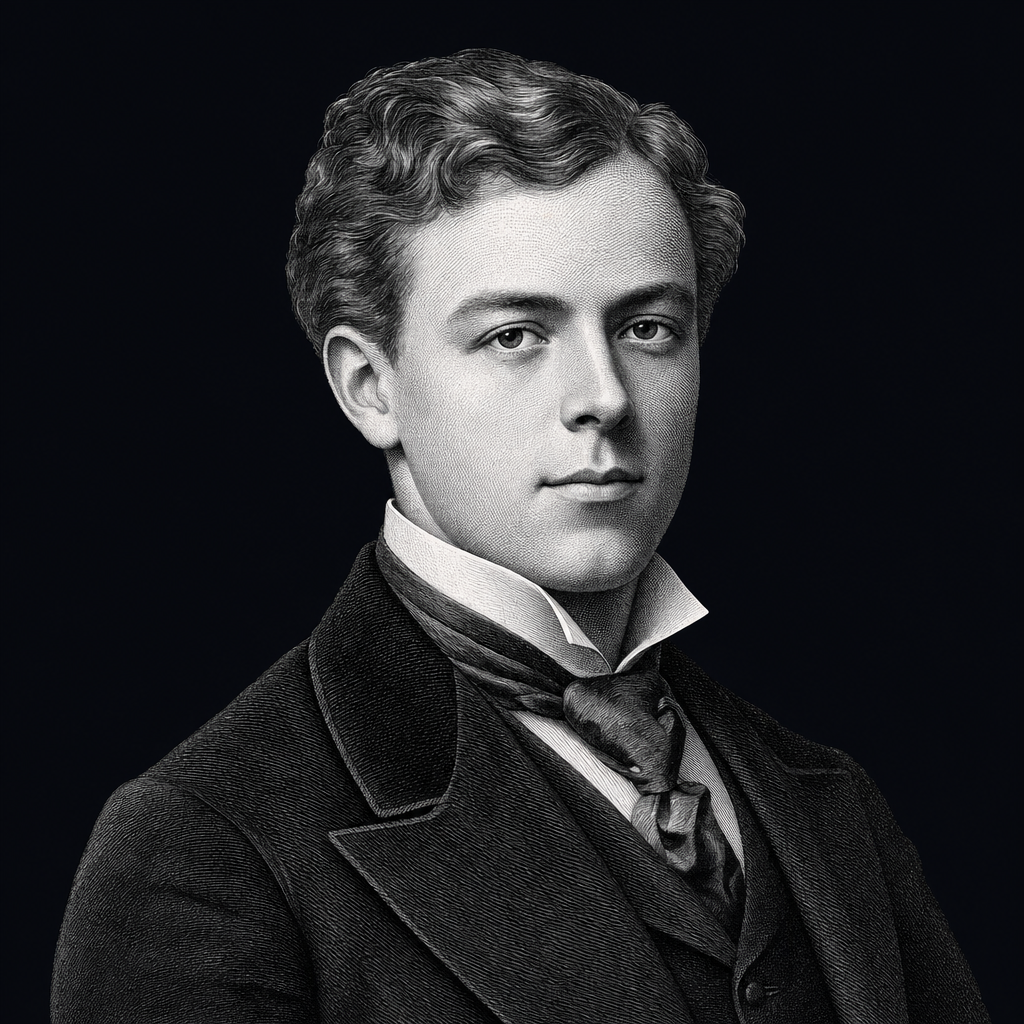
Harry Nelson Pillsbury
“The American prodigy of Hastings”
His sensational victory at Hastings 1895 and astonishing feats of memory and blindfold chess
2755Peak ratingChessmetrics historical estimate
Born–died1872–1906
CountryUnited States
Active era1890s–1906
TitleU.S. Champion (1897–1906); world-class master
Harry Nelson Pillsbury was born on December 5, 1872, in Somerville, Massachusetts. He learned chess relatively late, around the age of sixteen, but progressed with breathtaking speed, soon becoming one of the strongest players in the United States. Tall, genial and gifted with a phenomenal memory, he combined fierce attacking talent with a deep understanding of the new positional ideas spreading from Europe.
His breakthrough was as dramatic as any in chess history. In 1895, at just twenty-two and largely unknown internationally, Pillsbury travelled to England for the great Hastings tournament — one of the strongest fields ever assembled, including the reigning champion Steinitz, the former champion-to-be Lasker, Tarrasch, Chigorin and Schlechter. Pillsbury won it outright, ahead of them all, announcing himself overnight as a genuine contender for the world title.
He backed up that triumph with strong results at the elite St. Petersburg 1895–96 quadrangular and at Nuremberg 1896, and he developed a famous, hard-fought rivalry with Emanuel Lasker. Pillsbury was associated above all with the Queen's Gambit, in which his aggressive handling of the white pieces — the so-called Pillsbury Attack with a knight to e5 and a pawn storm — influenced opening theory for decades.
Away from serious competition, Pillsbury was celebrated for almost superhuman feats of memory and mental stamina. He could play more than twenty games of blindfold chess simultaneously, set a record of twenty-two such games at Moscow in 1902, and would entertain audiences by reciting long lists of obscure words after a single hearing, or by playing blindfold chess and checkers while holding a hand of whist — all at once.
His career, however, was cut tragically short. Pillsbury contracted syphilis, and the disease steadily undermined his health and, eventually, his mind. Even so, he won the U.S. Championship from Jackson Showalter in 1897 and held it until his death. His results grew increasingly uneven as his illness advanced, and the chess world watched a great talent decline in real time.
Pillsbury died on June 17, 1906, in Philadelphia, at just thirty-three years of age. Many believe that, but for his illness, he would have challenged for and perhaps won the World Championship. He remains one of the great might-have-beens of the game, and the finest American player between Paul Morphy and the modern era.
Playing style
Pillsbury was a powerful attacking player who had also absorbed the positional lessons of the new scientific school, making him unusually well-rounded for his time. With the white pieces he was a leading exponent of the Queen's Gambit, where his trademark plan — establishing a knight on e5 and launching a kingside pawn storm — became a model attacking method. He calculated deeply and possessed a prodigious memory that let him recall opening analysis and entire games with ease. At his best he blended romantic-era aggression with modern strategic understanding, a combination that made him briefly one of the most dangerous players alive.
Signature openings
Queen's GambitRuy LopezPetroff DefenceQueen's Gambit DeclinedPillsbury Attack (Queen's Gambit setups)
Rivalries & key opponents
- Emanuel Lasker
- Siegbert Tarrasch
- Mikhail Chigorin
- Jackson Showalter
Career highlights
- Won the elite Hastings tournament outright at age 22 (1895)
- Shared and contested first at the St. Petersburg quadrangular (1895–96)
- Tied for third at the strong Nuremberg tournament (1896)
- Won the U.S. Championship from Jackson Showalter and held it until his death (1897–1906)
- Set a world record of 22 simultaneous blindfold games at Moscow (1902)
- Renowned for memory feats, including reciting long word lists after a single hearing
- Developed the Pillsbury Attack in the Queen's Gambit, influencing opening theory for decades
- Maintained a celebrated competitive rivalry with World Champion Emanuel Lasker
Famous games on BetterChess
More players





Biographical summary compiled by BetterChess. BetterChess is a practice tool — we make no guarantee you'll reach 1800 or any rating.
PRINTED CHESS PUZZLE CARDS
Chess puzzle playing card decks
54 poker-size cards in a tuck box. Puzzle on the front, solution on the back.