Lasker's Counterattack (1896)
- Black
- Emanuel Lasker
- Event
- St. Petersburg
- Year
- 1896
- Result
- 0–1
- Opening
- Queen's Gambit Declined
17. f5
17...Rxc3! The hammer blow. Lasker gives a rook to shatter the pawns shielding the white king; the b- and c-files crack wide open.
Why this game matters
St. Petersburg, 1895–96. Two attacks racing in opposite directions: Pillsbury castled queenside and threw his f-pawn at Lasker's king, while Lasker tore open the c-file toward Pillsbury's. The decisive moment is 17...Rxc3!, a rook sacrifice that rips the white king's cover apart. Lasker calculated that his attack arrived a crucial tempo sooner — and it did.
The lesson
In opposite-side castling, the game is a race: whoever's attack lands first usually wins, so count tempi, not material. Lasker gave up a rook on c3 to demolish the pawns around Pillsbury's king because the open lines and checks came faster than White's kingside push. When kings castle on opposite wings, attack with everything and don't slow down to defend.
Move by move
5. Bg55.Bg5 — Pillsbury's pet line against the Queen's Gambit. He took the queen to d4 and h4, signalling a kingside-flavoured plan even after castling long.
8. O-O-O8.O-O-O — both kings will end up on opposite wings (Black castles short next). From here it's a straight race of pawn storms.
14… Nxd414...Be6 — Lasker finishes development and prepares to throw everything down the c-file at White's king while Pillsbury readies f4–f5.
17. f517...Rxc3! The hammer blow. Lasker gives a rook to shatter the pawns shielding the white king; the b- and c-files crack wide open.
18… Ra318...Ra3! Refusing to recapture and instead piling on — the rook swings to a3 to keep tearing at the king's cover. Every tempo counts.
20… Qb6+20...Qb6+ — the checks begin. Lasker's queen and rooks converge while White's kingside attack has stalled a move too late.
21… Qxb5+21...Qxb5+ — material is restored and the white king is in a mating net on the queenside. The race is decided.
26… Rxa326...Rxa3! A second exchange thrown in to drag the king up the board. The hunt is now forced.
27. Qe6+27.Qe6+ Kh7 — White grabs a desperate check, but the black king strolls to safety while White's king has nowhere to hide.
30… Qc4+30...Qc4+ — White resigned: the king is hunted to b5 with mate to follow. Lasker's counterattack arrived first.
Frequently asked
What is the key idea of 17...Rxc3?
It's a rook sacrifice to demolish the pawn shelter (b- and c-pawns) around White's queenside king. In an opposite-castling race the open lines and checks Lasker gains are worth far more than the rook, because his attack lands a tempo before Pillsbury's.
Why is this game famous?
It's regarded as one of Lasker's finest attacking wins and a model of opposite-side castling play — calm development followed by a violent, correctly-timed breakthrough against the enemy king. Kasparov singled it out for praise in his predecessors series.
Can I try the breakthrough myself?
Yes — take the board as Black just before 17...Rxc3 and try to find the rook sacrifice and the king hunt, or step through the whole game move by move, no sign-up.
Similar games
Lasker's Double Bishop Sacrifice (1889)
Emanuel Lasker vs Johann Bauer · 1889 · Bird's Opening
Replay & play ›Lasker's Strategic Masterpiece (1914)
Emanuel Lasker vs Jose Raul Capablanca · 1914 · Ruy Lopez, Exchange
Replay & play ›The Pipe Game (1900)
Frank Marshall vs Amos Burn · 1900 · Queen's Gambit Declined
Replay & play ›Rubinstein's Endgame Clinic (1912)
Akiba Rubinstein vs Carl Schlechter · 1912 · Queen's Gambit Declined, Semi-Tarrasch
Replay & play ›Want this on your own games? BetterChess puts a real engine inside Claude, so it finds the moves that actually decided the game instead of listing every inaccuracy.
BetterChess is a practice tool. We make no guarantee you'll reach 1800 or any rating. This is a historical game; the analysis is our own.
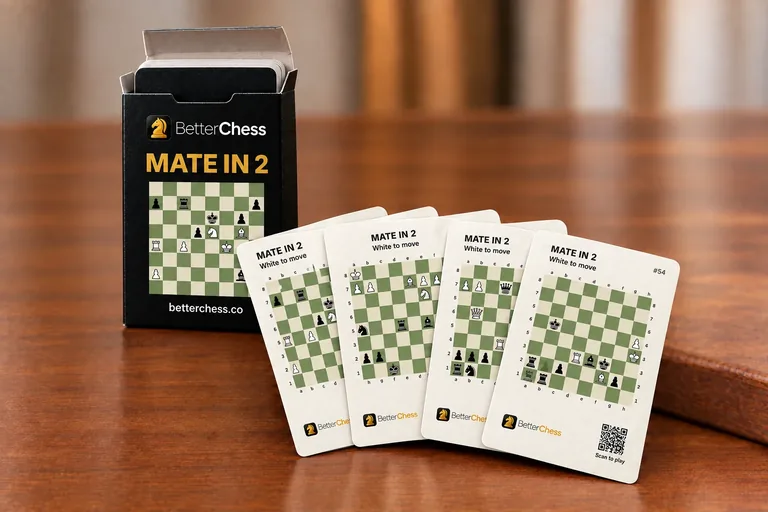
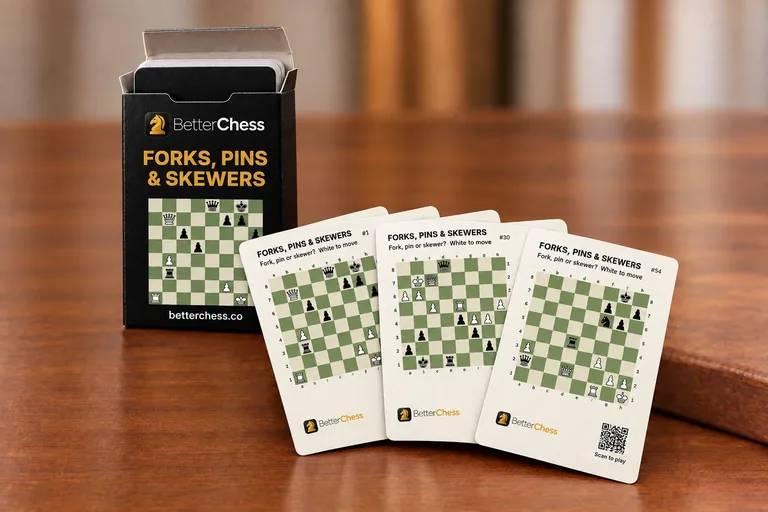
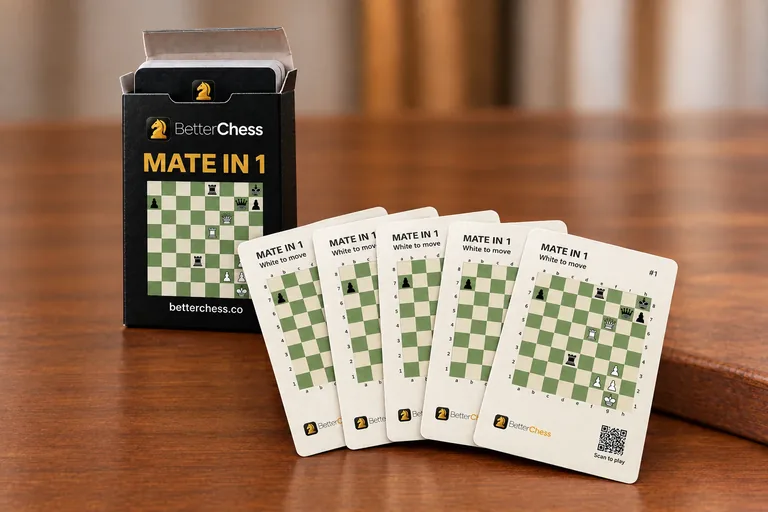
PRINTED CHESS PUZZLE CARDS
Chess puzzle playing card decks
54 poker-size cards in a tuck box. Puzzle on the front, solution on the back.