Petrov Defense
Starting position
Engine ready — step through to see live evals.
Press ▶ Watch to play the line out, or Next to step through it — the engine evaluates every position.
The Petrov Defense (also called the Russian Game) answers 2.Nf3 with the symmetrical 2...Nf6: instead of defending the e5-pawn, Black counter-attacks e4. It has a reputation as one of the most solid replies to 1.e4 and has served world-class defenders from Karpov's era to Caruana today. For club players it is a practical dream: the plans are clear, the theory is manageable, and one move-order trap is all you really must memorize.
The idea in one line
Counter-attack e4 with 2...Nf6 instead of defending e5, remember to insert 3...d6 before recapturing, and reach a symmetrical, rock-solid position where you play on equal terms.
Key ideas
- Symmetry with a point: rather than defending e5, Black hits e4. If both sides grab a pawn, the material stays level and Black has solved the opening by move five.
- The one thing you must know: after 3.Nxe5, play 3...d6 first and only then take on e4. The immediate 3...Nxe4? runs into 4.Qe2 with serious trouble.
- Black's pieces flow to natural squares: ...d5 supports the strong e4-knight, then ...Nc6 or ...Bd6 and ...O-O complete a healthy setup with no weaknesses.
- Solidity does not mean passivity: the knight on e4 is a real outpost, and Black often gets active play against d4 and along the e-file.
Plans for each side
White: Regain the pawn with Nxe5 and Nf3, build the centre with d4 and Bd3, castle, then question Black's e4-knight with c4 or Re1 and try to squeeze something lasting out of the extra tempo.
Black: Insert ...d6 before taking on e4, then support the knight with ...d5, develop with ...Nc6 or ...Bd6 and ...O-O, and trade into a comfortable, symmetrical middlegame where White's first-move edge slowly evaporates.
Common mistakes to avoid
- Never grab e4 immediately: 3...Nxe4? 4.Qe2 costs material, since 4...Nf6 5.Nc6+ is a discovered check that wins the queen. Play 3...d6 first, every single time.
- Once the knights land on e4 and f3, stop copying: mirroring White's moves mechanically eventually loses to the extra tempo. Copy ideas, not moves.
- Support the e4-knight properly with ...d5; if it gets kicked while your pieces are still at home, White wins the centre for free.
The main line, explained
2… Nf6...Nf6 is the Petrov: Black ignores the threat to e5 and counter-attacks e4 instead.
3. Nxe5Nxe5 accepts the challenge and is the main test. Quiet moves let Black equalize without effort.
3… d6...d6! is the move you must remember. It kicks the knight first; the immediate 3...Nxe4? loses material to 4.Qe2.
4… Nxe4...Nxe4 now regains the pawn safely, since the e-file discovery tricks no longer work.
5… d5...d5 supports the strong e4-knight and stakes out Black's full share of the centre.
6… Nc6...Nc6 develops with pressure against d4; both sides finish development in a balanced, symmetrical position.
Frequently asked
Is the Petrov Defense drawish?
It is solid rather than drawish. The symmetry ends quickly once White plays d4 and c4 or Re1, and the middlegames have real content. At club level games are decided by play, not by the opening's reputation.
What is the main trap in the Petrov?
After 1.e4 e5 2.Nf3 Nf6 3.Nxe5, taking back at once with 3...Nxe4? is a known mistake: 4.Qe2 hits the knight along the e-file, and after 4...Nf6 5.Nc6+ the discovered check wins the queen. Play 3...d6 first and there is no trap at all.
Is the Petrov good for club players?
Yes. The plans are simple, the structure is healthy, and there is far less theory than in the Ruy Lopez or Sicilian. If you remember 3...d6, you get a dependable position every game.
Traps in the Petrov Defense
- Marshall Trap: wins the exchange
More openings to explore
Berlin Defense
King's Pawn (1.e4 e5) · C65-C67
Learn & play ›Stafford Gambit
King's Pawn (1.e4 e5) · C42
Learn & play ›Knowing the moves of the Petrov Defense is not the same as knowing why they work. Use Claude? BetterChess gives it a real engine, so it explains this opening from the board in front of you instead of from memory.
BetterChess is a practice tool — we make no guarantee you'll reach 1800 or any rating. The lines here are standard, well-established opening theory, and every move is checked legal with the same engine the board runs.
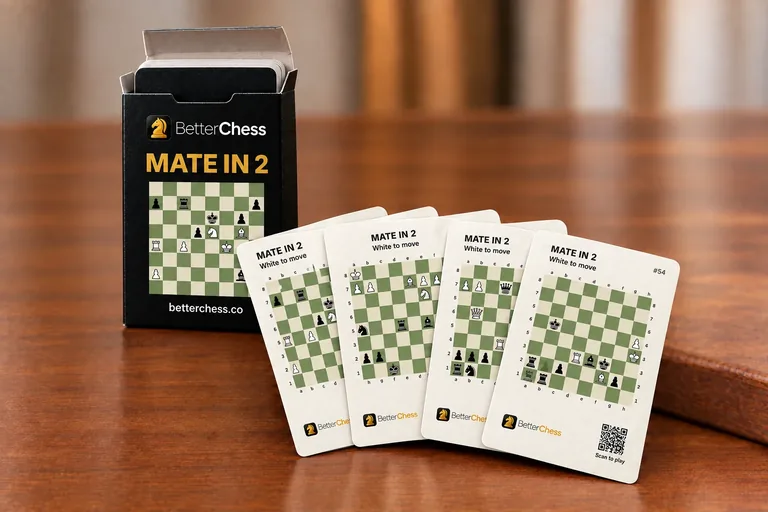
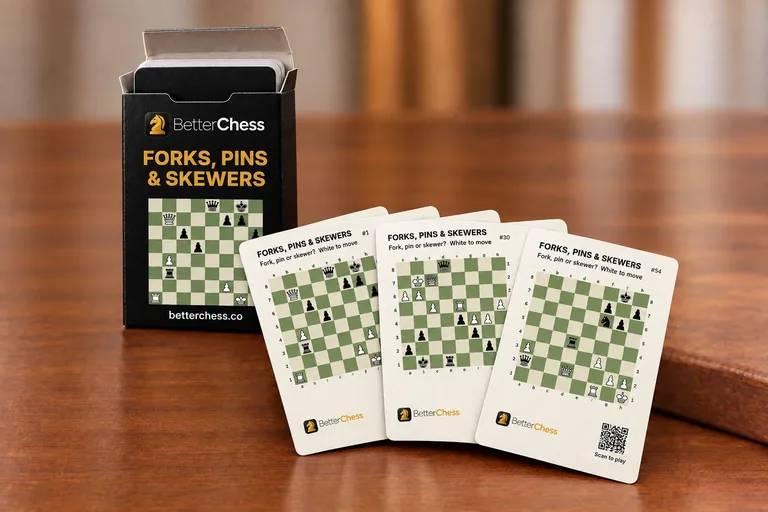
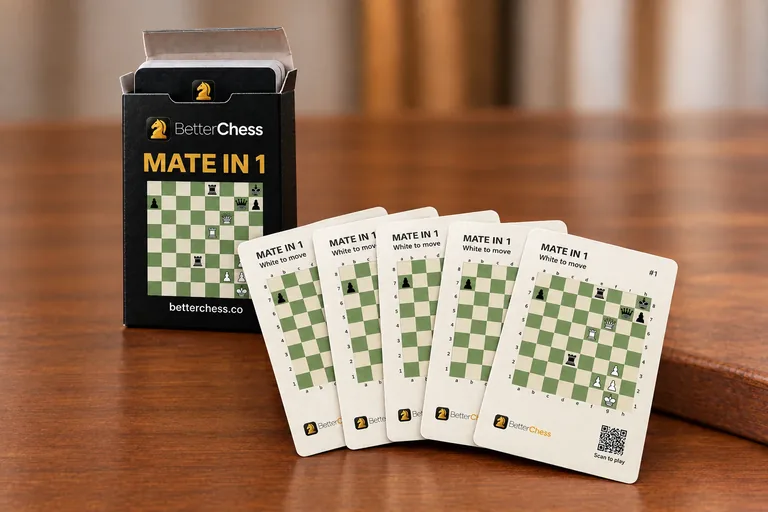
PRINTED CHESS PUZZLE CARDS
Chess puzzle playing card decks
54 poker-size cards in a tuck box. Puzzle on the front, solution on the back.