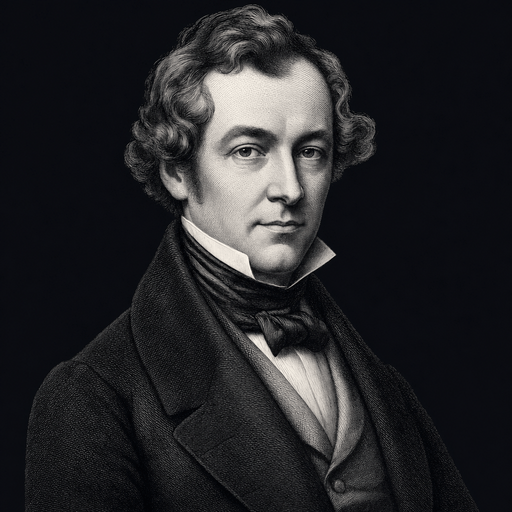
Adolf Anderssen
“Master of the Romantic attack”
Winning London 1851 and playing the Immortal and Evergreen games.
2744Peak ratingChessmetrics historical estimate
World #11851–1858 and c. 1861–1866
Born–died1818–1879
CountryGermany (Prussia)
Active erac. 1848–1877
TitleLeading master of the 1850s–1860s
Karl Ernst Adolf Anderssen was born on July 6, 1818, in Breslau, Prussia (now Wrocław, Poland), and lived there almost his whole life. He learned the game as a boy from his father and from a book of Greco's games, and he studied mathematics and philosophy at the University of Breslau. For most of his career chess was an amateur passion rather than a livelihood: he earned his living as a respected teacher of mathematics and German at the Friedrichs-Gymnasium in his home city.
Anderssen's breakthrough came in 1851, when, on the strength of his reputation and a match against Daniel Harrwitz, he was invited to represent German chess at the first great international tournament, organised in London alongside the Great Exhibition. The event was a series of knockout matches, and Anderssen swept through the field — beating Kieseritzky, József Szén, the tournament organiser Howard Staunton and finally Marmaduke Wyvill — to win first prize and emerge as the strongest player in the world.
It is for two off-hand games, rather than tournament results, that Anderssen is most loved. During the London congress, on June 21, 1851, he played a casual game against Lionel Kieseritzky in which he sacrificed a bishop, both rooks and finally his queen to deliver checkmate; it became known as the 'Immortal Game.' The following year, against his pupil Jean Dufresne, he produced another sacrificial gem dubbed the 'Evergreen Game.' Together these two games came to define the Romantic ideal of chess as an art of attack and sacrifice.
Anderssen's supremacy was twice interrupted. In 1858 the young American Paul Morphy beat him decisively in a Paris match (7–2), and Anderssen graciously acknowledged the loss, famously remarking that he could not play his usual brilliancies because 'Morphy will not let me.' After Morphy's retirement Anderssen was again regarded as the world's best, a status confirmed when he won the strong London 1862 tournament. Then in 1866 he lost a hard-fought match to Wilhelm Steinitz, the contest often cited as the symbolic start of the modern era.
Even in his later years Anderssen remained a formidable and active competitor, far from a relic of an earlier age. He won the important Baden-Baden 1870 tournament ahead of Steinitz and others, and he continued to take prizes into the 1870s. He died in Breslau on March 13, 1879, mourned as one of the great gentlemen of the game.
Anderssen's legacy is twofold. As a competitor he was the dominant figure of the 1850s and 1860s and a bridge between the casual chess of Philidor and Staunton and the scientific approach of Steinitz. As an artist he gave the game two of its most beloved miniatures and became the personification of Romantic chess, the style against which all later, more positional play would be measured.
Playing style
Anderssen was the archetype of the Romantic attacking master. He favoured open games and gambits, threw his pieces forward with great energy, and was willing to sacrifice enormous amounts of material — minor pieces, rooks, even the queen — in pursuit of a direct assault on the king. He prized the initiative and the beauty of a combination above material count or quiet positional gain, and his finest games unfold as a cascade of sacrifices culminating in a forced mate. While later analysis showed that some of his brilliancies were not entirely sound against best defence, his combinational vision and fearlessness made him almost unbeatable against the resources of his own day.
Signature openings
“Move these pieces as you may, Morphy will still beat you.”
— Adolf Anderssen, on the futility of playing against Paul Morphy (1858), as widely reported in contemporary accounts
Rivalries & key opponents
- London 1851 tournament: defeated Kieseritzky, Szén, Staunton and Wyvill to win first prize.
- Match with Paul Morphy (1858): lost 2–7, conceding the unofficial title.
- Match with Wilhelm Steinitz (1866): lost 6–8, a milestone toward the modern World Championship.
- Baden-Baden 1870 tournament: won ahead of Steinitz and other leading masters.
Career highlights
- Won the first international tournament, London (1851)
- Played the Immortal Game vs Kieseritzky (1851)
- Played the Evergreen Game vs Dufresne (1852)
- Won the strong London (1862) tournament
- Won Baden-Baden (1870) ahead of Steinitz
- Regarded as the world's strongest player for much of the 1850s and 1860s
- Lost the 1866 match to Steinitz, often cited as the dawn of the modern era
Famous games on BetterChess
The Immortal Game (1851)
Adolf Anderssen vs Lionel Kieseritzky · 1851 · King's Gambit
Replay & play ›The Evergreen Game (1852)
Adolf Anderssen vs Jean Dufresne · 1852 · Evans Gambit
Replay & play ›Anderssen vs Zukertort (1869)
Adolf Anderssen vs Johannes Zukertort · 1869 · Evans Gambit
Replay & play ›More players




Biographical summary compiled by BetterChess. BetterChess is a practice tool — we make no guarantee you'll reach 1800 or any rating.
PRINTED CHESS PUZZLE CARDS
Chess puzzle playing card decks
54 poker-size cards in a tuck box. Puzzle on the front, solution on the back.