The Immortal Game (1851)
- White
- Adolf Anderssen
- Black
- Lionel Kieseritzky
- Event
- London
- Year
- 1851
- Result
- 1–0
- Opening
- King's Gambit
See this game roasted by the engine
21… Kd8
White to move. Anderssen has already given up both rooks — now the queen goes too. Can you find the mate in two?
Why this game matters
London, 1851. In a casual game between tournament rounds, Adolf Anderssen produced the most celebrated attack in chess history — giving up both rooks and his queen, then mating with three minor pieces. It became known as 'The Immortal Game.' Step through it, or take the board at the famous finish.
The lesson
Material is only a means to an end, and the end is the enemy king. Anderssen poured every piece toward the king and spent his queen and rooks without hesitation, because the mate was worth more than any amount of material. When the king is exposed, count threats, not points.
Move by move
2. f4The King's Gambit — White offers a pawn to rip open the f-file and seize the centre. Romantic-era chess in one move.
3… Qh4+…Qh4+ forces Kf1, so White loses the right to castle. Both sides are playing for the attack from the start.
11… cxb5Black grabs the bishop on b5, but his pieces are all offside or on the queenside — White's attack just rolls on.
15. Bxf4Every white piece points at the black king while Black's queen wanders and the queenside has never moved.
17. Nd5Nd5! In with tempo. Anderssen ignores his hanging rook on a1 — his attack is simply faster than Black's grabbing.
18. Bd6Bd6!! Offering the second rook. The point is to deflect Black's pieces and trap the king in the centre.
19… Qxa1+Black has now won a queen and two rooks — and is about to be checkmated. Material is irrelevant here.
21. Nxg7+Nxg7+ drags the king to d8, straight into the mating net.
22. Qf6+Qf6+!! The final sacrifice — it forces …Nxf6 and clears the way for the bishop.
23. Be7#Be7# — mate with two knights and a bishop, after giving up the queen, two rooks and a bishop. The Immortal Game.
Frequently asked
Why is it called the Immortal Game?
Chess writers were so struck by Anderssen's cascade of sacrifices — two rooks, a bishop and the queen, ending in checkmate with minor pieces — that they called it 'immortal.' The name has stuck for over 170 years.
Was it a serious tournament game?
No — it was a casual game played in London in 1851 between rounds of the first international tournament. That informality is part of its legend.
Can I try the famous finish?
Yes. Hit 'Try Anderssen's finish' to take over with White and find the mate, or step through the whole game move by move — no sign-up.
Similar games
The Evergreen Game (1852)
Adolf Anderssen vs Jean Dufresne · 1852 · Evans Gambit
Replay & play ›Morphy's Opera Game (1858)
Paul Morphy vs Duke of Brunswick & Count Isouard · 1858 · Philidor Defense
Replay & play ›Chigorin's King's Gambit (1892)
Mikhail Chigorin vs Wilhelm Steinitz · 1892 · King's Gambit
Replay & play ›Spassky's King's Gambit (1960)
Boris Spassky vs David Bronstein · 1960 · King's Gambit
Replay & play ›Want this on your own games? BetterChess puts a real engine inside Claude, so it finds the moves that actually decided the game instead of listing every inaccuracy.
BetterChess is a practice tool. We make no guarantee you'll reach 1800 or any rating. This is a historical game; the analysis is our own.
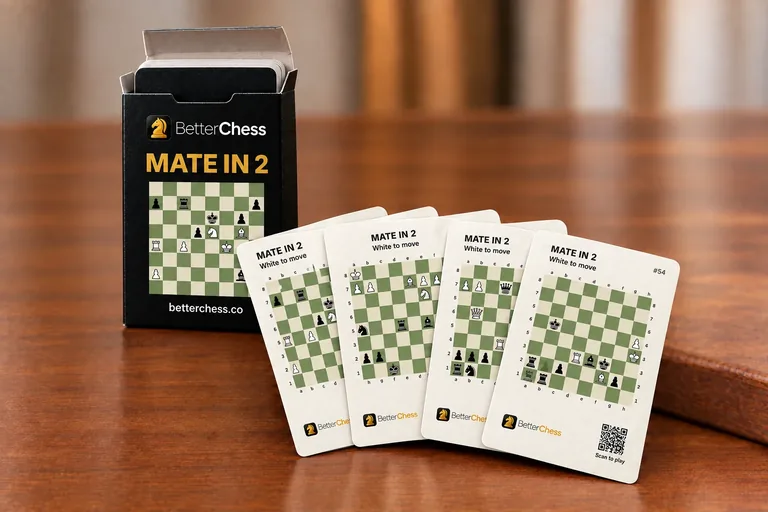
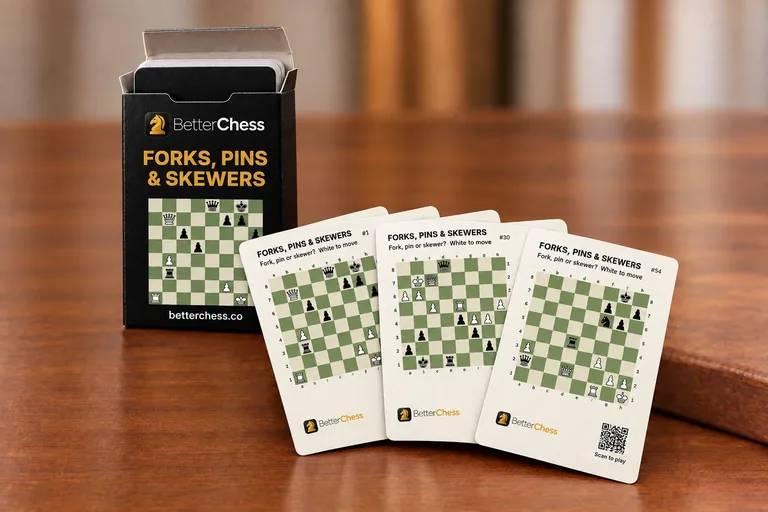
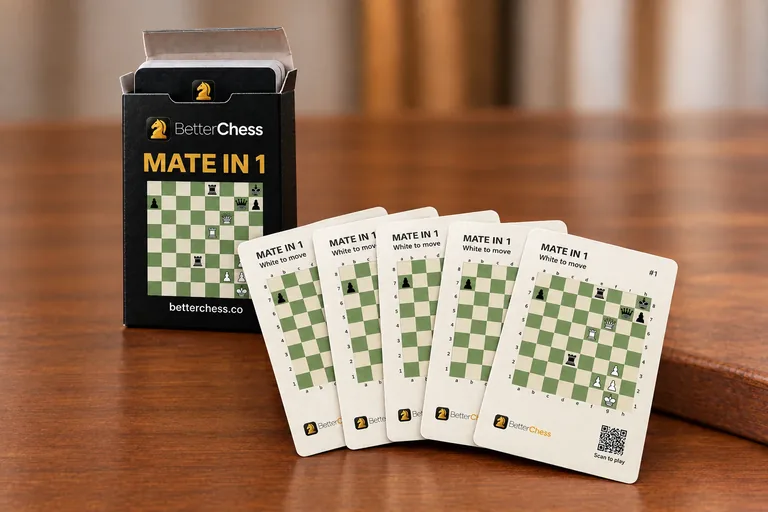
PRINTED CHESS PUZZLE CARDS
Chess puzzle playing card decks
54 poker-size cards in a tuck box. Puzzle on the front, solution on the back.