The Evergreen Game (1852)
- White
- Adolf Anderssen
- Black
- Jean Dufresne
- Event
- Berlin
- Year
- 1852
- Result
- 1–0
- Opening
- Evans Gambit
See this game roasted by the engine
19… Qxf3
White to move. Black has just threatened mate on g2 — but Anderssen has a forced mate of his own. Can you find it? (Hint: start with a rook check.)
Why this game matters
Berlin, 1852. Anderssen against his friend Jean Dufresne in a swashbuckling Evans Gambit. The finish — a quiet rook move, then a queen sacrifice into forced mate — was later called 'evergreen' by Wilhelm Steinitz because its beauty never fades.
The lesson
Bring every piece into the attack before you strike. Anderssen's 19.Rad1! looks modest, but it adds the last attacker; only then does he sacrifice the queen and hunt the king with a string of forcing checks. Quiet preparation, then forcing finish.
Move by move
4. b4The Evans Gambit — White sacrifices the b-pawn to build a big centre and open lines quickly.
7. O-OWhite castles and lets Black keep the extra pawn (…d3). Anderssen is buying time and open lines, not material.
11. Ba3Ba3 stops Black from castling — the king will be stuck in the centre, which is exactly where it gets mated.
17. Nf6+Nf6+!? sacrificing a knight to shatter the cover around the black king.
19. Rad1Rad1! The quiet move behind the brilliance — the last piece joins before the storm. Black's …Qxf3 threatens mate, but Anderssen has calculated further.
20. Rxe7+Rxe7+!! The combination begins. From here every single move is a check.
21. Qxd7+Qxd7+!! The queen sacrifice — it drags the king out into the open where the bishops finish it.
24. Bxe7#Bxe7# — checkmate. The 'Evergreen' finish: quiet preparation, a queen sacrifice, and a forced king hunt.
Frequently asked
Why is it called the 'Evergreen' Game?
Wilhelm Steinitz, the first World Champion, described it as 'an evergreen in the laurel crown' of Anderssen — beauty that never fades. The nickname stuck.
What's the main lesson?
Get every piece into the attack first (19.Rad1!), then use forcing checks and a queen sacrifice to hunt a king stuck in the centre.
Can I play it out?
Yes — step through it, or take the board at the critical moment and try to find Anderssen's forced mate, no sign-up.
Similar games
The Immortal Game (1851)
Adolf Anderssen vs Lionel Kieseritzky · 1851 · King's Gambit
Replay & play ›Anderssen vs Zukertort (1869)
Adolf Anderssen vs Johannes Zukertort · 1869 · Evans Gambit
Replay & play ›Morphy's Opera Game (1858)
Paul Morphy vs Duke of Brunswick & Count Isouard · 1858 · Philidor Defense
Replay & play ›Steinitz vs von Bardeleben (1895)
Wilhelm Steinitz vs Curt von Bardeleben · 1895 · Italian Game
Replay & play ›Want this on your own games? BetterChess puts a real engine inside Claude, so it finds the moves that actually decided the game instead of listing every inaccuracy.
BetterChess is a practice tool. We make no guarantee you'll reach 1800 or any rating. This is a historical game; the analysis is our own.
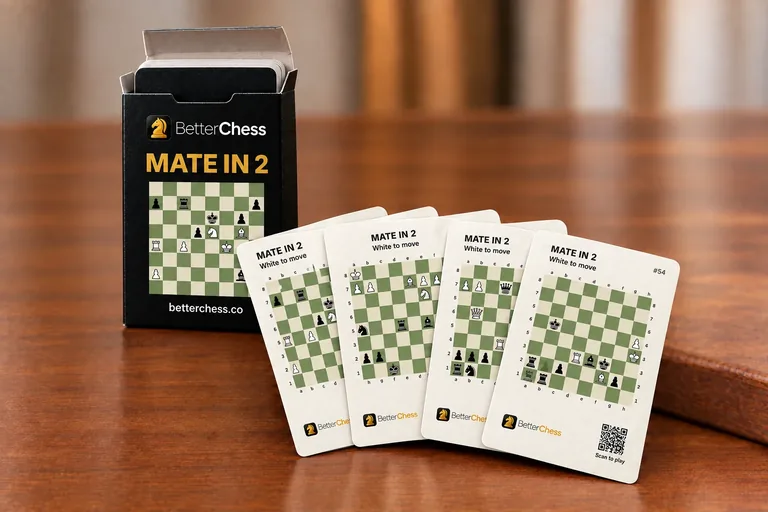
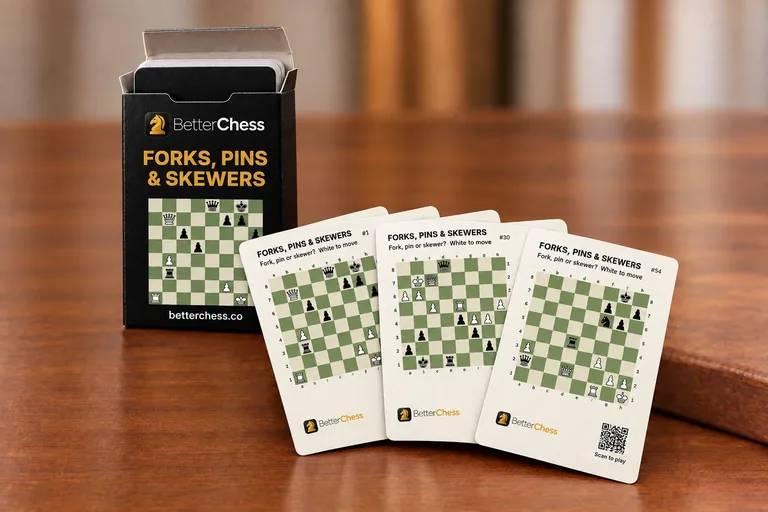
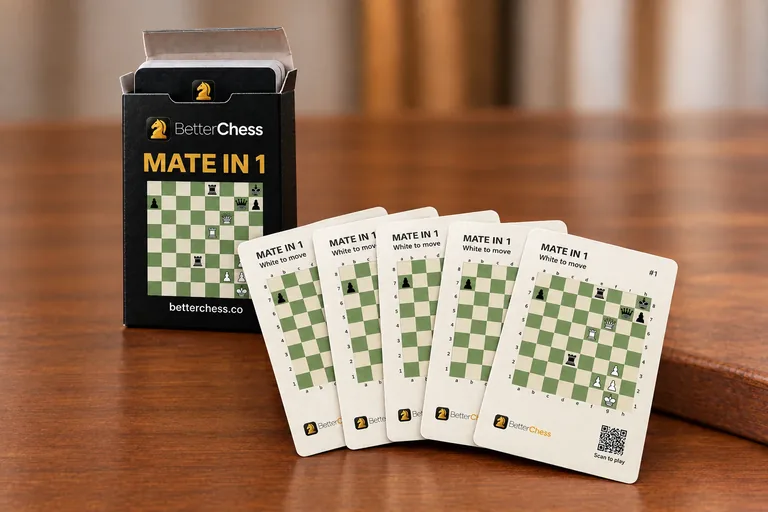
PRINTED CHESS PUZZLE CARDS
Chess puzzle playing card decks
54 poker-size cards in a tuck box. Puzzle on the front, solution on the back.