Evans Gambit
Starting position
Engine ready — step through to see live evals.
Press ▶ Watch to play the line out, or Next to step through it — the engine evaluates every position.
The Evans Gambit is the Italian Game with the gloves off: on move four White tosses in b4 to deflect Black's bishop, then builds the full pawn centre with tempo. It dominated the romantic era, and Kasparov dusted it off to beat Anand in 25 moves in 1995. Unlike most old gambits it still holds up under engine scrutiny, which makes it one of the best attacking investments a club player can make.
The idea in one line
Offer the b-pawn to deflect the Italian bishop, then build the big centre with c3 and d4, castle quickly, and attack f7 and the centre files before Black finishes developing.
Key ideas
- 4.b4 is a bribe: White gives a flank pawn so that c3 and d4 arrive with tempo on the wandering bishop, converting one pawn into two or three moves of free development.
- Everything still points at f7. The Evans keeps the Italian bishop on c4 and adds open lines and a lead in development to the attack.
- White's moves flow naturally: c3, d4, O-O, then Qb3, Ba3 or Re1 depending on Black's setup. White plays the position; Black defends it.
- It is honest value: engines rate White's compensation as fully adequate, so you are not gambling, you are trading a pawn for time at a fair price.
Plans for each side
White: Play c3 and d4 with tempo, castle short, and keep every developing move a threat: Qb3 against f7, Ba3 against an uncastled king, Re1 and e5 in the centre. Do not pause to regain the pawn; the initiative is the compensation, and quiet moves refund it to Black.
Black: Accept the pawn, then hand it back at the right moment to finish developing. Lasker's classic recipe (...d6 with ...Bb6, returning the extra pawn for a sound structure) takes the sting out of the attack; what loses is grimly clinging to material while White's pieces flood the board.
Common mistakes to avoid
- Don't slow down to win the pawn back. The gambit runs on tempo, and one quiet move usually hands Black a comfortable game a pawn up.
- The Compromised Defence (grabbing a third pawn with 7...dxc3) is aptly named: Black's development freezes while White's attack plays itself. Two pawns is the limit, and one usually comes back.
- Know your retreat before you accept: after 5.c3 the bishop must choose between a5 and e7 immediately. On a5 it sits far from the kingside defence, so plan to reroute it via ...Bb6 before the attack arrives.
The main line, explained
3. Bc4Bc4 aims at f7, normal Italian development; so far, so quiet.
4. b4b4 is the Evans Gambit: a flank pawn offered purely to gain time on the bishop for c3 and d4.
4… Bxb4...Bxb4 accepts, the classical main line. Declining with 4...Bb6 is solid but lets White claim extra space for free.
5. c3c3 hits the bishop again and prepares d4. The pawn White gave up is being converted into tempi and a big centre.
5… Ba5...Ba5 is the classical retreat, keeping an eye on c3; ...Be7 is the solid modern alternative.
6. d4d4 stakes out the full centre with another gain of time. White's compensation is now visible: space, open lines, and faster development.
6… exd4...exd4 keeps the material argument going; after 7.O-O White is two pawns down and completely happy, with every piece ready to join the attack.
Frequently asked
Is the Evans Gambit sound?
As sound as a gambit gets. Engines rate White's compensation as fully adequate, and world champions from Fischer to Kasparov have played it. Black can equalize with precise defence, but at club level the initiative is usually worth more than the pawn.
Should Black accept or decline the Evans Gambit?
Accepting with 4...Bxb4 is the main line and objectively fine. Declining with 4...Bb6 sidesteps the sharpest theory at the cost of giving White a pleasant space edge. What fails is accepting and then defending passively.
How is the Evans Gambit different from the Italian Game?
It starts as an Italian (1.e4 e5 2.Nf3 Nc6 3.Bc4 Bc5) and then offers the b-pawn with 4.b4. Instead of the slow Giuoco Piano build-up, White buys immediate time to erect the full c3 and d4 centre and attack.
Famous games in the Evans Gambit
- The Evergreen Game (1852): Adolf Anderssen vs Jean Dufresne
- Anderssen vs Zukertort (1869): Adolf Anderssen vs Johannes Zukertort
More openings to explore
Italian Game
King's Pawn (1.e4 e5) · C50–C54
Learn & play ›King's Gambit
King's Pawn (1.e4 e5) · C30–C39
Learn & play ›Knowing the moves of the Evans Gambit is not the same as knowing why they work. Use Claude? BetterChess gives it a real engine, so it explains this opening from the board in front of you instead of from memory.
BetterChess is a practice tool — we make no guarantee you'll reach 1800 or any rating. The lines here are standard, well-established opening theory, and every move is checked legal with the same engine the board runs.
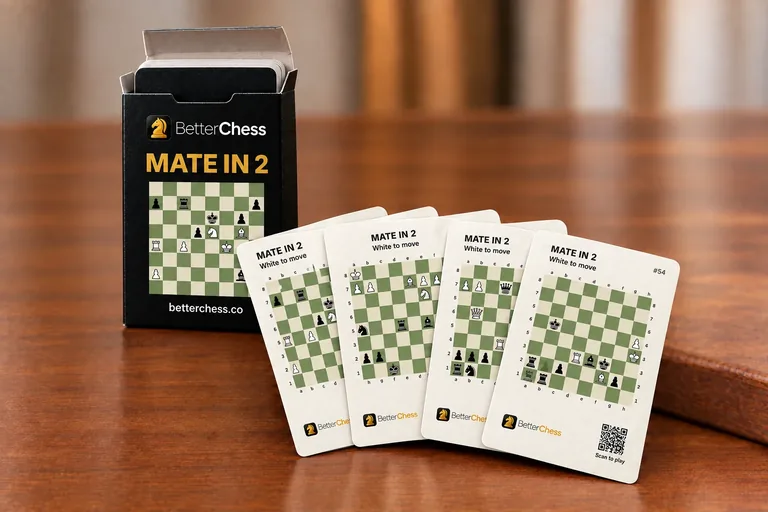
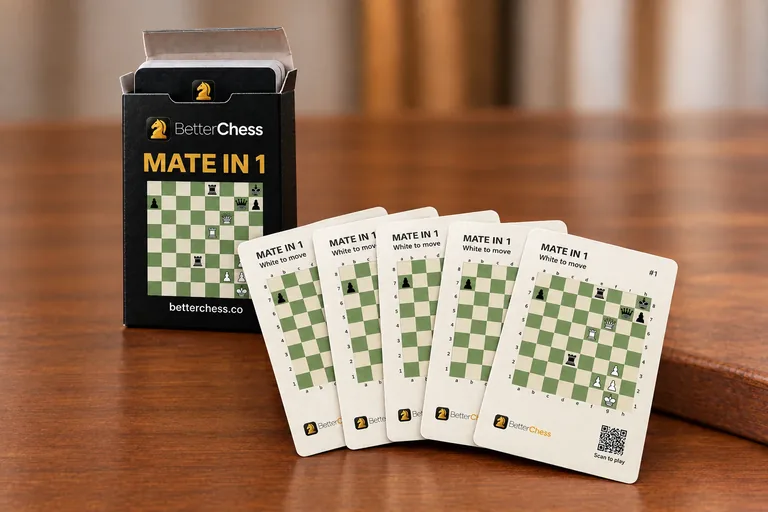
PRINTED CHESS PUZZLE CARDS
Chess puzzle playing card decks
54 poker-size cards in a tuck box. Puzzle on the front, solution on the back.