Lasker's Strategic Masterpiece (1914)
- White
- Emanuel Lasker
- Black
- Jose Raul Capablanca
- Event
- St. Petersburg
- Year
- 1914
- Result
- 1–0
- Opening
- Ruy Lopez, Exchange
15… Rad8
White to move. Lasker has fixed Black's pawns with f5 and wants to install a knight deep in Black's camp. Can you find the manoeuvre that lands a knight on the dominating e6 square?
Why this game matters
St. Petersburg, 1914. Trailing the young José Raúl Capablanca and needing a win, the reigning champion Emanuel Lasker made a famous psychological choice: the dry, drawish Exchange Variation of the Ruy Lopez. It was bait. Lasker slowly built a kingside bind, planted a knight on e6, and squeezed Capablanca until his position cracked — a triumph of strategy and competitive nerve over a player many already considered unbeatable.
The lesson
Choose your battleground to suit the opponent, not just the position. Lasker picked a 'harmless' opening precisely because it tempted Capablanca to relax and play for a draw; then he generated a slow positional bind, fixed Black's pawns, and used the e6 outpost to dominate. Patience, a good knight, and pressure on a fixed weakness did the rest.
Move by move
2… Nc63...a6 4.Bxc6 — the Exchange Ruy Lopez. Lasker deliberately chose this 'drawish' line to lull Capablanca, who needed only a draw to win the tournament group.
6. Qxd46.Nxd4 — queens are already off and the position looks dead level, exactly the impression Lasker wanted to give. The real fight is positional.
11. Nb311.f5! The key strategic decision. Lasker fixes the kingside pawns and begins to gain space, restricting Black's pieces.
14. Bxd614.Bxd6 cxd6 — Lasker saddles Black with a backward d6-pawn and prepares to occupy the gaping e6 hole with a knight.
16. Ne616.Ne6! The dream knight. It sits in the heart of Black's position, cramping every piece and supporting the whole bind. Black can never comfortably remove it.
21. a321.a3 — quiet preparation. Lasker improves slowly, in no hurry, while Capablanca has no active plan against the bind.
23. g423.g4! The pawn storm. With Black tied down, Lasker expands on the kingside to open a second front.
30. Kf330.Rg3 g5+ 31.Kf3 — the structure cracks open. Lasker has provoked weaknesses on both wings and his pieces are far more active.
35. e535.e5! The breakthrough. The centre opens at the perfect moment and White's pieces flood into Black's disorganised position.
42. Nc542.Nc5 — Capablanca resigned. One of the most celebrated strategic wins ever, and a rare loss for Capablanca in his prime.
Frequently asked
Why did Lasker play such a quiet opening?
It was a psychological masterstroke. Capablanca needed only a draw, so Lasker chose the 'harmless' Exchange Ruy Lopez to tempt him into passivity, then generated a slow positional bind in a position Capablanca had under-rated.
What was the key positional idea?
Fixing Black's pawns with f5, exchanging the dark-squared bishops to weaken d6, and installing a knight on the e6 outpost. From there Lasker had a permanent space advantage and a superb knight against a passive Black position.
Can I take over Lasker's side?
Yes — pick up the board as White around 16.Ne6 and try to play the bind, or step through the whole game move by move, no sign-up.
Similar games
Capablanca's Rook Endgame (1924)
José Raúl Capablanca vs Savielly Tartakower · 1924 · Dutch Defence
Replay & play ›Lasker's Counterattack (1896)
Harry Nelson Pillsbury vs Emanuel Lasker · 1896 · Queen's Gambit Declined
Replay & play ›Botvinnik's AVRO Masterpiece (1938)
Mikhail Botvinnik vs José Raúl Capablanca · 1938 · Nimzo-Indian Defence
Replay & play ›Tarrasch's Central Bind (1895)
Siegbert Tarrasch vs Karl Walbrodt · 1895 · Ruy Lopez
Replay & play ›Want this on your own games? BetterChess puts a real engine inside Claude, so it finds the moves that actually decided the game instead of listing every inaccuracy.
BetterChess is a practice tool. We make no guarantee you'll reach 1800 or any rating. This is a historical game; the analysis is our own.
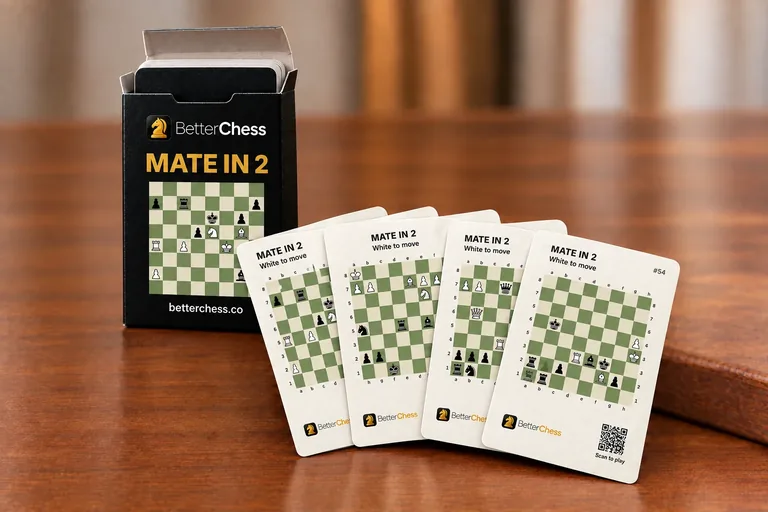
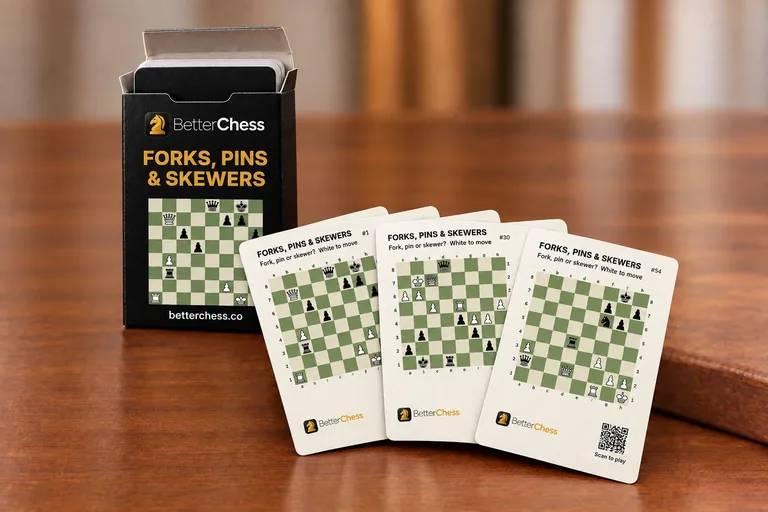
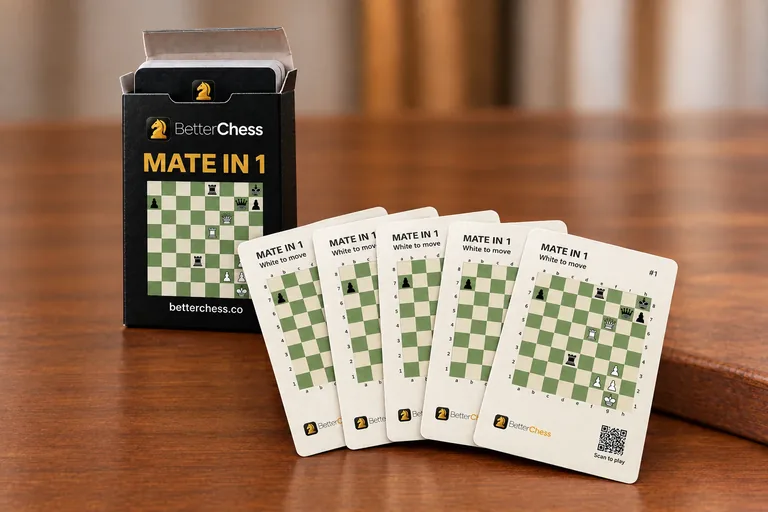
PRINTED CHESS PUZZLE CARDS
Chess puzzle playing card decks
54 poker-size cards in a tuck box. Puzzle on the front, solution on the back.