Italian Game
Starting position
Engine ready — step through to see live evals.
Press ▶ Watch to play the line out, or Next to step through it — the engine evaluates every position.
The Italian Game is the most natural way to open a chess game: push the king's pawn, develop the knight, and point the bishop at f7 — Black's most fragile square. It has been played for 500 years and is still one of the best openings for a club player to learn, because every move teaches a real principle.
The idea in one line
Aim the bishop at f7, develop quickly, castle, and choose between a slow build-up (c3 and d3, the 'Giuoco Pianissimo') or a sharp central break with c3 and d4. You are not memorizing traps — you are learning to develop with purpose.
Key ideas
- Bishop to c4 stares straight at f7, the only square in Black's camp defended just by the king. That pressure shapes the whole opening.
- c3 prepares the central push d4 — the main way White tries to take over the centre and open lines for the pieces.
- Castle early. In an open e-file position, a king stuck in the centre is the single most common way club players lose.
- The slow set-up (d3, Nbd2, Re1, then a kingside build-up) is easy to play and avoids memorizing sharp theory — ideal under 1800.
Plans for each side
White: Develop the bishop to c4 and knight to f3, castle, play c3 and aim for d4. If Black holds the centre, switch to a slow plan: d3, re-route the queen's knight via d2–f1–g3, and build a kingside attack.
Black: Mirror White: bishop to c5, knight to f6, castle, fight for the d4 square and look for ...d5 to free the position.
Common mistakes to avoid
- Watch the f7 trap: after 3...Nf6, the move Ng5 hits f7 and threatens the Fried Liver Attack — know it before you wander into it (it has its own page).
- Don't grab the e5 pawn early with your knight and lose time; development is worth more than a pawn here.
- If you delay castling to push pawns on the kingside, the open centre usually punishes you first.
The main line, explained
1. e41.e4 — claim the centre and free both the bishop and the queen. The most principled first move there is.
2. Nf3Nf3 develops a piece and attacks the e5 pawn at the same time. Good opening moves do two jobs.
3. Bc4Bc4 — the move that names the opening. The bishop points directly at f7, Black's weak spot.
4. c3c3 — quietly preparing d4, the central break that opens the position for White's better-developed pieces.
5. d3d3 supports e4 and opens the c1-bishop's diagonal. This is the calm 'Pianissimo' — easy and very sound.
6. O-OO-O — castle. King safe, rook activated toward the centre. Now White can plan in peace.
Frequently asked
Is the Italian Game good for beginners?
Yes — it's one of the best first openings. Every move follows a principle you'll reuse forever: develop toward the centre, target a weakness (f7), and castle. There's no heavy memorization required to play it well.
What's the difference between the Italian and the Ruy Lopez?
Both start 1.e4 e5 2.Nf3 Nc6. The Italian plays 3.Bc4 (bishop to c4, hitting f7); the Ruy Lopez plays 3.Bb5 (bishop to b5, pinning the knight that defends e5). The Italian is more direct and easier to learn.
What is the Giuoco Piano?
It's the main line of the Italian after 3...Bc5 — 'the quiet game' in Italian. Modern club players usually play the even calmer 'Pianissimo' with d3, a slow, safe build-up.
Traps in the Italian Game
- Légal's Mate: checkmate (queen sacrifice)
- Blackburne Shilling Gambit Trap: checkmate
Famous games in the Italian Game
- Steinitz vs von Bardeleben (1895): Wilhelm Steinitz vs Curt von Bardeleben
More openings to explore
Ruy Lopez (Spanish)
King's Pawn (1.e4 e5) · C60–C99
Learn & play ›Caro-Kann Defense
Black vs 1.e4 · B10–B19
Learn & play ›Knowing the moves of the Italian Game is not the same as knowing why they work. Use Claude? BetterChess gives it a real engine, so it explains this opening from the board in front of you instead of from memory.
BetterChess is a practice tool — we make no guarantee you'll reach 1800 or any rating. The lines here are standard, well-established opening theory, and every move is checked legal with the same engine the board runs.
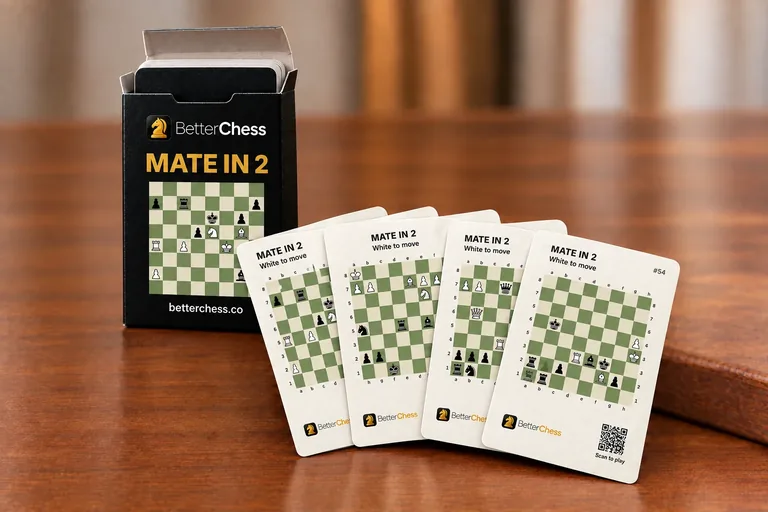
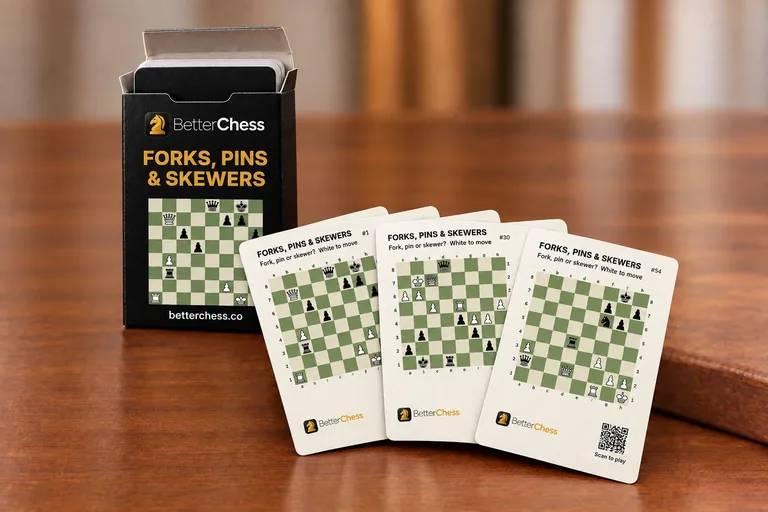
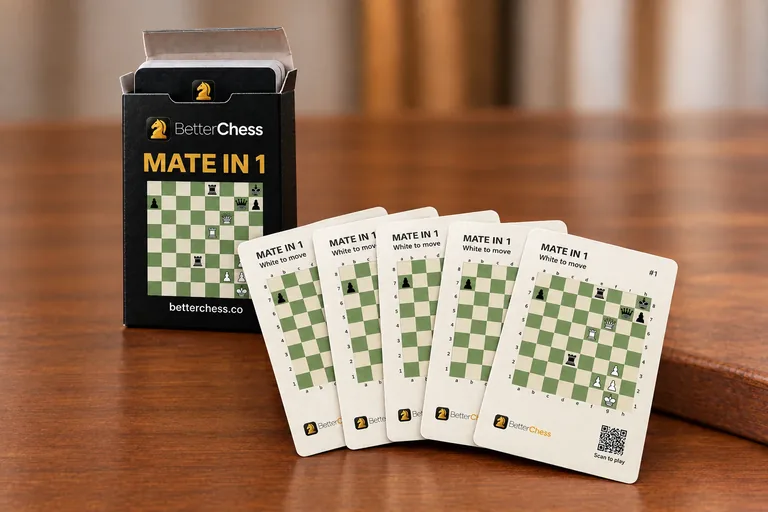
PRINTED CHESS PUZZLE CARDS
Chess puzzle playing card decks
54 poker-size cards in a tuck box. Puzzle on the front, solution on the back.