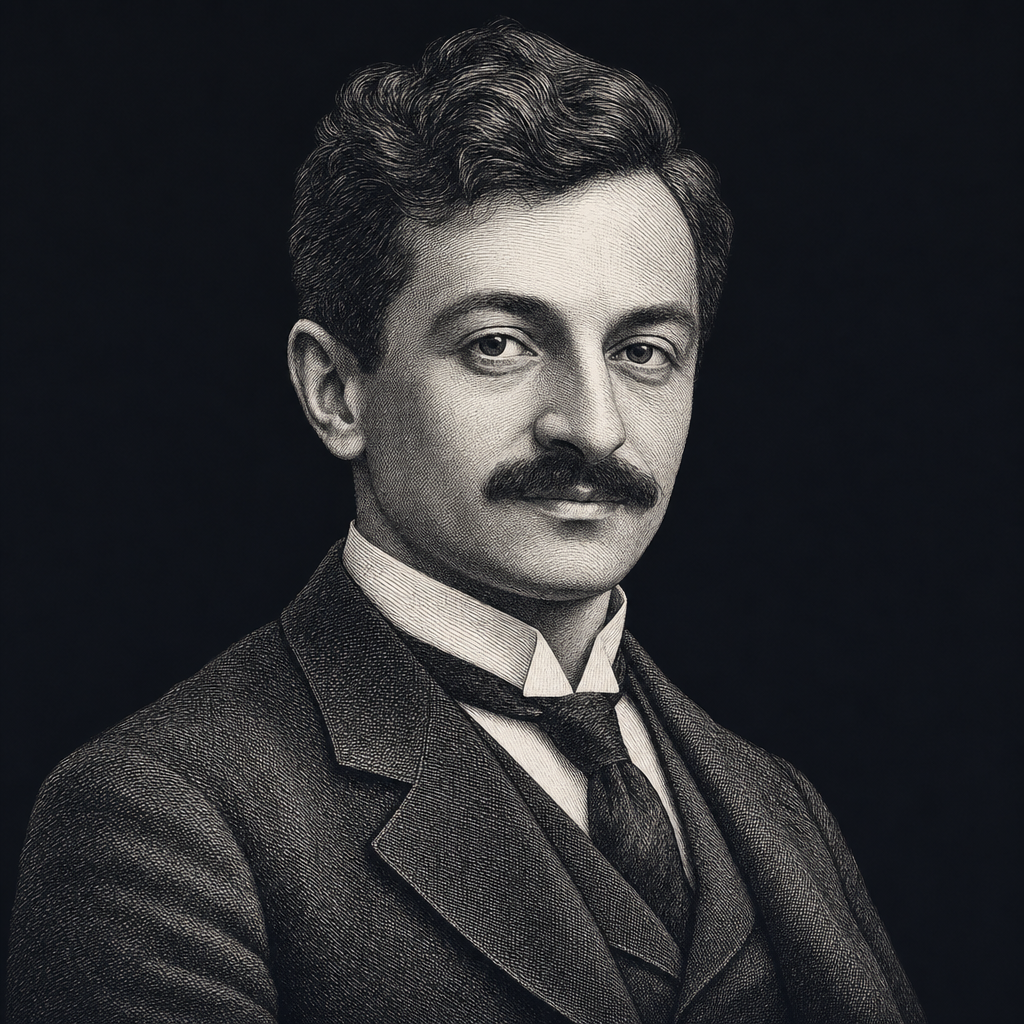
Edward Lasker
“Engineer, chess and Go master”
The 1912 king-hunt brilliancy against Sir George Thomas, and pioneering Go in America.
2583Peak ratingChessmetrics historical estimate (peak August 1924)
Born–died1885–1981
CountryUnited States (born in Germany)
Active erac. 1908–1956
TitleInternational Master (1963)
Eduard Lasker was born on December 3, 1885, in Kempen, Prussia (now Kępno, Poland), into a region that produced more than one chess Lasker. He was distantly related to the World Champion Emanuel Lasker, with whom he is often confused, but the two were not close relatives. Edward trained as an engineer, earning degrees in mechanical and electrical engineering at the Technische Hochschule in Charlottenburg (now the Technical University of Berlin) around 1910.
Before emigrating he was already a strong master in the rich German and central European chess scene of the early 1900s, playing in events across Germany and beyond. It was during a stay in England, at the City of London Chess Club in 1912, that he played the game that would make his name: a casual encounter against Sir George Thomas in which he sacrificed his queen with 11.Qxh7+ and marched the black king the entire length of the board to a checkmate — one of the most celebrated king hunts ever recorded.
Lasker emigrated to the United States in 1914 and made his career there as an engineer while remaining a top-class amateur. He won five US Open Championships (then called the Western Championship) in 1916, 1917, 1919, 1920 and 1921, and in 1923 he contested a narrow, hard-fought match for the US Championship against Frank Marshall, losing only by the slimmest of margins. He continued to compete in strong international tournaments, including New York 1924, for decades, playing serious chess into the 1950s.
He was equally important as a writer and promoter of strategy games. His books Chess Strategy and Chess and Checkers: The Way to Mastership introduced the game to a wide English-speaking audience, and he was also one of the foremost early champions of Go in the West. He co-founded the American Go Association, wrote the influential primer Go and Go-Moku, and helped popularise the Asian game in the United States; in 1971 Japan's Nihon Ki-in awarded him the Okura Prize for his lifelong promotion of Go.
FIDE recognised his lifetime of accomplishment with the International Master title in 1963. Lasker remained active and engaged into great old age and died in New York City on March 25, 1981, at the age of 95, one of the last living links to the chess world of the early twentieth century.
Edward Lasker's legacy rests on three pillars: a clutch of US titles and a long competitive career; a body of popular, lucid writing that introduced both chess and Go to generations of Western readers; and, above all, the immortal 1912 king hunt against George Thomas, a textbook brilliancy that has delighted players ever since.
Playing style
Edward Lasker was an imaginative, attacking player with a flair for the clean, forcing combination, as his famous king hunt against Thomas vividly demonstrates. A strong amateur rather than a full-time professional, he combined sound classical principles with a sharp eye for tactics and a willingness to sacrifice for a concrete mating attack. His instincts as a teacher and writer show in his games and books alike: he favoured clear, instructive ideas and had a gift for explaining strategy in plain terms, which made him one of the most readable chess authors of his generation.
Signature openings
Rivalries & key opponents
- King-hunt game vs Sir George Thomas (1912): his immortal queen-sacrifice brilliancy.
- US Championship match vs Frank Marshall (1923): lost a very close, hard-fought contest.
Career highlights
- Played the celebrated king-hunt brilliancy vs Sir George Thomas (1912)
- Won five US Open (Western) Championships (1916, 1917, 1919, 1920, 1921)
- Narrowly lost the US Championship match to Frank Marshall (1923)
- Awarded the International Master title by FIDE (1963)
- Co-founded the American Go Association and helped pioneer Go in the West
- Authored popular books including Chess Strategy and Go and Go-Moku
- Received Japan's Okura Prize for promoting Go (1971)
Famous games on BetterChess
More players




Biographical summary compiled by BetterChess. BetterChess is a practice tool — we make no guarantee you'll reach 1800 or any rating.
PRINTED CHESS PUZZLE CARDS
Chess puzzle playing card decks
54 poker-size cards in a tuck box. Puzzle on the front, solution on the back.