The Immortal Zugzwang Game (1923)
- White
- Friedrich Sämisch
- Black
- Aron Nimzowitsch
- Event
- Copenhagen
- Year
- 1923
- Result
- 0–1
- Opening
- Queen's Indian Defence
25. Rce1
Black to move. White looks cramped but alive — yet Nimzowitsch found a single quiet pawn move that left White with no good move at all. Can you find it?
Why this game matters
Copenhagen, 1923. Aron Nimzowitsch, the great theorist of the hypermodern school, slowly throttles Friedrich Sämisch until White has no useful move at all. The finish — the quiet waiting move 25...h6 — leaves White in zugzwang in the middlegame, a rarity so striking the game was named 'immortal.'
The lesson
Restriction and prophylaxis can win without a single sacrifice. Nimzowitsch didn't hunt the king — he took away White's squares one by one until every white move worsened the position. The lesson: control the position so completely that your opponent has nothing to do, then simply pass the move back.
Move by move
7… d57...d5 — Nimzowitsch claims the centre with a pawn only after fully developing, the hypermodern way. His pieces, not his pawns, will do the work.
10… a610...a6 — preparing ...b5 to seize the c4 outpost. Nimzowitsch builds his bind square by square, his trademark restraint at work.
12… Nc612...Nc6 — 'the ghost,' as Nimzowitsch called it, pressing silently toward c4. White trades it off just to be rid of the pressure.
16… f516...f5! Having clamped the queenside, Nimzowitsch turns to the kingside. Every white piece is now passive and short of squares.
20… fxe420...fxe4! A pawn sacrifice that opens lines and, more importantly, hands Black total control of the light squares around White's king.
21… Rxf221...Rxf2! The rook lands on the second rank. White's army is now almost completely paralysed.
23… R8f523...R8f5 — doubling rooks and tightening the net. White's pieces cannot move without losing material.
24… Bd324...Bd3 — the bishop seals White's coordination. Now Black just needs one more quiet move to complete the bind.
25… h625...h6!! The immortal move. Black makes a tiny waiting move and White is in zugzwang: every legal move loses on the spot. With no good move left, White resigned. A middlegame zugzwang so rare the game became 'immortal.'
Frequently asked
What is zugzwang, and why is this game famous for it?
Zugzwang means a player is harmed by having to move — any move worsens the position. It's common in endgames but almost unheard of with most pieces still on the board. Here Nimzowitsch engineered it in the middlegame, which is why the game is called the 'Immortal Zugzwang Game.'
Why is 25...h6 the winning move?
It's a pure waiting move. After it, White must move but every option loses material or collapses the position (for example, freeing moves run into ...R5f3). Black can shuffle his king forever; White cannot. Nimzowitsch simply handed the move back.
Who was Nimzowitsch?
Aron Nimzowitsch was the leading theorist of the hypermodern school and author of 'My System,' one of the most influential chess books ever written. This game is the purest demonstration of his ideas: restraint, blockade, and prophylaxis.
Similar games
Alekhine vs Nimzowitsch (1930)
Alexander Alekhine vs Aron Nimzowitsch · 1930 · French Defence (Winawer)
Replay & play ›Botvinnik's AVRO Masterpiece (1938)
Mikhail Botvinnik vs José Raúl Capablanca · 1938 · Nimzo-Indian Defence
Replay & play ›Réti vs Bogoljubov (1924)
Richard Réti vs Efim Bogoljubov · 1924 · Réti / English Opening
Replay & play ›Rubinstein's Positional Squeeze (1908)
Akiba Rubinstein vs Georg Salwe · 1908 · Tarrasch Defence
Replay & play ›Want this on your own games? BetterChess puts a real engine inside Claude, so it finds the moves that actually decided the game instead of listing every inaccuracy.
BetterChess is a practice tool. We make no guarantee you'll reach 1800 or any rating. This is a historical game; the analysis is our own.
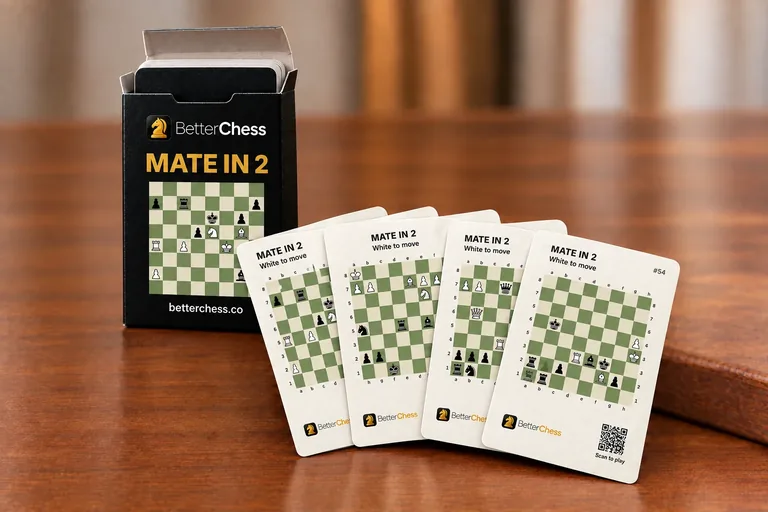
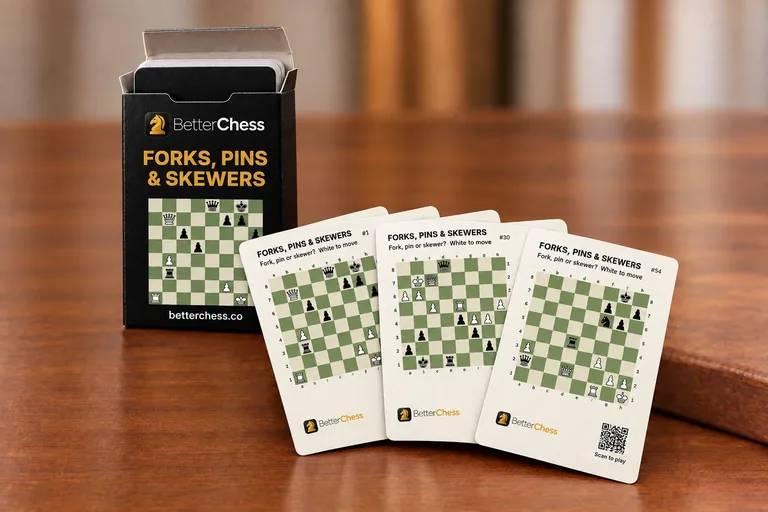
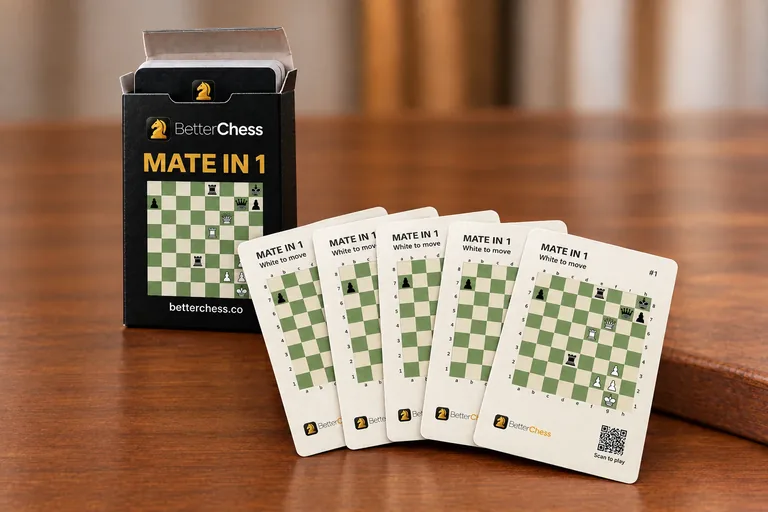
PRINTED CHESS PUZZLE CARDS
Chess puzzle playing card decks
54 poker-size cards in a tuck box. Puzzle on the front, solution on the back.