Lasker's Double Bishop Sacrifice (1889)
- White
- Emanuel Lasker
- Black
- Johann Bauer
- Event
- Amsterdam
- Year
- 1889
- Result
- 1–0
- Opening
- Bird's Opening
14… Nxh5
White to move. Both of Lasker's bishops are aimed at Black's castled king, and the queen and rook stand ready. Can you find the first sacrifice that tears the king open?
Why this game matters
Amsterdam, 1889. A 20-year-old Emanuel Lasker, in his first big international event, unveiled a combination so clean it became a named pattern: the double bishop sacrifice. Bauer's 13...a6 looked harmless, but it let both of Lasker's bishops smash through the kingside in two moves, dragging the king out and winning the queen. The idea has been copied by masters ever since.
The lesson
When both your bishops point at a castled king and you have a queen and rook to follow up, the pawns sheltering that king are not safe — they're targets. Lasker gave up both bishops on h7 and g7 because the resulting king exposure let him win the queen with checks. The pattern: Bxh7+, then Qxh5+ and Bxg7 with the rook lift waiting behind.
Move by move
1. f41.f4 — Bird's Opening. Lasker grabs space and prepares to mass pieces on the kingside; the e5/d4 setup with two bishops on the long diagonals is the whole plan.
12. Bxe512.Bxe5 — both bishops are now beautifully placed: one on e5 raking g7, one on d3 aimed at h7. This is the launching position for the combination.
13… a613...a6?? The fatal slip. 13...g6 keeps the king safe; instead Black does nothing about the two bishops bearing down on his king.
15. Bxh7+15.Bxh7+! The first sacrifice. After …Kxh7 the king is dragged into the open with the queen ready to check on h5.
16. Qxh5+16.Qxh5+ — the queen joins with check, herding the king back to g8 so the second bishop can strike.
17. Bxg717.Bxg7! The twin sacrifice. The last pawn shield is ripped away; if Black declines, 18.Qg4+ and the attack crashes through anyway.
18. Qg4+18.Qg4+ — now the point of the whole idea: a discovered geometry that wins the loose bishop on b7 by force.
19. Rf319.Rf3! The quiet rook lift. It swings to h3 with check and forces Black to give up the queen to avoid mate.
21… Kxh621.Rxh6+ Kxh6 — the dust settles. Lasker has given two bishops and a rook but is about to fork the bishops and emerge with a winning material edge.
22. Qd722.Qd7! The fork that justifies everything. It hits both black bishops; Lasker nets a piece and the rest is technique.
38. Qxd338.Qxd3 — Black resigned. From two quiet bishops to a winning material advantage in a dozen moves: the double bishop sacrifice in its purest form.
Frequently asked
What is the double bishop sacrifice?
It's a thematic attack where both bishops, aimed at a castled king, are sacrificed on h7 (or h2) and g7 (or g2) to strip away the pawns, after which the queen and a rook deliver the decisive blows. Lasker vs Bauer 1889 is the model game; Nimzowitsch–Tarrasch 1914 echoed it.
Where did Black go wrong?
13...a6 was the losing move — it ignored the two bishops trained on the king. 13...g6 would have kept the kingside solid and the game roughly equal. Once both bishops were unopposed, the combination was already there.
Can I try the combination myself?
Yes — take the board as White just before 15.Bxh7+ and try to find the two sacrifices and the rook lift, or step through the whole game move by move, no sign-up.
Similar games
Lasker's Counterattack (1896)
Harry Nelson Pillsbury vs Emanuel Lasker · 1896 · Queen's Gambit Declined
Replay & play ›Lasker's Strategic Masterpiece (1914)
Emanuel Lasker vs Jose Raul Capablanca · 1914 · Ruy Lopez, Exchange
Replay & play ›Rubinstein's Immortal (1907)
Georg Rotlewi vs Akiba Rubinstein · 1907 · Tarrasch Defence
Replay & play ›Marshall's Gold Coins Game (1912)
Stepan Levitsky vs Frank Marshall · 1912 · Queen's Pawn Game
Replay & play ›Want this on your own games? BetterChess puts a real engine inside Claude, so it finds the moves that actually decided the game instead of listing every inaccuracy.
BetterChess is a practice tool. We make no guarantee you'll reach 1800 or any rating. This is a historical game; the analysis is our own.
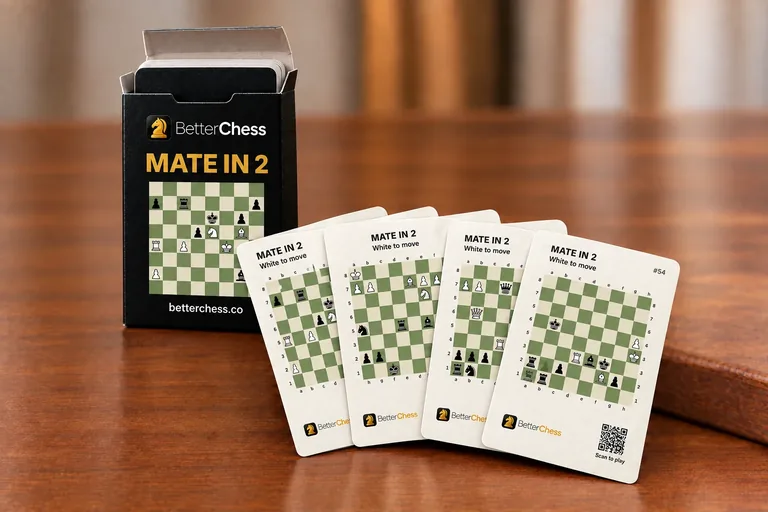
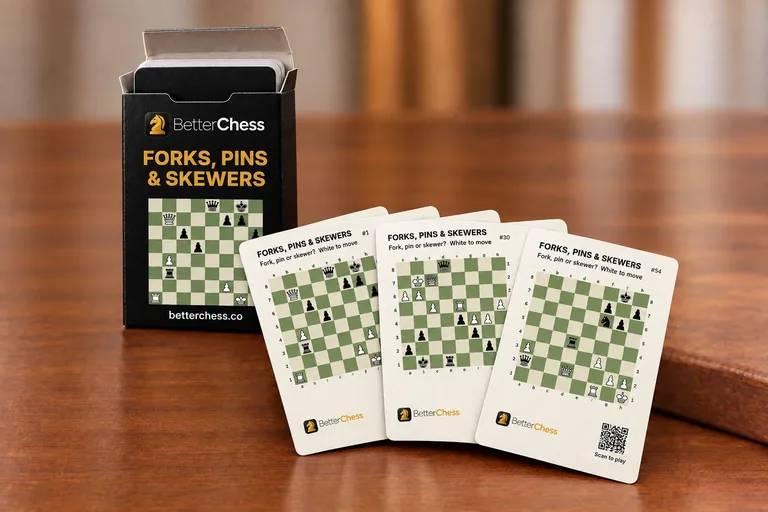
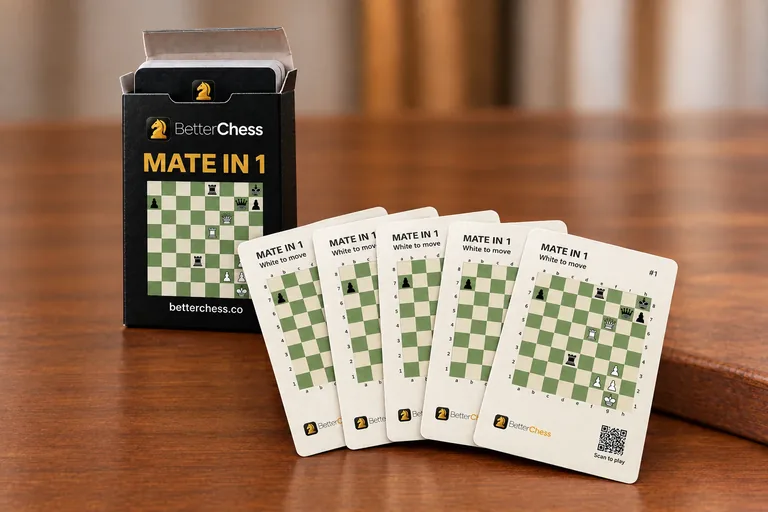
PRINTED CHESS PUZZLE CARDS
Chess puzzle playing card decks
54 poker-size cards in a tuck box. Puzzle on the front, solution on the back.