Morphy's Opera Game (1858)
- White
- Paul Morphy
- Black
- Duke of Brunswick & Count Isouard
- Event
- Paris Opera House
- Year
- 1858
- Result
- 1–0
- Opening
- Philidor Defense
See this game roasted by the engine
15… Nxd7
White to move. Morphy finished with a queen sacrifice — can you find the mate in two?
Why this game matters
Paris, 1858. Paul Morphy is at the opera and gets dragged into a casual game against two amateurs sharing the board. What follows is the most famous teaching game in chess history — a 17-move clinic in development, open lines, and attacking the uncastled king. Step through it below, or take over the board and play it out yourself.
The lesson
The whole game is one idea: get every piece into play fast, rip open lines toward the enemy king, and don't waste time grabbing pawns while you're ahead in development. Morphy never moved a piece twice without reason, declined a free pawn to keep developing, and finished with a queen sacrifice into mate.
Move by move
2. Nf3Nf3 — develop a piece and hit e5 at the same time. Almost every strong opening move does two jobs.
3… Bg4…Bg4 pins the knight, but Black is developing the wrong things in the wrong order. Morphy will punish it by opening the centre.
4. dxe5dxe5 — open the position while you're better developed. Open lines favour whoever has more pieces ready.
5. Qxf3Qxf3 keeps everything coordinated and already eyes f7 — Black's most fragile square.
6. Bc4Bc4 trains the bishop straight at f7. Two pieces now point at Black's weakest point.
7. Qb3Qb3! A double attack — the queen hits b7 and joins the bishop against f7.
8. Nc3Nc3 — the key moment. Morphy ignores the free b7 pawn and just develops. Development beats material in an open position.
9. Bg5Bg5 pins the f6-knight. Every white piece is now working; Black's queenside has never moved.
10. Nxb5Nxb5! A sacrifice to tear open the c- and d-files and reach Black's stuck king.
11. Bxb5+Bxb5+ — check, and the d7-knight is pinned. Black is tangled up and can't develop.
12. O-O-OO-O-O!! Castling that instantly drops the rook onto the open d-file, attacking the pinned knight. Castling as an attacking move.
13. Rxd7Rxd7 removes a defender and keeps piling onto the pin.
14. Rd1Rd1 brings the last piece in. Black's d7 is overloaded and pinned — the position collapses.
15. Bxd7+Bxd7+ clears the path for the finish.
16. Qb8+Qb8+!! The immortal queen sacrifice — it drags the knight to b8 and clears d8 for mate.
17. Rd8#Rd8# — checkmate. Every white piece joined the attack; Black's queenside never moved. Develop fast, open lines, attack the king.
Frequently asked
Why is the Opera Game so famous?
It's the clearest demonstration of opening principles ever played: rapid development, opening lines, and attacking before the opponent can catch up — finished with a textbook queen sacrifice. It's been taught to beginners for over 150 years.
What can a club player learn from it?
Three things: develop a new piece almost every move, don't grab pawns when you're ahead in development, and open lines toward an uncastled king. Those alone win a lot of games under 1800.
Can I play the position myself?
Yes — use the board above. Step through the moves, or hit “Play from here” to take over against the computer, right in your browser, no sign-up.
Similar games
Paulsen vs Morphy (1857)
Louis Paulsen vs Paul Morphy · 1857 · Four Knights Game
Replay & play ›Bird vs Morphy (1858)
Henry Bird vs Paul Morphy · 1858 · Philidor Defence, Philidor Countergambit
Replay & play ›The Immortal Game (1851)
Adolf Anderssen vs Lionel Kieseritzky · 1851 · King's Gambit
Replay & play ›The Evergreen Game (1852)
Adolf Anderssen vs Jean Dufresne · 1852 · Evans Gambit
Replay & play ›Want this on your own games? BetterChess puts a real engine inside Claude, so it finds the moves that actually decided the game instead of listing every inaccuracy.
BetterChess is a practice tool. We make no guarantee you'll reach 1800 or any rating. This is a historical game; the analysis is our own.
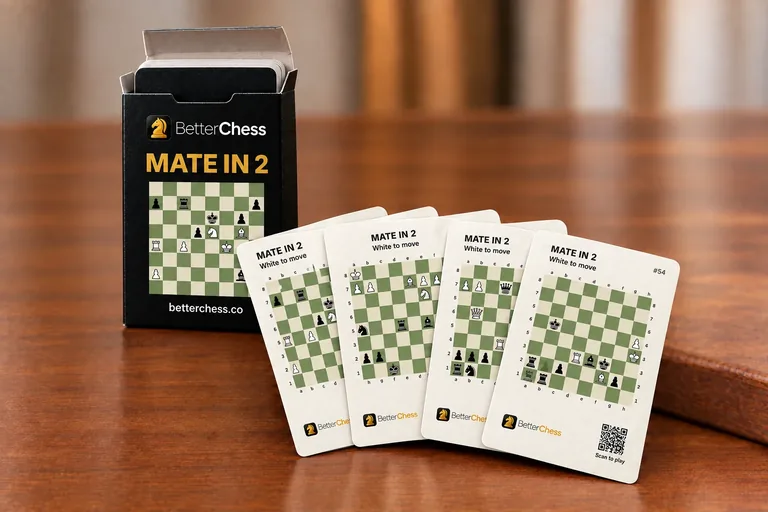
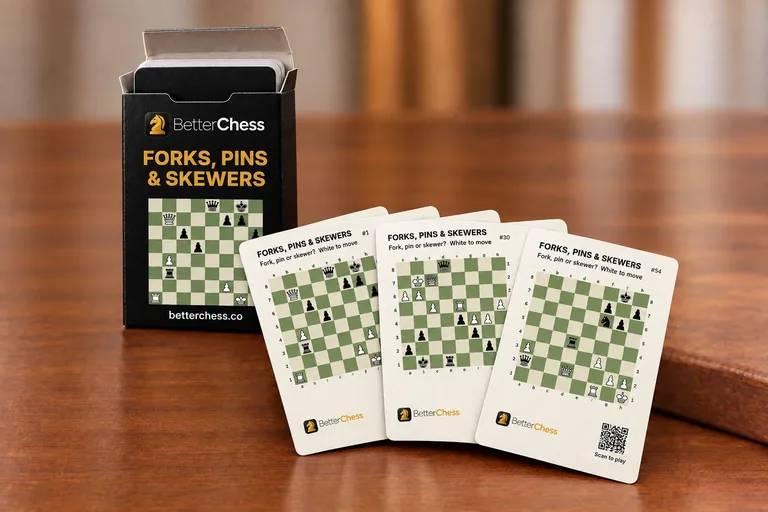
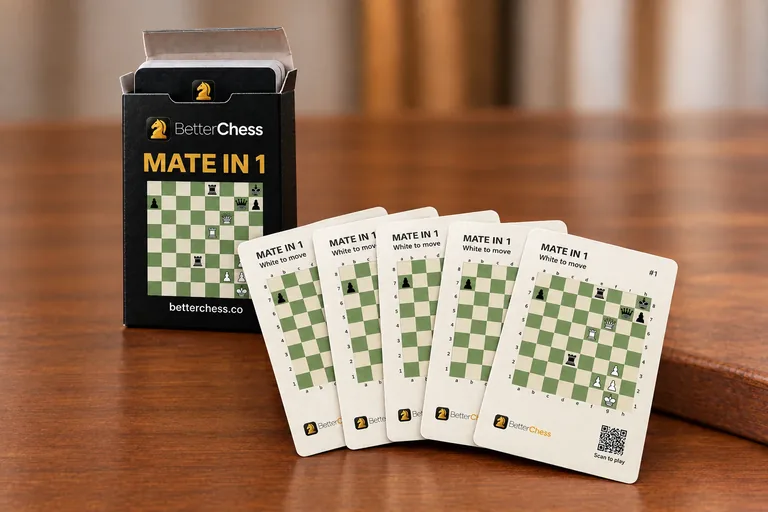
PRINTED CHESS PUZZLE CARDS
Chess puzzle playing card decks
54 poker-size cards in a tuck box. Puzzle on the front, solution on the back.