Philidor Defense
Starting position
Engine ready — step through to see live evals.
Press ▶ Watch to play the line out, or Next to step through it — the engine evaluates every position.
The Philidor Defense protects e5 with 2...d6, a modest move with a long pedigree: it carries the name of the 18th century champion who declared pawns the soul of chess. Modern club players like it because it is compact, low on theory, and hard to attack. The price is a small concession of space, so Black must know the right setup and the right moment to strike back in the centre.
The idea in one line
Defend e5 with the modest 2...d6, exchange in the centre at the right moment, and build a compact, resilient position that invites White to overextend.
Key ideas
- 2...d6 defends e5 with a pawn instead of a piece, keeping the position compact and sidestepping White's sharpest gambits and pet lines.
- The central trade ...exd4 is not surrender: it frees Black's game and leads to a small but very solid setup with ...Nf6, ...Be7 and ...O-O.
- Black's counterplay comes later: the breaks ...d5 in one go, or ...c5 with queenside expansion, hit back once development is complete.
- The setup that keeps the e5-point (the Hanham with ...Nd7) is strong but needs an exact move order; most club players do better with the simple exchange setup shown here.
Plans for each side
White: Grab space with d4, develop naturally, castle, and use the extra room to build up slowly; White's centre and freer pieces promise a modest, low-risk pull with almost no losing chances.
Black: Trade on d4 at a moment of your choosing, complete development with ...Nf6, ...Be7 and ...O-O, keep the position tight, then counter in the centre with ...d5 or on the queenside with ...c5 and ...a6.
Common mistakes to avoid
- Move order matters in the Hanham: after an early ...Nd7 White's Bc4 sets concrete problems around f7 and e5. If you want that setup, learn its exact sequences; otherwise take on d4 and stay safe.
- Do not drift into pure passivity: if you never play ...exd4, ...d5 or ...c5, White builds a big centre and attacks for free.
- Watch the e5-point before you finish development: leaving it loosely defended while pieces sit at home is the classic way Philidor players lose miniatures.
The main line, explained
2… d6...d6 is the Philidor: e5 gets a pawn's protection and Black accepts a slightly cramped but sturdy game.
3. d4d4 is the principled reply, hitting e5 at once and claiming the centre.
3… exd4...exd4 releases the tension on Black's terms; holding the centre with ...Nd7 setups is playable but demands exact move orders.
4… Nf6...Nf6 develops and attacks e4, obliging White to spend energy covering the pawn.
5… Be7...Be7 keeps the bishop modest and safe; in the Philidor it often re-routes later after ...Re8 and ...Bf8.
6… O-O...O-O completes a compact setup: Black is slightly cramped but has no weaknesses for White to attack.
Frequently asked
Is the Philidor Defense passive?
It is compact rather than passive. Black concedes some space but keeps a healthy structure and clear plans: finish development, then break with ...d5 or ...c5. Many strong players use it as a low-maintenance weapon.
Should I play ...exd4 or hold the centre with ...Nd7?
The exchange with ...exd4 is the simplest and safest route and is what this page recommends. The Hanham setup that holds e5 is strong but depends on precise move orders; mix them up and White's Bc4 tricks around f7 become unpleasant.
Why is it called the Philidor?
It is named after Francois-Andre Danican Philidor, the strongest player of the 18th century, who championed the idea that pawns should defend pawns and famously taught that pawn structure decides the game.
Famous games in the Philidor Defense
- Morphy's Opera Game (1858): Paul Morphy vs Duke of Brunswick & Count Isouard
- Bird vs Morphy (1858): Henry Bird vs Paul Morphy
More openings to explore
Pirc Defense
Black vs 1.e4 · B07–B09
Learn & play ›Petrov Defense
King's Pawn (1.e4 e5) · C42-C43
Learn & play ›Knowing the moves of the Philidor Defense is not the same as knowing why they work. Use Claude? BetterChess gives it a real engine, so it explains this opening from the board in front of you instead of from memory.
BetterChess is a practice tool — we make no guarantee you'll reach 1800 or any rating. The lines here are standard, well-established opening theory, and every move is checked legal with the same engine the board runs.
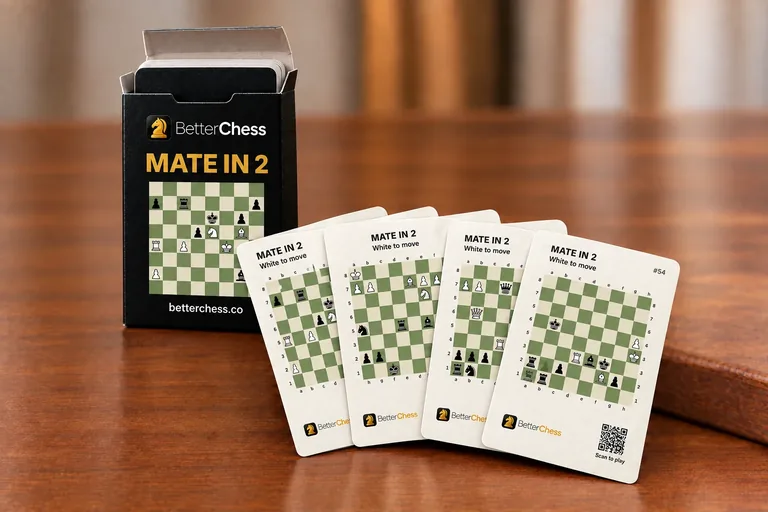
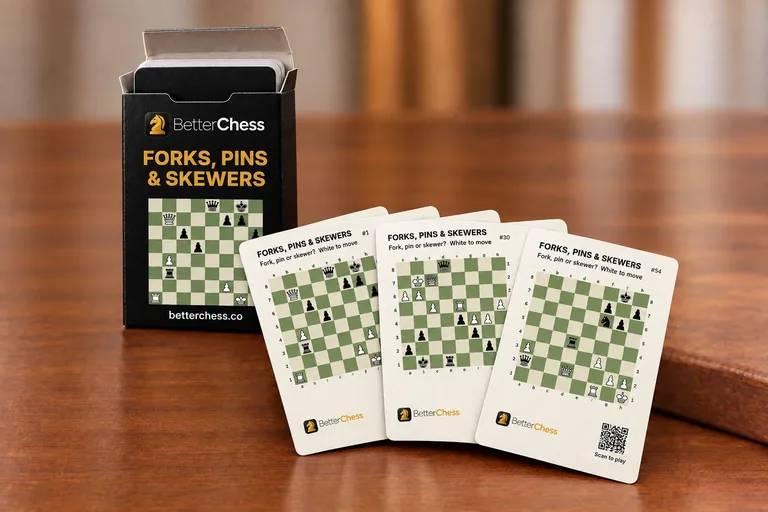
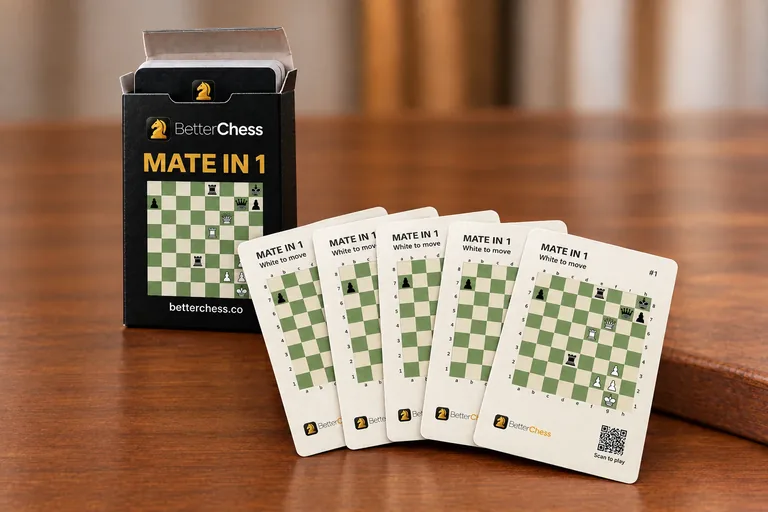
PRINTED CHESS PUZZLE CARDS
Chess puzzle playing card decks
54 poker-size cards in a tuck box. Puzzle on the front, solution on the back.