Cambridge Springs Trap
Part of the Queen's Gambit Declined: see the full opening guide
Starting position
Engine ready — step through to see live evals.
Press ▶ Watch to play the line out, or Next to step through it — the engine evaluates every position.
The Cambridge Springs is a Queen's Gambit Declined system built around hidden tactics against White's queenside, and this is its best-known trap. After Black's early ...Qa5, one careless developing move, 9.Bd3, leaves two white bishops loose at the same time. Black wins a clean piece with a pawn capture and one precise in-between move. It is a big reason the Cambridge Springs stays popular with club players.
The idea in one line
Black's queen on a5 pins White's queenside and eyes the g5-bishop along the fifth rank. When White plays the natural 9.Bd3, the reply 9...dxc4! attacks the d3-bishop and threatens ...Qxg5 at the same time; the zwischenzug 10...cxd3! then wins a full piece.
How the trap works
After 1.d4 d5 2.c4 e6 3.Nc3 Nf6 4.Bg5 Nbd7 5.Nf3 c6 6.e3 Qa5, Black's queen pins the c3-knight along the a5-e1 diagonal. White's main move 7.Nd2 blocks that diagonal and defends e4, but it has a hidden cost: the knight was the only defender of the g5-bishop. After 7...Bb4 8.Qc2 O-O, White plays the natural 9.Bd3?? and the trap springs: 9...dxc4! attacks the d3-bishop with the pawn, and because the d5-pawn has left the fifth rank, the queen on a5 suddenly sees g5, threatening ...Qxg5 for free. White cannot save both bishops. 10.Bxf6 deals with the g5 problem by cashing the bishop for a knight, expecting 10...Nxf6 11.Bxc4 with everything holding, but Black has the killer in-between move 10...cxd3!: it captures the other bishop and attacks the c2-queen, so White never gets time for Bxc4. After 11.Qxd3 Nxf6, Black has won two bishops for a knight and a pawn, a clean piece up.
The move that springs it
9. Bd3 — 9.Bd3?? (ply 17) is the losing move. Developing the bishop toward castling looks completely standard, but it puts a second piece on a loose square while the g5-bishop already stands undefended. 9.Be2 was the right square, keeping the bishop protected and out of the c4-pawn's reach; sequencing with 9.Bxf6 first is also fine.
How to avoid it
The whole trap rests on one detail: after 7.Nd2, nothing defends the g5-bishop, so any position where ...dxc4 opens the fifth rank is dangerous. Before every slow move in this structure, ask what ...dxc4 does. The clean approach is the one Capablanca used against Alekhine in their 1927 world championship match: meet ...dxc4 with Bxf6 followed by Nxc4, trading the loose bishop before it becomes a target. And if you want simple development, 9.Be2 keeps every piece defended and White stands normally.
The full line, explained
6… Qa5...Qa5 defines the Cambridge Springs: the queen pins the c3-knight along the a5-e1 diagonal and eyes White's queenside from a distance.
7. Nd2Nd2 blocks the a5-e1 diagonal and defends e4, but it costs the g5-bishop its only defender. That detail decides the game.
7… Bb4...Bb4 piles onto the diagonal and pins the d2-knight. White's position is fine, but only careful moves keep it that way.
9. Bd3Bd3?? develops toward castling and loses a piece. 9.Be2 was correct, keeping the bishop defended.
9… dxc4...dxc4! springs the trap: the pawn attacks the d3-bishop, and with d5 vacated the queen on a5 threatens ...Qxg5 as well.
10. Bxf6Bxf6 saves the g5-bishop by trading it, hoping for 10...Nxf6 11.Bxc4 when White escapes intact.
10… cxd3...cxd3! is the zwischenzug: it captures the other bishop and hits the c2-queen, so White never gets time for Bxc4.
11… Nxf6...Nxf6 completes the operation. Black has two bishops for a knight and a pawn: a clean piece up.
Frequently asked
Why does 9.Bd3 lose a piece?
Because two bishops hang at once. 9...dxc4 attacks the d3-bishop and opens the fifth rank so the a5-queen threatens ...Qxg5. 10.Bxf6 answers one threat, but the in-between move 10...cxd3 attacks White's queen while winning the second bishop. Only 9.Be2, or resolving with Bxf6 earlier, keeps everything defended.
Is the Cambridge Springs a real opening or just a trap?
It is a fully respectable Queen's Gambit Declined line, played by Kasparov and Carlsen among many others. The traps are a bonus: club players regularly win material straight out of the opening, and even when White knows the theory, Black's setup remains sound.
More traps to learn
Elephant Trap
Queen's Gambit Declined (1.d4 d5 2.c4 e6) · Wins a piece
Learn & play ›Kieninger Trap
Budapest Gambit (1.d4 Nf6 2.c4 e5) · Checkmate (smothered)
Learn & play ›Every trap works until your opponent does not play into it — and then the same move often loses a piece. That is exactly what BetterChess catches: it checks the position instead of recognising the pattern.
A trap only works if your opponent makes the mistake — strong players sidestep these, which is why each page also shows how to avoid it. Every line here is checked legal with the same engine the board runs, and every checkmate is verified.
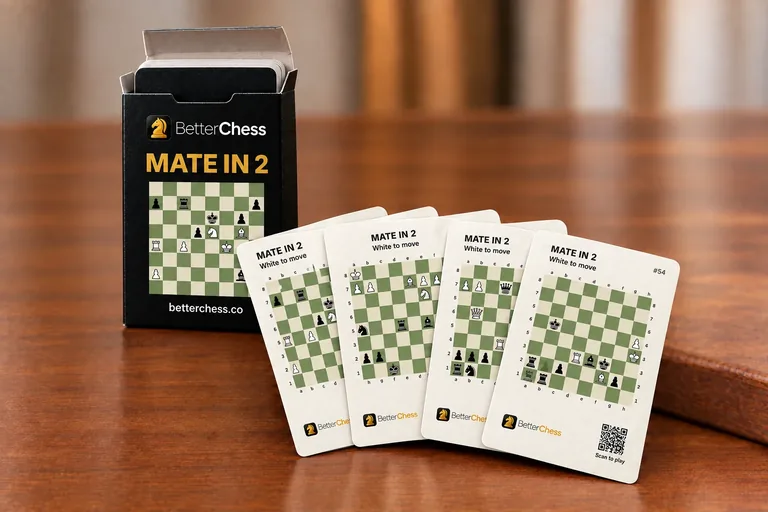
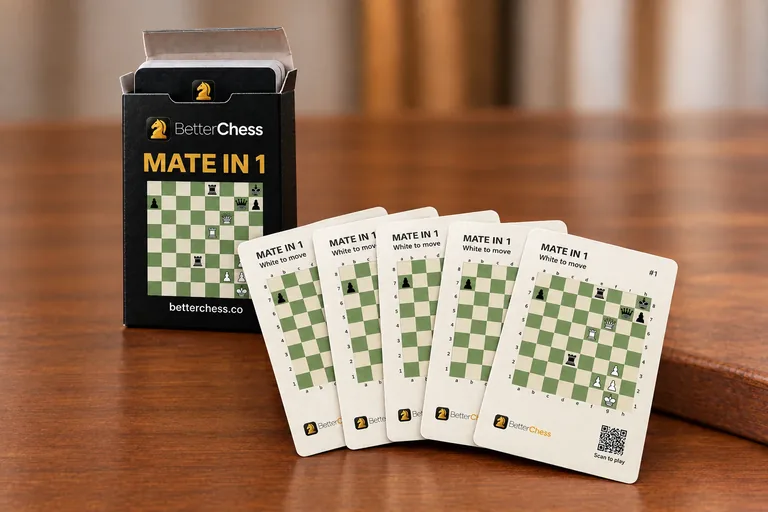
PRINTED CHESS PUZZLE CARDS
Chess puzzle playing card decks
54 poker-size cards in a tuck box. Puzzle on the front, solution on the back.