King's Indian Defense
Starting position
Engine ready — step through to see live evals.
Press ▶ Watch to play the line out, or Next to step through it — the engine evaluates every position.
The King's Indian is the great fighting defence to 1.d4. Black deliberately lets White grab the big centre with pawns on d4, c4 and e4, fianchettoes the dark-squared bishop to g7, and castles — then counterattacks. It's the opening of choice for players who want an unbalanced struggle and real winning chances with Black.
The idea in one line
Fianchetto the bishop to g7, castle, and let White take the centre — then hit back, usually with ...e5 (and often ...f5), aiming a kingside pawn storm straight at White's king.
Key ideas
- Hand White the broad centre on purpose, then undermine it: the g7-bishop and a timely ...e5 give Black active piece play in return.
- The fianchettoed bishop on g7 is the soul of the opening — it eyes the long diagonal and supports every central and queenside break.
- In the main lines White attacks on the queenside while Black storms the kingside with ...f5, ...f4 and ...g5 — a thrilling race of opposite-wing attacks.
- It's a setup, not a memorised line: the same Nf6, g6, Bg7, d6, O-O scheme works against most of White's tries.
Plans for each side
White: Build and hold the big pawn centre (d4, c4, e4), develop with Nc3 and Nf3, castle, and expand on the queenside with c5 and a minority-style push while keeping the centre locked.
Black: Complete the fianchetto setup and castle, play ...Nc6 or ...Nbd7 and ...e5 to challenge the centre, then launch a kingside pawn storm with ...f5, ...f4 and ...g5.
Common mistakes to avoid
- Don't push ...e5 or ...f5 before you've castled and developed — opening the centre with your king still in the middle backfires badly.
- If White is allowed to play d5 and clamp the centre, react in the right zone: it usually means your play is the kingside with ...f5, not passive shuffling.
- Trading off the g7-bishop cheaply guts your attack and leaves the dark squares around your king weak — guard that piece.
The main line, explained
1… Nf6...Nf6 — controls e4 and develops, the flexible Indian start that keeps White guessing.
2… g6...g6 — preparing the fianchetto. Black will put the bishop on g7 rather than fight for the centre with pawns yet.
3… Bg7...Bg7 — the King's Indian bishop, eyeing the long diagonal. This piece anchors every plan Black has.
4… d6...d6 — supports a future ...e5 and opens the c8-bishop's diagonal. Black concedes space to strike later.
5… O-O...O-O — king safety first. Only now does Black uncork the central and kingside counterplay the opening is built for.
Frequently asked
Is the King's Indian too risky for club players?
It's sharp, but very learnable as a setup: the same moves (Nf6, g6, Bg7, d6, O-O) appear against almost everything. The reward is real winning chances with Black and a clear attacking plan, which suits players who want to fight.
Why does Black give White such a big centre?
On purpose. Black lets the centre overextend, then undermines it with ...e5 and piece pressure. The fianchettoed bishop and the kingside pawn storm are the compensation for the space conceded.
What's the main idea once the centre locks with d5?
When White plays d5 and closes the centre, Black's attack is the kingside: ...f5, ...f4, ...g5 and pieces pouring toward the white king, while White races on the other wing.
Famous games in the King's Indian Defense
- Tal's Knight Sacrifice (1960): Mikhail Botvinnik vs Mikhail Tal
- Petrosian's Championship Immortal (1966): Tigran Petrosian vs Boris Spassky
More openings to explore
Grünfeld Defense
Black vs 1.d4 · D70–D99
Learn & play ›Nimzo-Indian Defense
Black vs 1.d4 · E20–E59
Learn & play ›Knowing the moves of the King's Indian Defense is not the same as knowing why they work. Use Claude? BetterChess gives it a real engine, so it explains this opening from the board in front of you instead of from memory.
BetterChess is a practice tool — we make no guarantee you'll reach 1800 or any rating. The lines here are standard, well-established opening theory, and every move is checked legal with the same engine the board runs.
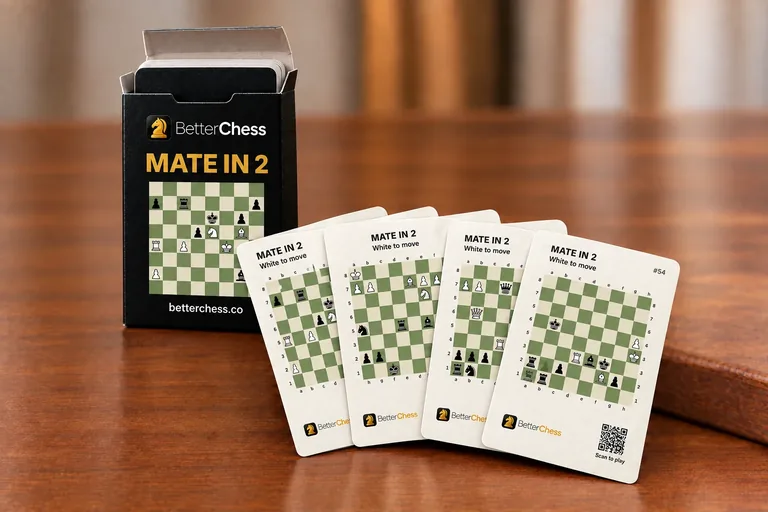
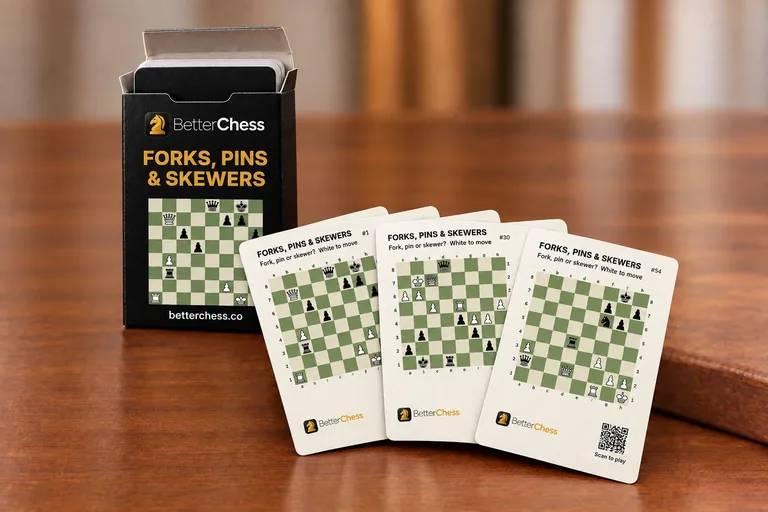
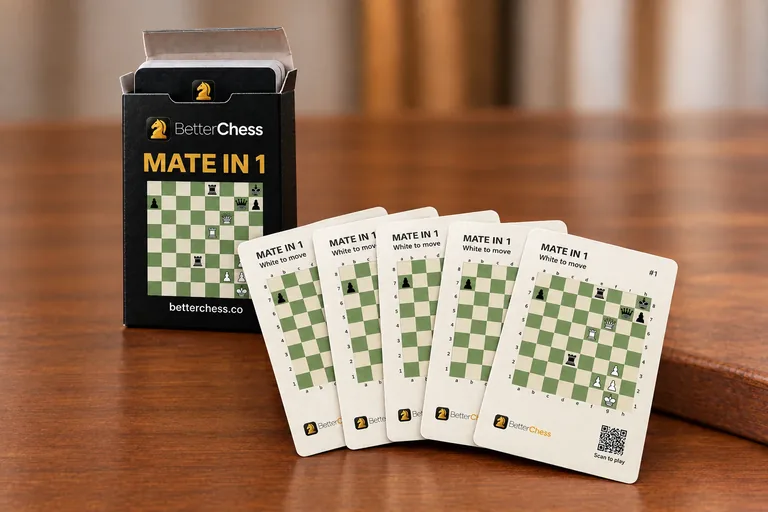
PRINTED CHESS PUZZLE CARDS
Chess puzzle playing card decks
54 poker-size cards in a tuck box. Puzzle on the front, solution on the back.