Scandinavian Defense
Starting position
Engine ready — step through to see live evals.
Press ▶ Watch to play the line out, or Next to step through it — the engine evaluates every position.
The Scandinavian — also called the Center Counter — is the most direct answer to 1.e4: Black immediately challenges the king's pawn with 1...d5. After White takes, Black recaptures with the queen, accepting that it will be chased once, then tucks it safely on a5. The result is a sound, low-theory defence where Black gets the light-squared bishop out cleanly and plays a clear, understandable structure.
The idea in one line
Hit the centre at once with 1...d5, recapture with the queen and park it on a5 after Nc3, then develop with ...Nf6, ...c6, ...Bf5 or ...Bg4, and ...e6 into a solid, easy-to-play setup.
Key ideas
- ...d5 challenges e4 immediately — the most direct strike there is — and after the trade Black has no central pawn tension to manage.
- Recapturing with the queen breaks the rule about early queen moves, but the queen retreats once to a safe square (a5 or d6) and the lost tempo is small.
- Black gets the light-squared bishop out of the chain easily, to f5 or g4, before playing ...e6 — no bad bishop, unlike the French.
- It's a low-theory, structurally sound defence: Black aims for a solid ...c6, ...e6 set-up and a reliable middlegame rather than sharp memorized lines.
Plans for each side
White: Develop with tempo by harassing Black's queen (Nc3, then d4 and Bd2/Nf3), build a strong centre with the extra space, and aim to exploit the time Black spends moving the queen.
Black: Retreat the queen to safety (a5 or d6), develop the light-squared bishop outside the pawn chain, play ...c6 and ...e6 for a solid structure, castle, and reach a sound middlegame.
Common mistakes to avoid
- After ...Qa5, watch out for White's b4 and Nd5 ideas that hit the queen and gain tempo — keep the queen's retreat squares in mind.
- Don't leave the queen exposed in the centre; tuck it away promptly or White develops with gain of time and a lasting initiative.
- Get the light-squared bishop out before ...e6, or you give up the one structural plus the Scandinavian offers over the French.
The main line, explained
1… d5...d5 — the Scandinavian. Black challenges the e4-pawn on the very first move, the most direct reply to 1.e4.
2… Qxd5...Qxd5 recaptures with the queen, accepting it will be chased once; the lost tempo is the price of a sound structure.
3. Nc3Nc3 develops a piece while attacking the queen, gaining time — White's whole plan is to harass and develop.
3… Qa5...Qa5 — the main retreat. The queen sits safely on the a5–d8 diagonal, eyeing the c3-knight and out of immediate danger.
4. d4d4 grabs the centre and frees White's pieces; the position takes on a clear, classical shape.
4… Nf6...Nf6 develops toward the centre and prepares ...c6, ...Bf5 and ...e6 — Black's standard, solid setup.
Frequently asked
Is the Scandinavian good for club players?
Yes — it's one of the most practical defences to 1.e4. The plans are clear, the theory is light, and Black reaches a sound structure quickly, so you spend your effort on the middlegame rather than memorizing lines.
Isn't moving the queen out early bad?
Normally yes, but here it's a calculated exception: the queen is chased only once and retreats to a safe square, costing a single tempo in return for a clean structure and an active light-squared bishop.
Scandinavian vs Caro-Kann?
Both develop the light-squared bishop actively and aim for solidity, but the Scandinavian resolves the centre immediately with 1...d5, while the Caro-Kann prepares ...d5 with 1...c6 first and keeps more central tension.
Traps in the Scandinavian Defense
- Tennison Gambit Trap: wins the queen
More openings to explore
Caro-Kann Defense
Black vs 1.e4 · B10–B19
Learn & play ›French Defense
Black vs 1.e4 · C00–C19
Learn & play ›Knowing the moves of the Scandinavian Defense is not the same as knowing why they work. Use Claude? BetterChess gives it a real engine, so it explains this opening from the board in front of you instead of from memory.
BetterChess is a practice tool — we make no guarantee you'll reach 1800 or any rating. The lines here are standard, well-established opening theory, and every move is checked legal with the same engine the board runs.
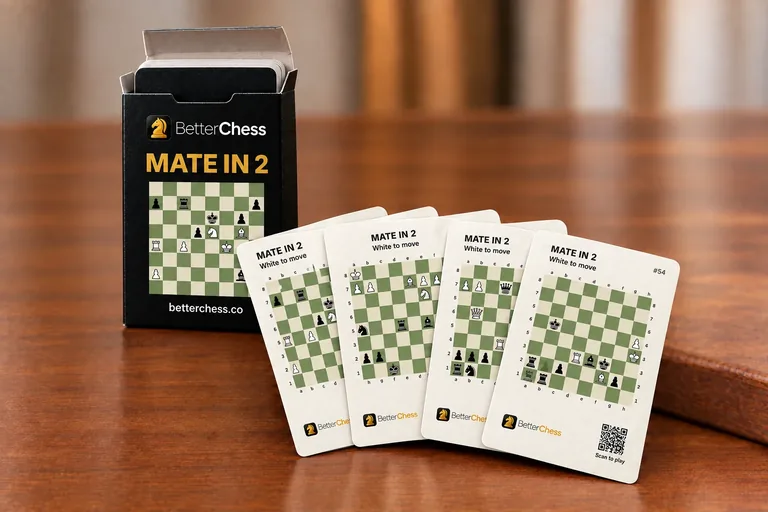
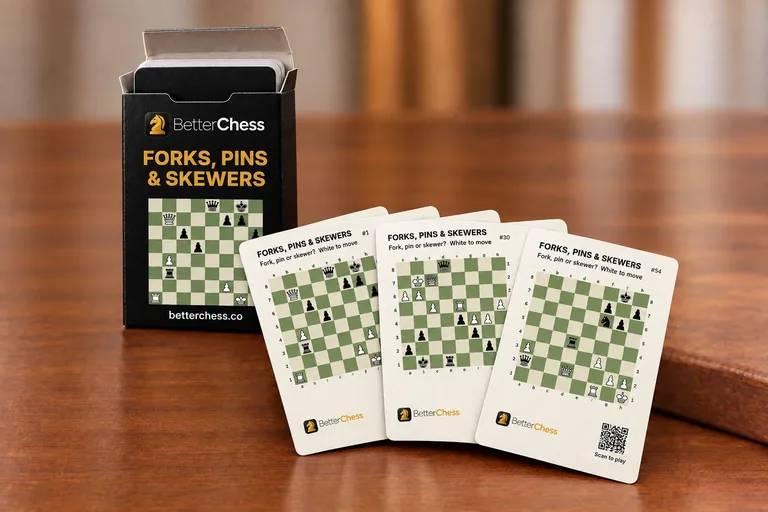
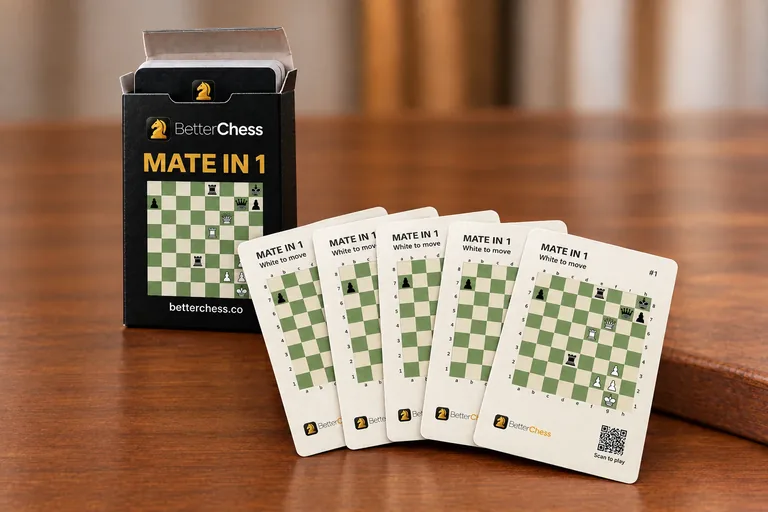
PRINTED CHESS PUZZLE CARDS
Chess puzzle playing card decks
54 poker-size cards in a tuck box. Puzzle on the front, solution on the back.