Tennison Gambit Trap
Part of the Scandinavian Defense: see the full opening guide
Starting position
Engine ready — step through to see live evals.
Press ▶ Watch to play the line out, or Next to step through it — the engine evaluates every position.
The Tennison Gambit is an offbeat pawn sacrifice against the Scandinavian, and its famous ICBM line is one of the most-played traps on the internet. White gives up two pawns, points a knight and bishop at Black's king, and after one natural-looking pawn move by Black, wins the queen by force with a knight fork and a bishop check that clears the d-file. The gambit is objectively unsound; the trap is very real.
The idea in one line
White sacrifices the e-pawn and then the d-pawn to aim a knight at f7 and a bishop at the b1-h7 diagonal. When Black kicks the knight with 5...h6??, White strikes: 6.Nxf7! forks queen and rook, and 7.Bg6+! clears the d-file with check so 8.Qxd8 wins the queen.
How the trap works
After 1.e4 d5 2.Nf3 dxe4 3.Ng5, White attacks the e4-pawn and eyes f7. Black defends naturally with 3...Nf6, and now 4.d3! offers a second pawn purely to open the f1-bishop: 4...exd3 5.Bxd3. Look at the geometry: the knight on g5 and bishop on d3 both point at Black's kingside, and White's queen stands behind the bishop on the d-file, staring at Black's queen on d8. The losing move is 5...h6?? (ply 10), kicking the knight exactly where it wants to go: 6.Nxf7! forks the queen and the h8-rook, so 6...Kxf7 is practically forced. Then comes the move that made the line famous: 7.Bg6+!. The bishop was the only thing blocking White's queen from d8, and it steps aside with check, so Black never gets a move to save the queen. After 7...Kxg6 8.Qxd8, White has won the queen and a pawn for a knight and a bishop, a decisive material advantage.
The move that springs it
5… h6 — 5...h6?? (ply 10) is the losing move. Kicking the attacked knight looks like it wins a tempo, but it ignores what the knight does on f7 and the fact that the two queens share the d-file with only White's bishop in between. The calm 5...e6 keeps Black's extra pawn and a fine position; after ...h6 the forced sequence Nxf7, Bg6+ and Qxd8 cannot be stopped.
How to avoid it
Three checkpoints save Black. First, when a knight lands on g5 and a bishop points at your kingside, do not play ...h6 on autopilot: sacrifices on f7 are exactly what the attacker wants. Second, notice when your queen shares an open or half-open file with the enemy queen; here the d-file is the whole trick. Third, just play 5...e6: it blunts the d3-bishop, covers the key light squares, and leaves White two tempi and vague hopes for a pawn. Or sidestep everything earlier, since 3...e5 and returning the pawn also leaves Black comfortable.
The full line, explained
2. Nf3Nf3 offers the e4-pawn: the Tennison Gambit. It is objectively dubious, but it comes with concrete traps.
3. Ng5Ng5 attacks the e4-pawn and already stares at f7. Black should ask why White is so cooperative.
4. d3d3! offers a second pawn with one goal: open the f1-bishop toward d3, g6 and the black king.
5… h6...h6?? kicks the knight exactly where it wants to go. 5...e6 was the calm move that keeps the extra pawn.
6. Nxf7Nxf7! forks the queen on d8 and the rook on h8. Capturing the knight is the natural reply, and it loses.
7. Bg6+Bg6+! is the famous move: the bishop clears the d-file with check, so Black gets no tempo to move the queen.
8. Qxd8Qxd8: the queen falls. White has queen and pawn for knight and bishop, a winning material edge.
Frequently asked
Is the Tennison Gambit sound?
No. With accurate play Black simply keeps the extra pawn: theory considers the gambit unsound, and 5...e6 leaves White with nothing concrete. It survives because the ICBM trap wins the queen so often in blitz and online play that many players accept the objective risk.
Why does 7.Bg6+ win the queen?
It is a clearance with check. White's queen already attacks d8 along the d-file, but its own bishop on d3 blocks the way. Bg6+ moves that bishop while checking the king, so Black must answer the check instead of saving the queen, and 8.Qxd8 follows no matter how Black replies.
More traps to learn
Stafford Gambit Trap
Petrov / Stafford Gambit (1.e4 e5 2.Nf3 Nf6) · Checkmate
Learn & play ›Englund Gambit Trap
Englund Gambit (1.d4 e5) · Checkmate
Learn & play ›Every trap works until your opponent does not play into it — and then the same move often loses a piece. That is exactly what BetterChess catches: it checks the position instead of recognising the pattern.
A trap only works if your opponent makes the mistake — strong players sidestep these, which is why each page also shows how to avoid it. Every line here is checked legal with the same engine the board runs, and every checkmate is verified.
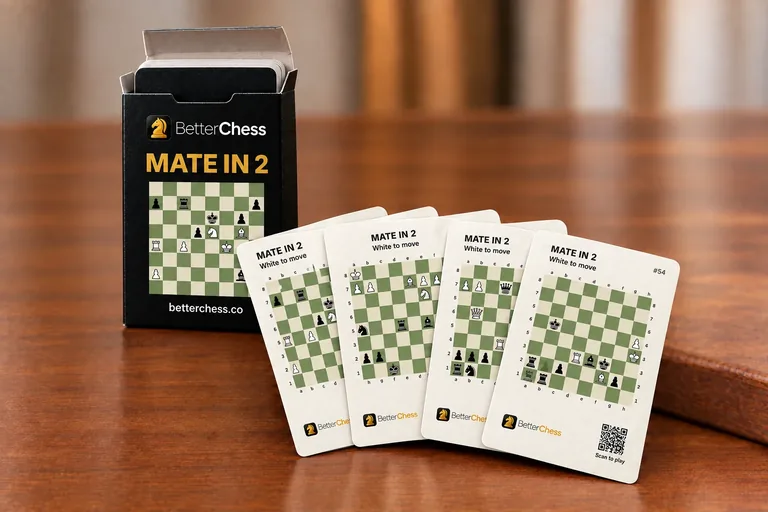
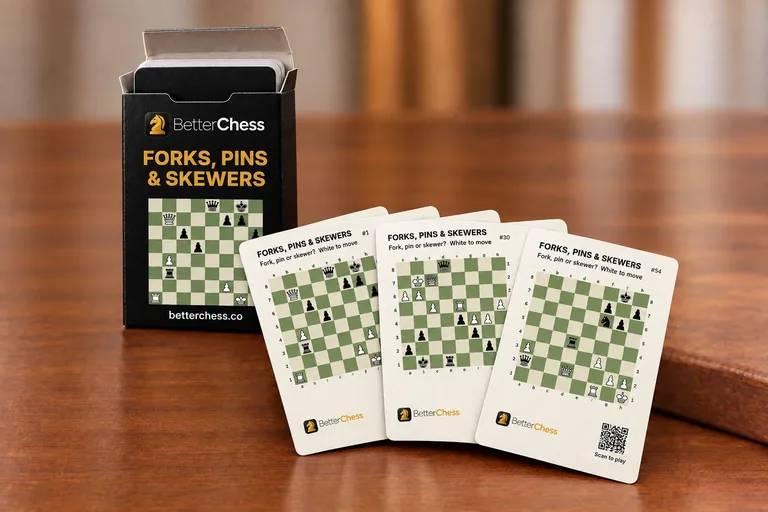
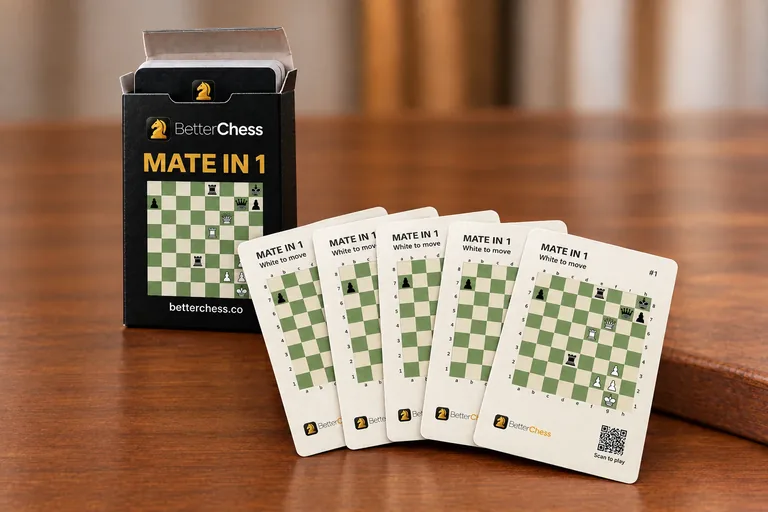
PRINTED CHESS PUZZLE CARDS
Chess puzzle playing card decks
54 poker-size cards in a tuck box. Puzzle on the front, solution on the back.