Bishop's Opening
Starting position
Engine ready — step through to see live evals.
Press ▶ Watch to play the line out, or Next to step through it — the engine evaluates every position.
The Bishop's Opening is the Italian's quieter cousin: White plays 2.Bc4 to point the bishop at f7 before committing the knight to f3. By delaying Nf3, White sidesteps a few of Black's sharpest defences and keeps the flexible option of an early f4. Played with d3, it leads to calm, solid King's-Pawn positions that are easy to handle at club level.
The idea in one line
Develop the bishop to c4 first, aiming at f7, then build a flexible set-up with d3 and Nf3 — a low-theory route into Italian-style positions that avoids some of Black's pet lines.
Key ideas
- 2.Bc4 targets f7 immediately, just like the Italian, but keeps the knight's options open and dodges defences such as the Petrov (which needs 2.Nf3 to exist).
- Delaying Nf3 lets White keep the f-pawn free for a later f4 push, adding an aggressive plan the Italian gives up.
- Lines often transpose: after d3 and Nf3 you typically reach a normal Italian/Giuoco Pianissimo structure, so the ideas you already know carry over.
- It's a calm, principled opening — develop, castle, and play on understanding rather than memorized theory.
Plans for each side
White: Develop the bishop to c4 and play d3 to support e4, then Nf3 and castle, reaching an Italian-style position — or keep the f-pawn free and prepare an f4 break for a more aggressive game.
Black: Develop naturally with ...Nf6 hitting e4, prepare the central freeing break ...d5 (often after ...c6), and aim for comfortable, equal development.
Common mistakes to avoid
- Don't auto-play Nf3 and miss the point — the move order exists partly to keep f4 available and to dodge specific defences, so choose your plan on purpose.
- After ...Nf6, watch the e4-pawn: support it with d3 (or be ready for the sharp Nc3 lines) rather than leaving it hanging.
- Black's ...d5 break is the standard equalizer; as White, meet it calmly (exchange or support the centre) instead of panicking and losing a tempo.
The main line, explained
2. Bc4Bc4 — the Bishop's Opening. The bishop hits f7 at once, before White decides where the knight goes.
2… Nf6...Nf6 develops and attacks e4, the most active and popular reply.
3. d3d3 calmly defends e4 and opens the c1-bishop's diagonal — a flexible, solid choice.
3… c6...c6 prepares the freeing central break ...d5, supporting the pawn on its way.
4. Nf3Nf3 develops naturally; the game now resembles a normal Italian Giuoco Pianissimo.
4… d5...d5 — Black's standard freeing break, challenging White's centre and equalizing comfortably.
Frequently asked
How is the Bishop's Opening different from the Italian Game?
Both play an early Bc4 aimed at f7. The Italian commits to 2.Nf3 first; the Bishop's Opening plays 2.Bc4 before the knight, keeping the f-pawn free for f4 and avoiding defences like the Petrov. Many lines simply transpose.
Is the Bishop's Opening good for beginners?
Yes — it's natural and low-theory. You develop a bishop to a strong square, support your centre with d3, castle, and reach familiar Italian-style positions where principles matter more than memorization.
Why delay Nf3?
Keeping the knight home leaves the f-pawn free for a possible f4 push and sidesteps a couple of Black's sharpest replies that depend on 2.Nf3. It's a small, flexible move-order trick.
Famous games in the Bishop's Opening
- Caruana Stuns Carlsen (2014): Magnus Carlsen vs Fabiano Caruana
More openings to explore
Italian Game
King's Pawn (1.e4 e5) · C50–C54
Learn & play ›Vienna Game
King's Pawn (1.e4 e5) · C25–C29
Learn & play ›Knowing the moves of the Bishop's Opening is not the same as knowing why they work. Use Claude? BetterChess gives it a real engine, so it explains this opening from the board in front of you instead of from memory.
BetterChess is a practice tool — we make no guarantee you'll reach 1800 or any rating. The lines here are standard, well-established opening theory, and every move is checked legal with the same engine the board runs.
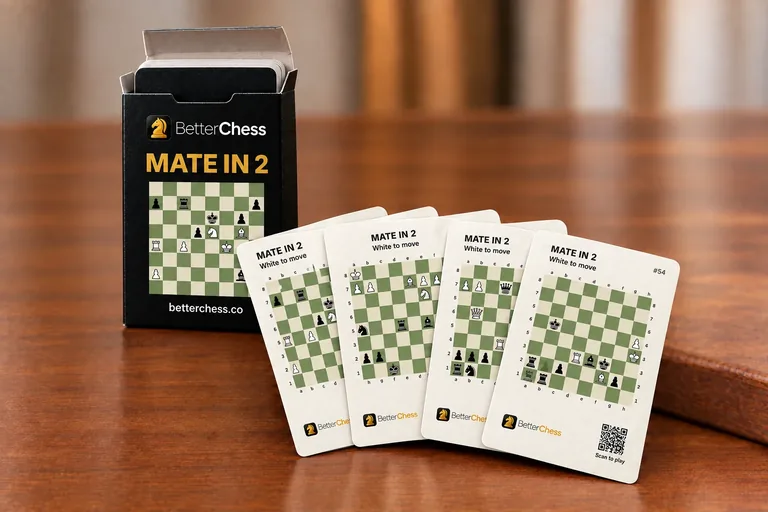
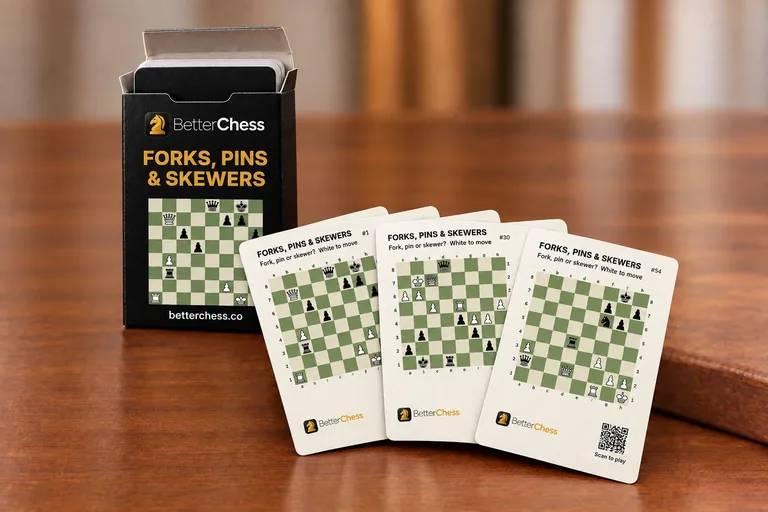
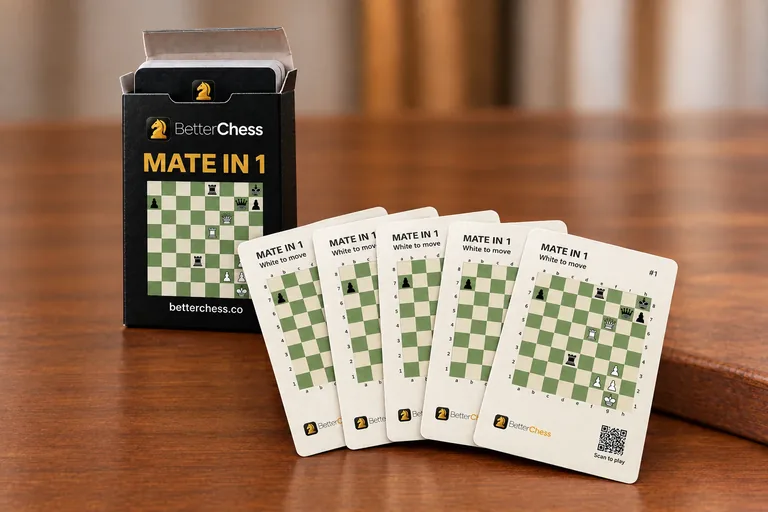
PRINTED CHESS PUZZLE CARDS
Chess puzzle playing card decks
54 poker-size cards in a tuck box. Puzzle on the front, solution on the back.