Wayward Queen Attack
Starting position
Engine ready — step through to see live evals.
Press ▶ Watch to play the line out, or Next to step through it — the engine evaluates every position.
The Wayward Queen Attack, 1.e4 e5 2.Qh5, is the opening every improving player must solve: it threatens Scholar's Mate on f7 and wins mountains of games at beginner level. This page trains the Black side, because punishing it correctly is a rite of passage: defend e5, hit the queen with gain of time, and come out of the opening with free extra development. Even strong players have tried 2.Qh5 as a shock weapon (a young Hikaru Nakamura played it in grandmaster tournaments), but against the right setup it simply concedes Black the better game.
The idea in one line
Meet 2.Qh5 calmly and by the numbers: 2...Nc6 defends e5, 3...g6 hits the queen, 4...Nf6 blocks the f7 threat, and every Black move develops while White's queen burns tempo.
Key ideas
- White's whole idea is one threat: Qxf7 mate, the Scholar's Mate pattern. Once f7 holds twice, the queen sortie has achieved nothing and cost real time.
- Order matters more than speed: 2...Nc6 first (defending e5), only then 3...g6 and 4...Nf6. Each move parries the current threat and develops or gains a tempo.
- By move five Black has three developed minor pieces and a castled-ready king, while White has spent two of five moves on the same queen.
- The refutation is not a forced win of material: it is a permanent lead in development and the long-term target of a misplaced queen. Play normal strong moves and the advantage compounds.
Plans for each side
White: White's scheme is one threat repeated: Qh5 eyes e5 and f7, Bc4 adds the mate threat, Qf3 renews it, and Ne2 with Nbc3 tries to rejoin normal chess. If the mate never lands, White is left with a misplaced queen and a development deficit, which is exactly what Black plays for.
Black: Defend and develop in the same breath: 2...Nc6 guards e5, 3...g6 gains a clean tempo on the queen, 4...Nf6 blocks the f-file and develops, 5...Bg7 finishes the fianchetto. Castle, strike with ...d5 when ready, and hunt the queen only with moves you would want to play anyway.
Common mistakes to avoid
- 2...Nf6?? defends nothing: 3.Qxe5+ picks up the e-pawn with check and the trick has already worked.
- 2...g6?? is the disaster: 3.Qxe5+ forks the king and the h8-rook, winning material on move three. Defend e5 first, then hit the queen.
- Don't chase the queen with weakening or non-developing moves: every attack on it should double as development (...Nc6, ...g6 with ...Bg7, ...Nf6), or you are spending tempi exactly as badly as White is.
The main line, explained
2. Qh5Qh5 attacks e5 and aims at f7, threatening Scholar's Mate ideas. It wins fast games against the unprepared and loses time against everyone else.
2… Nc6...Nc6 is the correct first response: it defends e5 and develops. Not 2...Nf6?? or 2...g6??, which both lose material to 3.Qxe5+.
3… g6...g6 hits the queen and gains a clean tempo; with e5 already defended, this is now safe and strong.
4. Qf3Qf3 keeps the dream alive by re-aiming at f7; the threat is real for exactly one more move.
4… Nf6...Nf6 parries the mate by blocking the f-file, develops a piece, and prepares to castle. Black's moves all do double duty.
5. Ne2Ne2 guards against ...Nd4, which would harass the queen again and eye c2; White is already playing defence.
5… Bg7...Bg7 completes a perfect setup: three pieces out, the king ready to castle, a clear plan. Same material, far better position for Black.
Frequently asked
Is the Wayward Queen Attack a good opening?
No. 2.Qh5 sets a real one-move trap (Scholar's Mate on f7) but violates basic principles, and against the correct response White ends up behind in development with an exposed queen. Every club player should know how to punish it rather than fear it.
How do you beat 2.Qh5?
In order: 2...Nc6 to defend e5, 3...g6 to hit the queen, 4...Nf6 to block the renewed f7 threat, then ...Bg7 and castle. You do not need to trap the queen; you win by finishing development several tempi ahead.
Why not attack the queen immediately with 2...g6?
Because e5 falls: 3.Qxe5+ forks the king and the rook on h8 and wins material outright. The queen must be met with defence first (2...Nc6), tempo-gaining attacks second.
Traps in the Wayward Queen Attack
- Scholar's Mate: checkmate
More openings to explore
Bishop's Opening
King's Pawn (1.e4 e5) · C23–C24
Learn & play ›Italian Game
King's Pawn (1.e4 e5) · C50–C54
Learn & play ›Knowing the moves of the Wayward Queen Attack is not the same as knowing why they work. Use Claude? BetterChess gives it a real engine, so it explains this opening from the board in front of you instead of from memory.
BetterChess is a practice tool — we make no guarantee you'll reach 1800 or any rating. The lines here are standard, well-established opening theory, and every move is checked legal with the same engine the board runs.
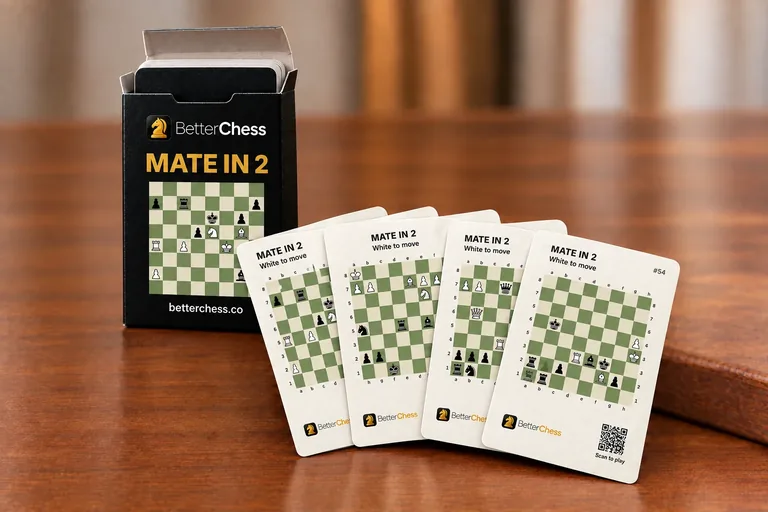
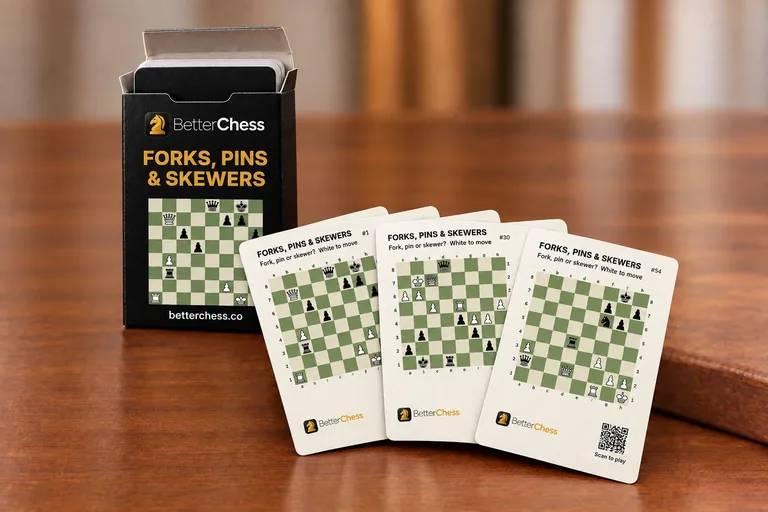
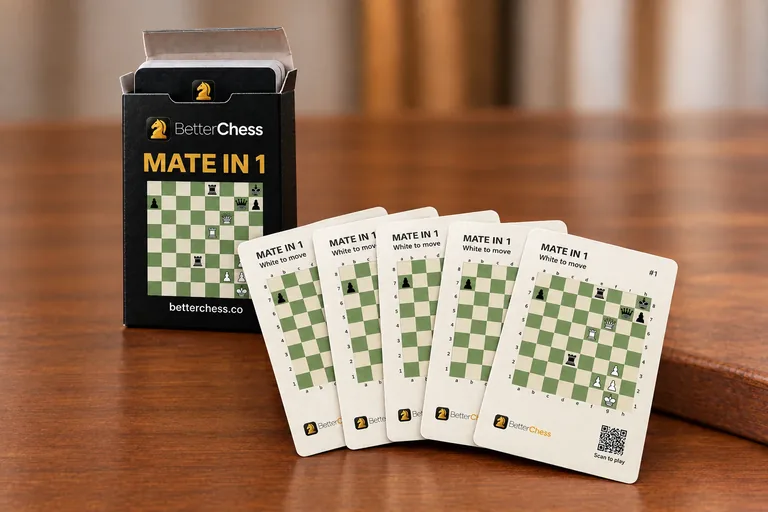
PRINTED CHESS PUZZLE CARDS
Chess puzzle playing card decks
54 poker-size cards in a tuck box. Puzzle on the front, solution on the back.