Vienna Gambit
Starting position
Engine ready — step through to see live evals.
Press ▶ Watch to play the line out, or Next to step through it — the engine evaluates every position.
The Vienna Gambit is the punch hiding behind the quiet Vienna Game: after 1.e4 e5 2.Nc3 Nf6 White throws 3.f4, a King's Gambit with the centre already reinforced. The killer detail is that accepting is a mistake: 3...exf4? runs into 4.e5, chasing the knight home and handing White a monster centre. Correct play with 3...d5 leads to open, lively positions, but the accuracy burden sits on Black from move three, which is why this gambit piles up points at club level.
The idea in one line
Play 2.Nc3 first so that 3.f4 comes with the centre covered: punish 3...exf4 with 4.e5, and meet the correct 3...d5 with fxe5 and fast development for a lively, open fight.
Key ideas
- 2.Nc3 is the insurance policy: e4 is covered before f4 is thrown, so White gets King's Gambit energy without the King's Gambit loose ends.
- The gambit's bread and butter: 3...exf4? 4.e5 forces the f6-knight backward, and White develops a huge centre and attack for free.
- Against the correct 3...d5 the game opens on White's terms: the half-open f-file and the e5 wedge give White easy, natural play.
- Engines call the main line equal, and that is fine: equal and sharp with a plan you know beats equal and unfamiliar, and every Black inaccuracy tips it White's way.
Plans for each side
White: Take on e5, develop with Nf3 and d4, put the bishop on d3 to question the e4-knight, castle, and use the half-open f-file and the e5 wedge for a kingside initiative. Against 3...exf4, push e5 immediately and take the whole centre.
Black: Do not take the pawn: 3...d5 is the move, counterstriking the centre. After 4.fxe5 Nxe4, develop quickly with ...Be7 and ...O-O, then challenge White's e5 wedge with ...f5 or piece pressure at the right moment.
Common mistakes to avoid
- 3...exf4? is the losing habit the Vienna Gambit farms: 4.e5 hits the knight, and whether it retreats to g8 or tries 4...Qe7, White emerges with a crushing centre and free development.
- f4 loosens the e1-h4 diagonal, so until Nf3 arrives, keep ...Qh4+ in your calculations; it is the one tactic that turns the gambit around.
- As Black, do not get attached to the e4-knight: when White challenges it, let it trade or come back. Leaving it stranded to be surrounded loses the thread.
The main line, explained
3. f4f4 is the Vienna Gambit: King's Gambit energy with the c3-knight already guarding e4. Accepting is already the mistake.
3… d5...d5 is the correct, principled answer, striking the centre instead of grabbing the pawn; 3...exf4? runs into 4.e5.
4. fxe5fxe5 takes with the f-pawn, opening the f-file and keeping the strongpoint on e5.
4… Nxe4...Nxe4 wins the pawn straight back. Trading knights on e4 does not trouble Black, so White gets on with development instead.
5. Nf3Nf3 develops and takes away ...Qh4+, the check White must always respect in f4 openings.
6. d4d4 claims the full centre; White's setup (Nf3, d4, Bd3, O-O) plays itself, which is the practical charm of the gambit.
6… O-O...O-O tucks the king away; theory continues 7.Bd3, when the e4-knight must justify itself, and a balanced but double-edged middlegame begins.
Frequently asked
Is the Vienna Gambit sound?
Yes, with an honest asterisk: against the correct 3...d5 engines call it equal, and the resulting open positions are fine for both sides. Its club-level power comes from 3...exf4?, a natural move that is already a serious mistake after 4.e5.
Why is taking the Vienna Gambit pawn bad?
Because of 4.e5. The attacked f6-knight has no good square, and after it retreats White develops a massive centre with tempo. In the King's Gambit taking is critical; in the Vienna the extra Nc3 move turns the tables.
What is the difference between the Vienna Game and the Vienna Gambit?
The Vienna Game is the family: 2.Nc3 keeps quiet g3 setups and sharp lines both available. The Vienna Gambit is its most aggressive branch, 3.f4 against 2...Nf6, offering a pawn that is poisoned to take.
Traps in the Vienna Gambit
- Würzburger Trap: wins a piece
More openings to explore
Vienna Game
King's Pawn (1.e4 e5) · C25–C29
Learn & play ›King's Gambit
King's Pawn (1.e4 e5) · C30–C39
Learn & play ›Knowing the moves of the Vienna Gambit is not the same as knowing why they work. Use Claude? BetterChess gives it a real engine, so it explains this opening from the board in front of you instead of from memory.
BetterChess is a practice tool — we make no guarantee you'll reach 1800 or any rating. The lines here are standard, well-established opening theory, and every move is checked legal with the same engine the board runs.
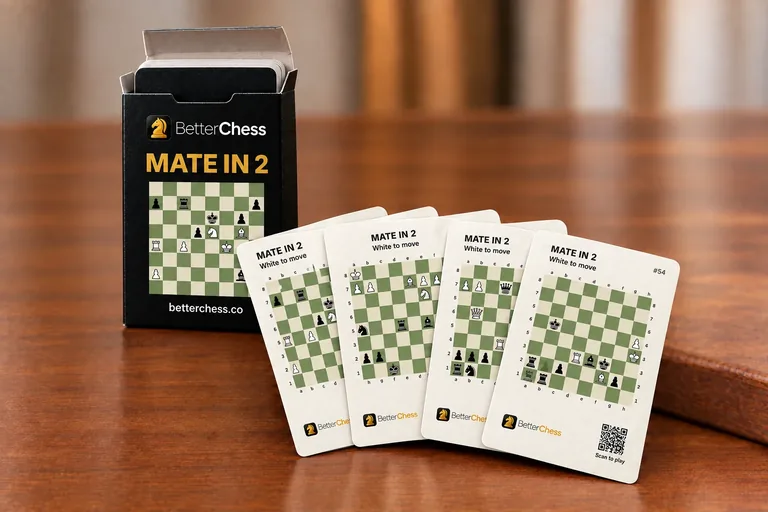
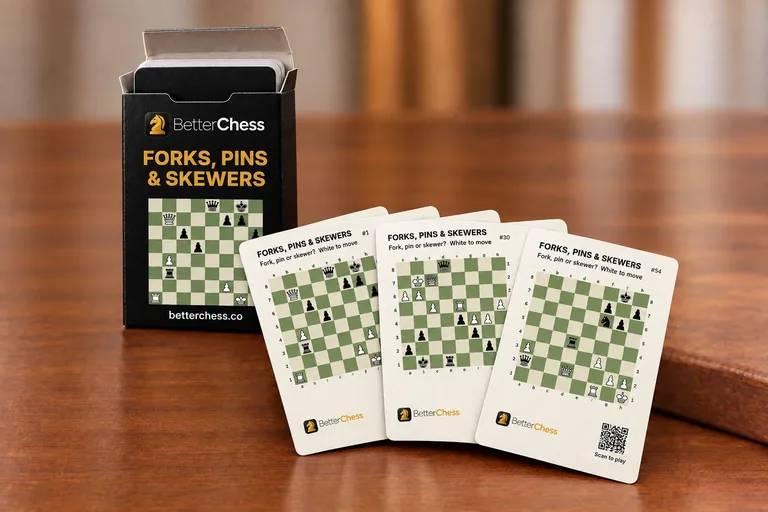
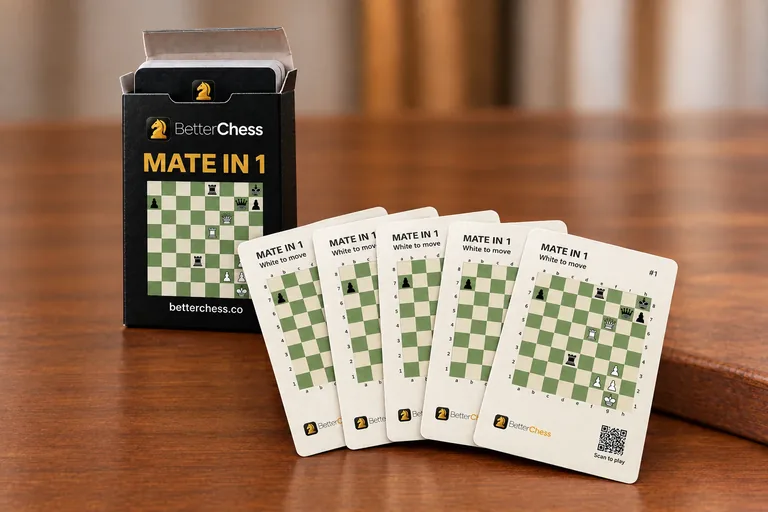
PRINTED CHESS PUZZLE CARDS
Chess puzzle playing card decks
54 poker-size cards in a tuck box. Puzzle on the front, solution on the back.