Two Knights Defense
Starting position
Engine ready — step through to see live evals.
Press ▶ Watch to play the line out, or Next to step through it — the engine evaluates every position.
The Two Knights Defense is Black's most combative answer to the Italian bishop: instead of the quiet 3...Bc5, Black plays 3...Nf6 and dares White to grab material with 4.Ng5. Tarrasch famously sneered at that knight sortie, yet it is the critical test: Black meets it with the main-line pawn sacrifice ...Na5 and ...c6, getting rapid development and a lasting initiative for a single pawn. If you like playing with the initiative as Black, this is your opening.
The idea in one line
Answer 3.Bc4 with 3...Nf6, meet the critical 4.Ng5 with the main-line pawn sacrifice ...Na5 and ...c6, and play for rapid development and a long initiative.
Key ideas
- 3...Nf6 fights for the centre immediately and invites 4.Ng5; Black is ready to sacrifice a pawn rather than defend passively.
- After 4.Ng5 d5 5.exd5 the key move is 5...Na5!, hitting the c4-bishop. Recapturing with 5...Nxd5?! walks into the notorious Fried Liver attack on f7.
- The pawn sacrifice with ...c6 buys time: Black gains tempo after tempo on the b5-bishop and the g5-knight and completes development far ahead of White.
- The resulting positions are a model of initiative versus material: Black's lead in development must be used actively before White consolidates the extra pawn.
Plans for each side
White: Take the pawn with exd5 and dxc6, then weather the storm: retreat accurately with Bb5+, Be2 and Nf3, finish development, and steer for a middlegame or endgame where the extra pawn finally counts.
Black: Sacrifice the pawn with ...Na5 and ...c6, chase White's pieces with gain of time (...h6, ...e4, ...Bd6), develop everything quickly, and attack in the centre and on the kingside before White untangles.
Common mistakes to avoid
- Do not recapture with 5...Nxd5?! against 4.Ng5: both 6.Nxf7 (the Fried Liver) and the calm 6.d4 give White a dangerous attack on f7 and in the centre.
- As Black, tempo is everything: every move must develop a piece or chase one of White's. If you drift for even a move or two, you are simply a pawn down.
- As White, greed is the danger: keeping the extra pawn while behind in development requires precise retreats, and one careless move turns Black's initiative into a mating attack.
The main line, explained
4. Ng5Ng5 is the critical test, attacking f7 at once. Tarrasch mocked the move, but Black must know the answer.
4… d5...d5 is essentially forced, blocking the bishop's diagonal to f7 with a central counter-strike.
5… Na5...Na5! is the main line, hitting the c4-bishop. The natural 5...Nxd5?! invites the Fried Liver sacrifice on f7.
6… c6...c6 offers a pawn to open lines and gain time on the b5-bishop; this is the heart of Black's concept.
8… h6...h6 puts the question to the g5-knight and gains yet another tempo for development.
9… e4...e4 kicks the knight again; Black has given one pawn and received the entire initiative in return.
10… Bd6...Bd6 completes the picture: every Black piece is active while White must still untangle. A century of practice says Black has full compensation.
Frequently asked
Is the Two Knights Defense sound?
Yes. The main-line pawn sacrifice with ...Na5 and ...c6 has been tested for well over a century, and theory agrees Black gets full compensation: faster development, better pieces, and a lasting initiative for one pawn.
What happens if Black just takes on d5?
Against 4.Ng5, recapturing with 5...Nxd5?! is risky: 6.Nxf7 (the Fried Liver) drags the king into the open, and 6.d4 is at least as dangerous. That is exactly why the main line is 5...Na5.
Do I have to allow the Fried Liver as Black?
No. The Fried Liver only exists if Black plays 5...Nxd5. Stick to 5...Na5 followed by ...c6 and ...h6 and you get the main line, where Black sacrifices a pawn on his own terms.
Traps in the Two Knights Defense
- Fried Liver Attack: winning attack (knight sacrifice)
More openings to explore
Italian Game
King's Pawn (1.e4 e5) · C50–C54
Learn & play ›Scotch Gambit
King's Pawn (1.e4 e5) · C44
Learn & play ›Knowing the moves of the Two Knights Defense is not the same as knowing why they work. Use Claude? BetterChess gives it a real engine, so it explains this opening from the board in front of you instead of from memory.
BetterChess is a practice tool — we make no guarantee you'll reach 1800 or any rating. The lines here are standard, well-established opening theory, and every move is checked legal with the same engine the board runs.
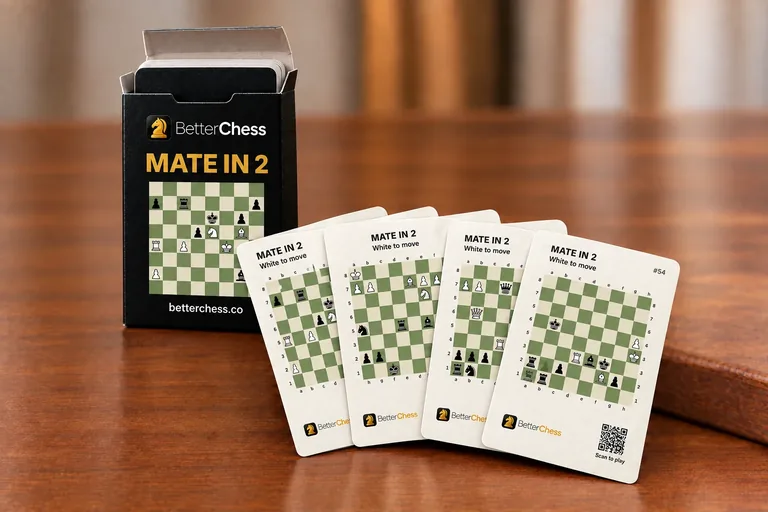
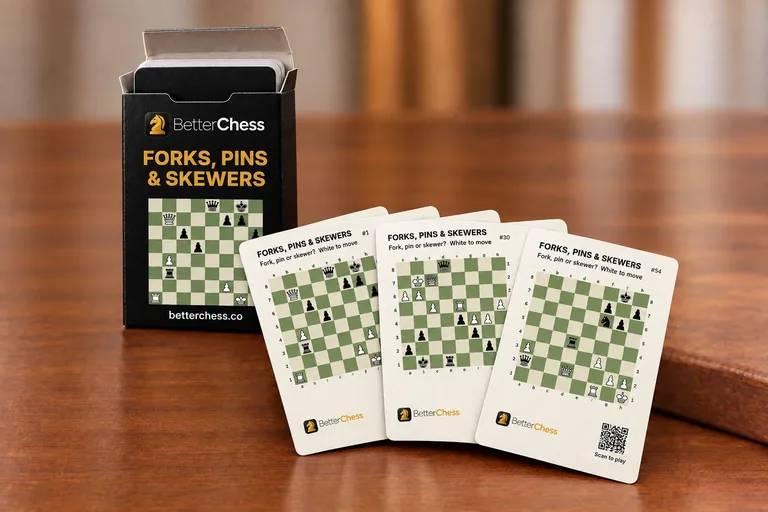
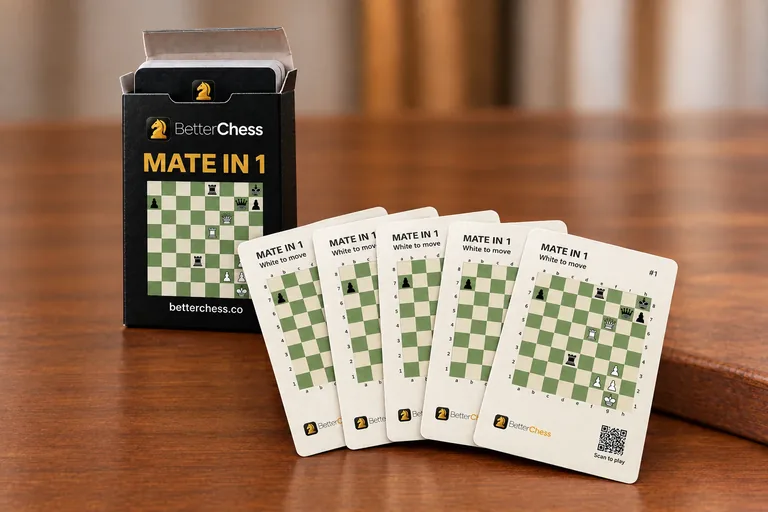
PRINTED CHESS PUZZLE CARDS
Chess puzzle playing card decks
54 poker-size cards in a tuck box. Puzzle on the front, solution on the back.