Scotch Gambit
Starting position
Engine ready — step through to see live evals.
Press ▶ Watch to play the line out, or Next to step through it — the engine evaluates every position.
The Scotch Gambit opens the centre with 3.d4 like the Scotch Game, then refuses to recapture: 4.Bc4 develops with a hit on f7 and invites Black to keep the pawn. White gets rapid development and dangerous attacking lines, and depending on Black's reply the game can steer into Italian Gambit or Two Knights waters where White is the one who knows the map. It is one of the most practical 1.e4 weapons at club level.
The idea in one line
Give the d4-pawn a moment of freedom: develop Bc4 with threats against f7, regain the pawn on your own terms, and attack before Black completes development.
Key ideas
- White delays recapturing on d4 and plays Bc4 instead: one pawn's worth of time invested in development and pressure on f7.
- Greed gets punished immediately: 4...Bc5 5.c3 dxc3? walks into 6.Bxf7+ Kxf7 7.Qd5+, forking the king and the c5-bishop.
- It is a transpositional weapon: 4...Nf6 heads into Two Knights territory and 4...Bc5 5.c3 into Italian Gambit structures, and in both White's plan is the same, fast pieces and central breaks.
- Objectively Black can equalize with accurate play, but the positions stay sharp and open, exactly the kind where the better developed side wins at club level.
Plans for each side
White: Develop with threats: Bc4 at f7, c3 to challenge the d4-pawn, e5 to kick the f6-knight, and castle early. Regain the pawn when it comes with interest, and use the open centre files while Black's king is still deciding where to live.
Black: Return the pawn for smooth development rather than defending it. Meet 5.c3 with 5...Nf6, answer 6.e5 with the counterstrike 6...d5, and aim for the balanced middlegame that theory promises, where the tempo battle is over and material is level.
Common mistakes to avoid
- As Black, 5...dxc3 is the move the gambit is fishing for: 6.Bxf7+ Kxf7 7.Qd5+ regains the piece with a big attack on top.
- As White, don't recapture on d4 by reflex; the whole point of 4.Bc4 is that the pawn can wait while you develop with threats.
- After 6.e5, retreating the f6-knight meekly instead of striking back with 6...d5 gives White exactly the attack the gambit dreams of.
The main line, explained
3. d4d4 opens the centre like the Scotch Game; the difference is what White does next.
3… exd4...exd4 accepts, as Black should; leaving the tension helps White for free.
4. Bc4Bc4 is the gambit: no recapture. White develops with a hit on f7 and lets the d4-pawn sit.
4… Bc5...Bc5 develops and guards d4. The other main road is 4...Nf6, transposing toward the Two Knights Defence.
5. c3c3 asks the d4-pawn a question. Taking it is the famous mistake; developing is the answer.
5… Nf6...Nf6 develops with a counterattack on e4, the correct, principled response.
6… d5...d5 is the standard counterstrike, hitting the c4-bishop; after 7.Bb5 Ne4 8.cxd4 both sides have active pieces and a fight on their hands.
Frequently asked
Is the Scotch Gambit sound?
Yes, in the practical sense: the pawn buys real development and attacking chances, and theory says Black must give it back to equalize. With best play the game is balanced; below master level White's initiative wins far more than its share.
What is the difference between the Scotch Game and the Scotch Gambit?
Both start 1.e4 e5 2.Nf3 Nc6 3.d4 exd4. The Scotch Game recaptures with 4.Nxd4 and plays a normal position; the Scotch Gambit plays 4.Bc4, leaving the pawn in order to develop faster and attack f7.
What should Black play against the Scotch Gambit?
Either 4...Nf6, steering into Two Knights waters, or 4...Bc5 followed by developing and returning the pawn at the right moment. What Black should not do is hoard the d4-pawn at the cost of development: 5...dxc3 walks into 6.Bxf7+.
More openings to explore
Scotch Game
King's Pawn (1.e4 e5) · C45
Learn & play ›Max Lange Attack
King's Pawn (1.e4 e5) · C55
Learn & play ›Knowing the moves of the Scotch Gambit is not the same as knowing why they work. Use Claude? BetterChess gives it a real engine, so it explains this opening from the board in front of you instead of from memory.
BetterChess is a practice tool — we make no guarantee you'll reach 1800 or any rating. The lines here are standard, well-established opening theory, and every move is checked legal with the same engine the board runs.
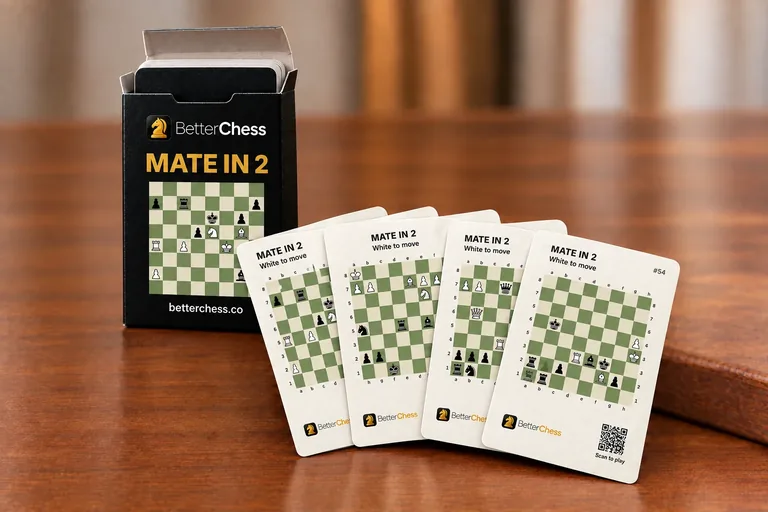
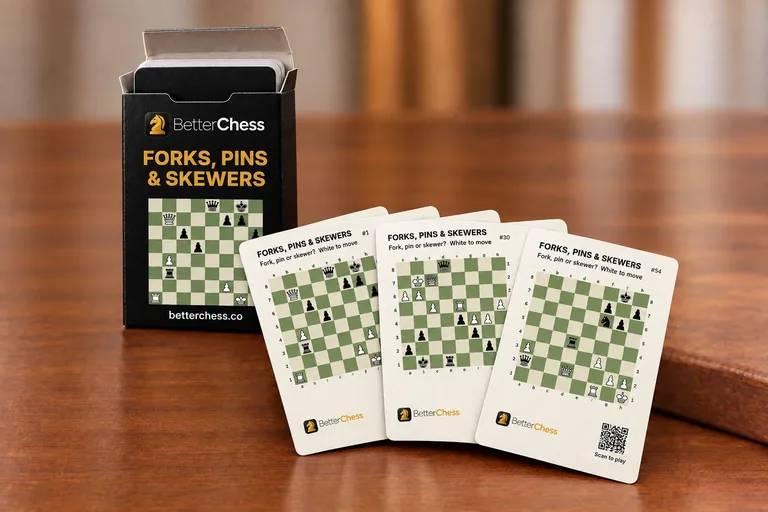
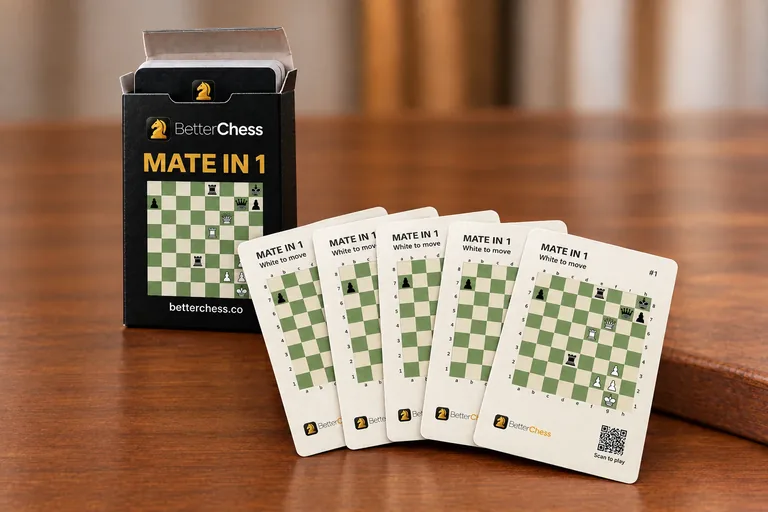
PRINTED CHESS PUZZLE CARDS
Chess puzzle playing card decks
54 poker-size cards in a tuck box. Puzzle on the front, solution on the back.