Tarrasch Defense
Starting position
Engine ready — step through to see live evals.
Press ▶ Watch to play the line out, or Next to step through it — the engine evaluates every position.
The Tarrasch Defense meets the Queen's Gambit with an immediate ...c5, accepting an isolated d-pawn in most main lines in exchange for the freest piece play any Queen's Gambit defence offers. Siegbert Tarrasch considered it Black's best reply, and Kasparov brought it to his first world championship match. It suits players who would rather have activity and a clear plan than a cramped but tidy position.
The idea in one line
Answer the Queen's Gambit with ...e6 and ...c5, accept the isolated d5-pawn, and use the open lines and easy development to press before White's structural edge can tell.
Key ideas
- ...c5 frees Black's game at once: both bishops get natural squares and there is no buried c8-bishop, the curse of the Queen's Gambit Declined.
- The isolated d5-pawn is a trade, not a blunder: it buys open lines, active pieces and the e4 outpost, and White must prove the pawn is weak before the activity tells.
- White's main try is the g3 fianchetto (the Rubinstein setup), aiming the bishop straight at d5; that is the one line every Tarrasch player must know.
- Plans are clear and repeatable: develop every piece to its natural square, castle, and play actively in the centre. That clarity is why coaches love the Tarrasch for improving players.
Plans for each side
White: Fianchetto with g3 and Bg2 to pressure d5, castle, and play against the isolated pawn: blockade the d4 square, trade minor pieces, and steer toward endgames where the pawn becomes a lasting target.
Black: Develop rapidly with ...Nc6, ...Nf6, ...Be7 and ...O-O, keep pieces on the board, and use the open lines: ...Bg4 or ...Be6, ...Re8, and a well-timed ...d4 push. The moment White relaxes, the so-called weak pawn becomes a battering ram.
Common mistakes to avoid
- Trades favour White: every pair of minor pieces off the board makes the isolated pawn more of a liability, so keep pieces on and stay active.
- Do not tie your whole army to defending d5; if you find yourself doing that, you have already lost the thread. Counterplay comes first.
- Prepare properly for the Rubinstein g3 line: against casual setups the Tarrasch equalizes easily, and the fianchetto is the one system that asks real questions.
The main line, explained
3… c5...c5, the Tarrasch move: Black frees the position immediately instead of defending a cramped centre for twenty moves.
4. cxd5cxd5 is the main test, aiming to saddle Black with an isolated d-pawn.
4… exd5...exd5 recaptures and opens the c8-bishop's diagonal: already Black's pieces breathe more freely than in a normal Queen's Gambit.
5… Nc6...Nc6 develops toward the centre and leans on d4.
6. g3g3, the Rubinstein plan and the main line: the bishop goes to g2 to work against d5 for the rest of the game.
6… Nf6...Nf6 develops and defends d5. The standard position is nearly set, with ...Be7 and ...O-O to follow.
Frequently asked
Is the Tarrasch Defense sound at club level?
Very. The isolated pawn gives White something to press against, but Black's development is the easiest of any Queen's Gambit defence and the plans are clear. For improving players, the free piece play is usually worth more than the structural concession costs.
Why accept an isolated pawn on purpose?
Because of what comes with it: open lines for both bishops, active knights and the e4 outpost. Isolated-pawn positions reward the side with the more active pieces, and in the Tarrasch that side is usually Black in the early middlegame.
Which line should I prepare for most?
The Rubinstein setup with g3 and Bg2, White's main and best try: the fianchettoed bishop presses d5 for the whole game. Against everything else, natural development gives Black a comfortable game almost automatically.
Famous games in the Tarrasch Defense
- Rubinstein's Immortal (1907): Georg Rotlewi vs Akiba Rubinstein
- Rubinstein's Positional Squeeze (1908): Akiba Rubinstein vs Georg Salwe
More openings to explore
Queen's Gambit Declined
Black vs 1.d4 · D30–D69
Learn & play ›Queen's Gambit
Queen's Pawn (1.d4) · D06–D69
Learn & play ›Knowing the moves of the Tarrasch Defense is not the same as knowing why they work. Use Claude? BetterChess gives it a real engine, so it explains this opening from the board in front of you instead of from memory.
BetterChess is a practice tool — we make no guarantee you'll reach 1800 or any rating. The lines here are standard, well-established opening theory, and every move is checked legal with the same engine the board runs.
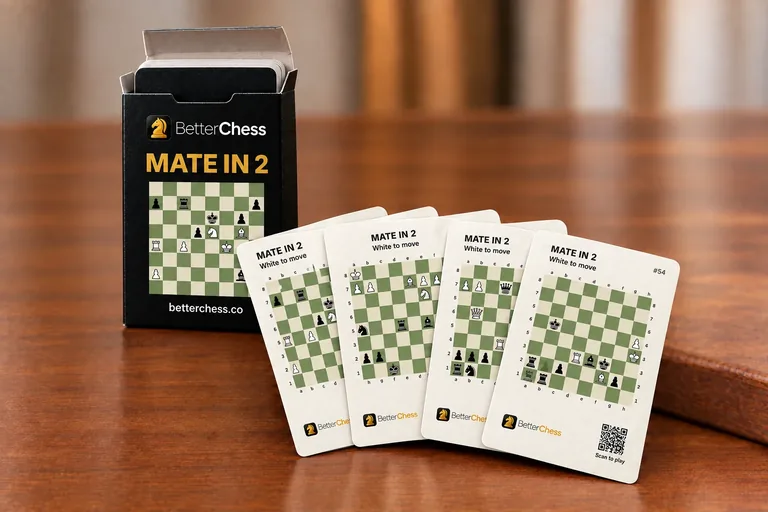
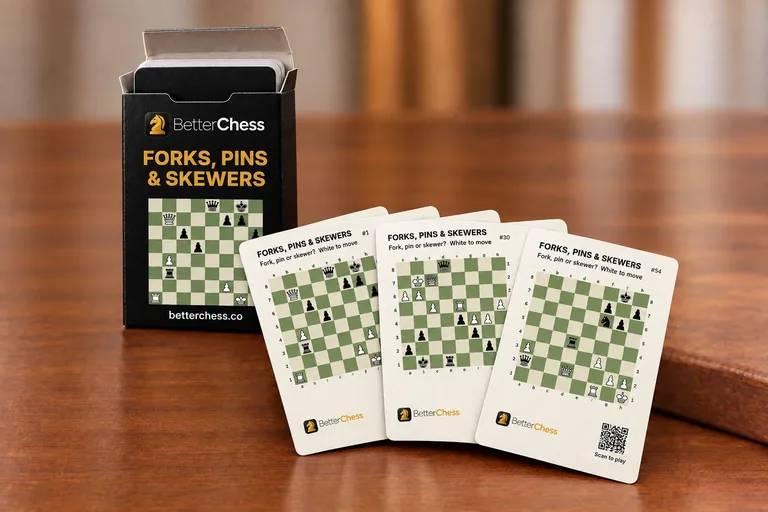
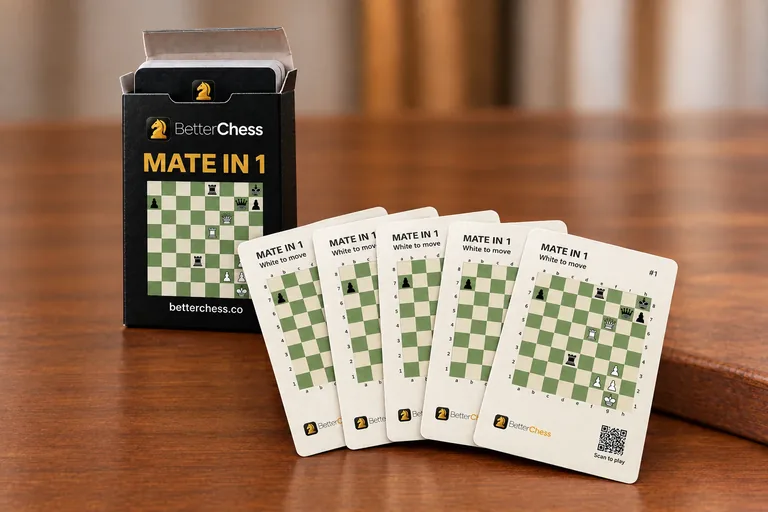
PRINTED CHESS PUZZLE CARDS
Chess puzzle playing card decks
54 poker-size cards in a tuck box. Puzzle on the front, solution on the back.