Stafford Gambit
Starting position
Engine ready — step through to see live evals.
Press ▶ Watch to play the line out, or Next to step through it — the engine evaluates every position.
The Stafford Gambit is the internet's favourite trap weapon: from a Petrov move order Black plays 3...Nc6!?, and after 4.Nxc6 dxc6 stands a clean pawn down with ferocious piece activity. Honesty first: engines consider the Stafford close to lost for Black against precise play, and it has no place in serious classical games. But its density of traps per move is unmatched, which is why it wins mountains of blitz games and why every 1.e4 player should also study how to beat it.
The idea in one line
Give a clean pawn out of the Petrov for raging piece play and the highest trap density in chess: objectively bad, practically lethal in blitz, and essential knowledge for both sides.
Key ideas
- The compensation is concrete, not positional: ...Bc5 eyes f2, and ...Ng4 with ...Qh4 tricks hang over White's position for the next ten moves.
- Almost every natural White move loses to something: that is the entire business model of the Stafford. The punishing setup must be known in advance, not found over the board.
- The antidote is a scheme, not a single move: d3 and Be2, careful handling of ...h5, and no further pawn grabs until development is finished.
- As a Black weapon it is strictly for fast time controls: when the tricks are known, Black is simply a pawn down with the looser position.
Plans for each side
White: Take the free pawn, then decline every further gift: play d3 and Be2, meet ...h5 calmly, castle only when g4 is covered, and trade pieces whenever offered fairly; each exchange takes Black one step closer to a lost endgame.
Black: Develop with maximum venom: ...Bc5 against f2, ...h5 and ...Ng4 against the king, the queen to h4 or d4 when the tactics allow; keep the position sharp and avoid trades, because without the attack there is no gambit.
Common mistakes to avoid
- For Black, honesty: if White plays the known antidote (5.d3 and 6.Be2), no amount of energy fixes the pawn deficit. Be ready to grind a worse position when the tricks run out.
- For White, the classic disaster is 5.e5??, chasing the knight: after 5...Ne4 the threats of ...Bc5 and ...Qh4 arrive far faster than White's development.
- White should not hurry to castle while ...h5 and ...Ng4 hang in the air; neutralize the kingside tricks first, then tuck the king away.
The main line, explained
3… Nc6...Nc6!? is the Stafford: instead of the correct Petrov move 3...d6, Black develops and offers a real pawn for raw activity.
4… dxc6...dxc6 is the point: the d-file opens, the c8-bishop breathes, and Black's development flows while White must start defending.
5. d3d3! is the key antidote, bolstering e4 before the ...Nxe4 tricks begin; engines already prefer White by a lot, but only this kind of care proves it.
5… Bc5...Bc5 trains everything on f2, the focal point of most Stafford tactics.
6. Be2Be2 calmly covers g4 and prepares to castle; White declines all further gifts and just finishes development.
6… h5...h5!? is the modern main try, renewing the ...Ng4 ideas at the cost of another tempo. With accurate play White consolidates and stays winning, but one natural slip can still end the game instantly.
Frequently asked
Is the Stafford Gambit sound?
No. With correct play, especially the early d3 and Be2 setup, engines assess White as close to winning. The Stafford is a trap weapon for blitz and casual games, and an honest Stafford player treats it exactly that way.
Why does it win so many games then?
Because the traps punish natural moves: pushing e5, casual development, quick castling. Unprepared opponents are in deep water by move seven, and at fast time controls preparation beats objectivity.
How do I beat the Stafford as White?
Remember one scheme: take on c6, then 5.d3 and 6.Be2, respect ...h5, and grab nothing more until you are developed. Trade pieces when you can; every exchange leaves Black a pawn down with less attack.
Traps in the Stafford Gambit
- Stafford Gambit Trap: checkmate
More openings to explore
Petrov Defense
King's Pawn (1.e4 e5) · C42-C43
Learn & play ›Latvian Gambit
King's Pawn (1.e4 e5) · C40
Learn & play ›Knowing the moves of the Stafford Gambit is not the same as knowing why they work. Use Claude? BetterChess gives it a real engine, so it explains this opening from the board in front of you instead of from memory.
BetterChess is a practice tool — we make no guarantee you'll reach 1800 or any rating. The lines here are standard, well-established opening theory, and every move is checked legal with the same engine the board runs.
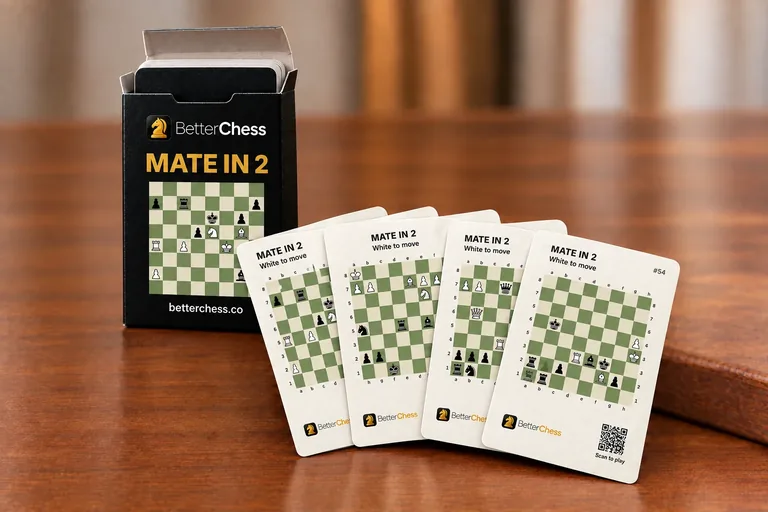
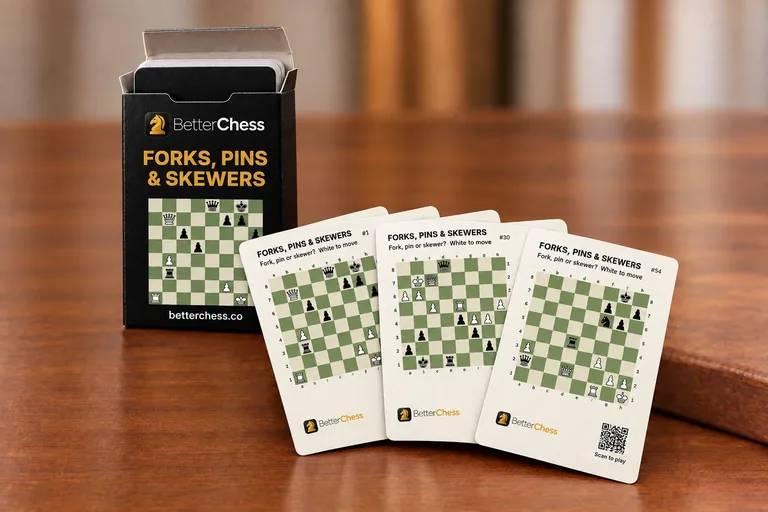
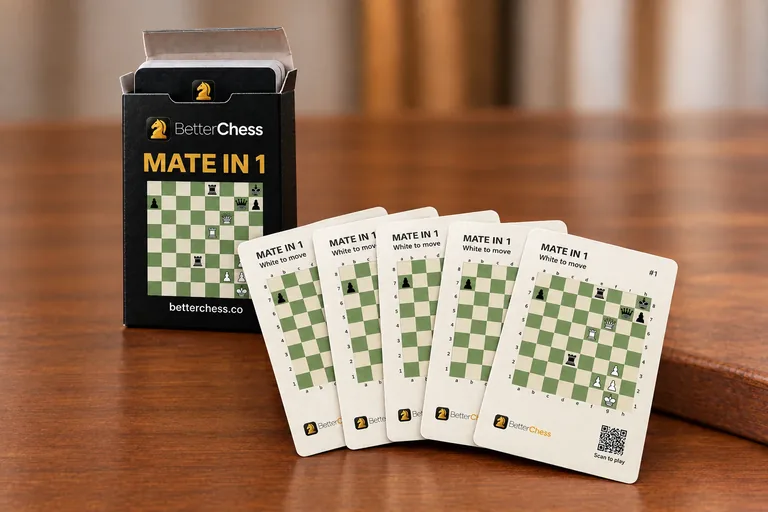
PRINTED CHESS PUZZLE CARDS
Chess puzzle playing card decks
54 poker-size cards in a tuck box. Puzzle on the front, solution on the back.