Latvian Gambit
Starting position
Engine ready — step through to see live evals.
Press ▶ Watch to play the line out, or Next to step through it — the engine evaluates every position.
The Latvian Gambit is 1.e4 e5 2.Nf3 f5, a King's Gambit with colours reversed and a move down. Honesty first: engines and modern theory rate it clearly better for White, and it has vanished from serious master play. What it offers is chaos on Black's terms: sharp, obscure positions where the prepared gambiteer knows the terrain and the opponent must find precise moves from move three. Treat it as a surprise weapon for fast games, not as a main defense.
The idea in one line
Throw the f-pawn forward on move two for a reversed King's Gambit: objectively dubious, practically dangerous, and strictly a surprise weapon for players who know its lines cold.
Key ideas
- The concept is a King's Gambit a full tempo down: Black wants open lines toward White's king and does not mind what the engine says about it.
- Material often stays level in the main line; White's edge is the safer king and the better squares. Black's practical chances live on the half-open f-file and the active queen.
- Preparation is the whole point: positions after 4...d6 and 5...fxe4 are rare and unbalanced, and at club level the player who has studied them usually wins, whatever the evaluation bar shows.
- Know the strongest replies before you play it: White's best tries involve calm consolidation rather than greed, and against precise play Black suffers. That is why this stays a blitz and rapid weapon.
Plans for each side
White: Take the pawn with 3.Nxe5, meet ...Qf6 with 4.d4, reroute the attacked knight via c4 toward e3, chip at Black's advanced e4-pawn with f3 or Ne3, develop calmly and castle; with the black kingside already loosened, a safe edge follows.
Black: Keep the initiative at any cost: post the queen on g6 against e4 and g2, develop quickly with ...Nf6 and ...Nc6, aim everything at the white king down the f-file, and steer for messy middlegames where preparation and nerve outweigh the engine's frown.
Common mistakes to avoid
- Do not confuse practical chances with soundness: after accurate play by White, Black is fighting for equality at best from move five. Use the Latvian with open eyes.
- The queen on f6 and g6 is exposed; if you lose more time with it, the whole compensation story collapses and you are just worse with a weak king.
- As White, the biggest mistakes are greed and panic: simple development plus the f3 break gives a safe, serious edge, while grabbing everything and opening lines near your own king is what Latvian players pray for.
The main line, explained
2… f5...f5?! declares the gambit: a reversed King's Gambit a tempo down. Engines disapprove; club opponents are on their own from here.
3. Nxe5Nxe5 is the strongest and most testing reply: White simply takes what is offered.
3… Qf6...Qf6 attacks the e5-knight and points the queen at the kingside; an early queen move, but the only consistent follow-up.
5. Nc4Nc4 sidesteps the attack from the d6-pawn and eyes the strong e3-square; White is happy to develop calmly.
5… fxe4...fxe4 restores material equality, but compare the kings: Black's f-pawn is gone and the e4-pawn will need constant care.
6… Qg6...Qg6 defends e4 and glares at g2; White's cleanest plan is f3 or Ne3, undermining the pawn while finishing development with the better game.
Frequently asked
Is the Latvian Gambit refuted?
Not refuted in the strict sense, but engines give White a clear, stable advantage in the main lines and it has disappeared from master play. It survives as a surprise weapon in blitz and rapid, where its rarity is worth real points.
Why would anyone play the Latvian?
Preparation asymmetry. The Latvian player has studied these strange positions; the opponent sees them once a year. At club level that gap often matters more than the objective evaluation, especially at fast time controls.
What is White's best response?
3.Nxe5 followed by calm development: after 3...Qf6 4.d4 d6 5.Nc4 fxe4, the simple 6.Nc3 hits e4 and develops. Avoid both panic and greed and White keeps a safe, serious advantage.
More openings to explore
King's Gambit
King's Pawn (1.e4 e5) · C30–C39
Learn & play ›Elephant Gambit
King's Pawn (1.e4 e5) · C40
Learn & play ›Knowing the moves of the Latvian Gambit is not the same as knowing why they work. Use Claude? BetterChess gives it a real engine, so it explains this opening from the board in front of you instead of from memory.
BetterChess is a practice tool — we make no guarantee you'll reach 1800 or any rating. The lines here are standard, well-established opening theory, and every move is checked legal with the same engine the board runs.
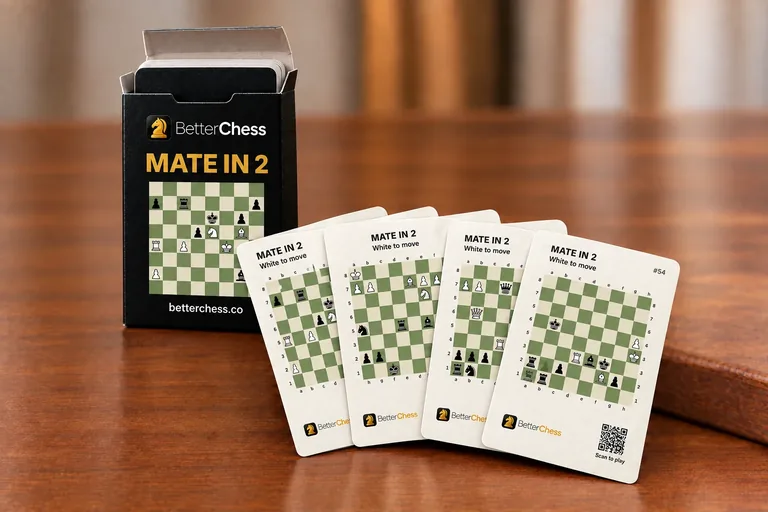
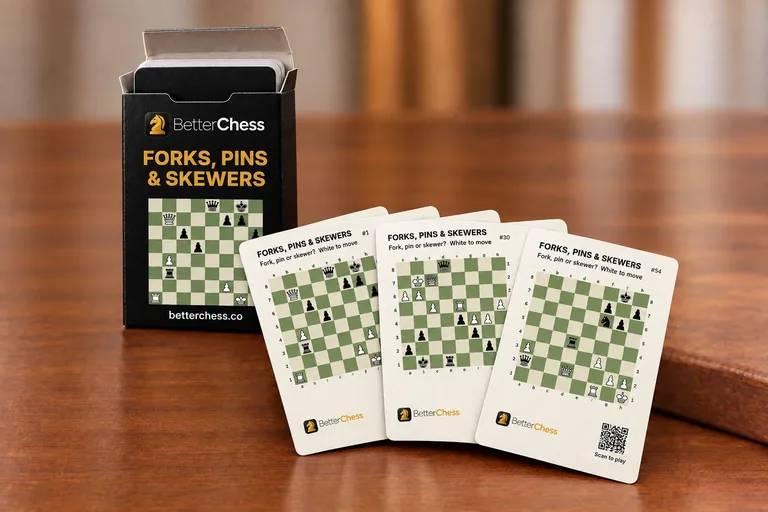
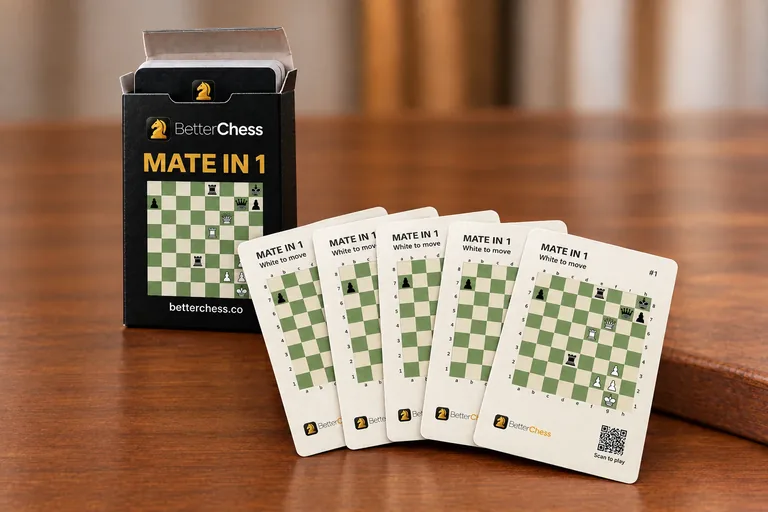
PRINTED CHESS PUZZLE CARDS
Chess puzzle playing card decks
54 poker-size cards in a tuck box. Puzzle on the front, solution on the back.