Smith-Morra Gambit
Starting position
Engine ready — step through to see live evals.
Press ▶ Watch to play the line out, or Next to step through it — the engine evaluates every position.
The Smith-Morra is White's gambit answer to the Sicilian: a pawn is offered on move three for the open c- and d-files and a big lead in development. Engines give Black roughly enough to hold with precise play, and it is rare at grandmaster level; at club level it is a different story. Every White piece gets an ideal square in one go (Nc3, Nf3, Bc4, Qe2, rooks to c1 and d1), and one imprecise Black move often decides the game.
The idea in one line
Give the c-pawn for the two open central files and rapid development: Bc4, Qe2, Rfd1 and Rac1 create constant threats against d6, f7 and the black queen before Black finishes developing.
Key ideas
- The compensation is concrete: both half-open files, a development lead of two to three moves, and a bishop already staring at f7. White's setup is nearly the same every game, which makes it easy to master.
- The rooks are the point: Rc1 pressures the c-file against Black's queen and c6-knight, Rd1 x-rays the d6-pawn and the black queen; many games end with a thematic Nd5 or Bxe6 blow.
- Black's soundest tries are the solid ...e6 and ...a6 setups or declining with 3...Nf6 (transposing to an Alapin); greedy or careless setups walk into standard tactics on d5 and e6.
- It is still a pawn: if Black survives the pressure and trades pieces, the endgame favours Black, so White must keep creating threats and avoid mass exchanges.
Plans for each side
White: Develop everything to its dream square: Nc3, Nf3, Bc4, Qe2, then Rd1 and Rc1 with O-O along the way. Pressure d6 and e6, watch for the Nd5 sacrifice and Bxe6 tricks, and strike before move twenty; the initiative is the whole investment.
Black: Return the structure to sanity: develop with ...Nc6, ...d6, ...e6, ...Nf6 and ...Be7, keep the queen off the c-file's line of fire (often ...Qc7 only when c-file tactics are covered), castle, and aim to trade pieces toward a healthy extra-pawn endgame. Declining with 3...Nf6 or 3...d3 is a respectable practical choice.
Common mistakes to avoid
- As Black, do not snack further or develop lazily: natural-looking moves like an early ...Nf6 and ...Bg4 walk into e5 breaks and Bxf7 or Nd5 tactics that are all catalogued.
- As White, do not trade pieces without gaining something: every exchange drains the initiative you paid a pawn for.
- Know the declined lines: after 3...Nf6 you are in an Alapin structure, and after 3...d3 you must be happy playing a space-edge middlegame instead of a gambit; if you only know the accepted lines you will drift.
The main line, explained
2. d4d4 immediately, offering the true gambit shape: White wants open lines, not the closed manoeuvring of other anti-Sicilians.
3. c3c3 is the Morra: White offers the pawn to open both central files and accelerate every piece.
3… dxc3...dxc3 accepts; declining with 3...Nf6 (heading for Alapin waters) or 3...d3 are the main alternatives.
4. Nxc3Nxc3 recaptures with tempo toward d5; White already threatens to finish development years ahead of Black.
5. Nf3Nf3 develops and controls e5 and d4; note White's rooks will soon own the c- and d-files.
6. Bc4Bc4 takes the classic diagonal against f7 and e6; with Qe2 and Rd1 coming, Black's centre is under permanent watch.
Frequently asked
Is the Smith-Morra Gambit sound?
Objectively Black can equalize with precise defence, which is why you rarely see it at the top. Practically it is dangerous well into master level: the attacking setup is easy for White and the defence is full of one-move traps. Fair value for a pawn at club level.
What if Black declines the Morra?
The main declines are 3...Nf6, transposing to Alapin-style positions, and 3...d3, giving the pawn back for a quiet game. Neither refutes anything; you get a normal small edge instead of a gambit, so a Morra player should know both.
How should Black set up against the Smith-Morra?
The solid recipe is ...Nc6, ...d6, ...e6, ...Nf6, ...Be7 and ...a6, castling quickly and keeping the queen safe from the c-file rook. Avoid early queenside pawn grabs and time ...Qc7 carefully; trade pieces when possible and head for the endgame a pawn up.
Traps in the Smith-Morra Gambit
- Siberian Trap: checkmate
More openings to explore
Sicilian Alapin
Sicilian Defence (1.e4 c5) · B22
Learn & play ›Danish Gambit
King's Pawn (1.e4 e5) · C21
Learn & play ›Knowing the moves of the Smith-Morra Gambit is not the same as knowing why they work. Use Claude? BetterChess gives it a real engine, so it explains this opening from the board in front of you instead of from memory.
BetterChess is a practice tool — we make no guarantee you'll reach 1800 or any rating. The lines here are standard, well-established opening theory, and every move is checked legal with the same engine the board runs.
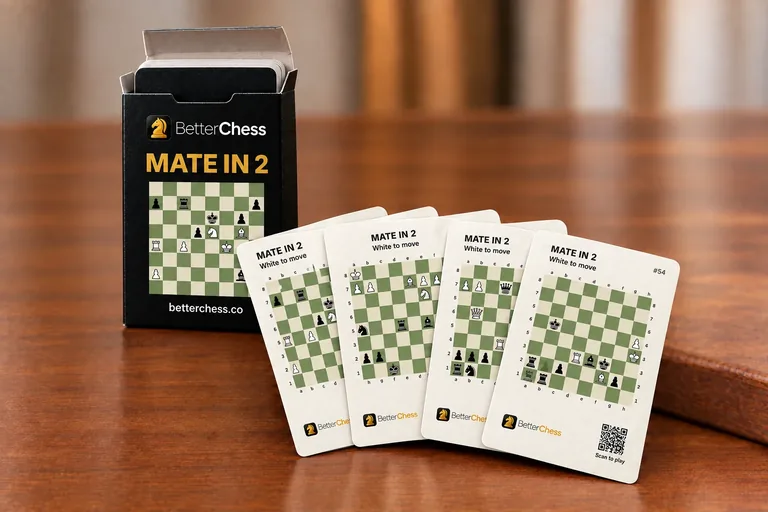
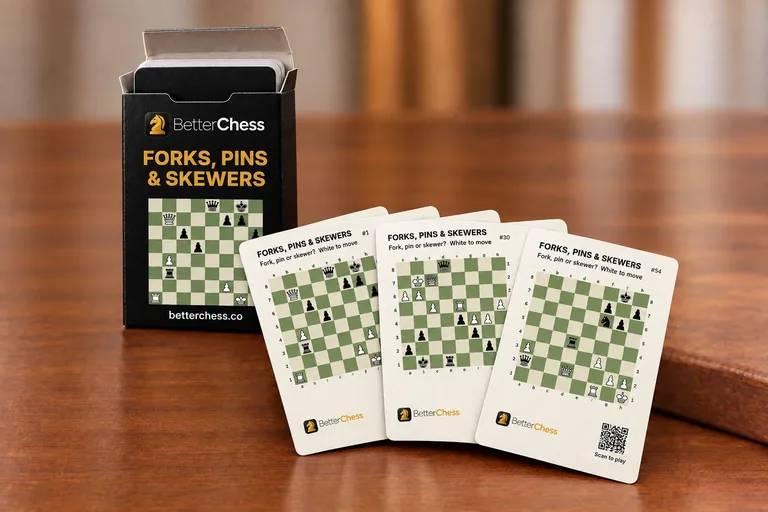
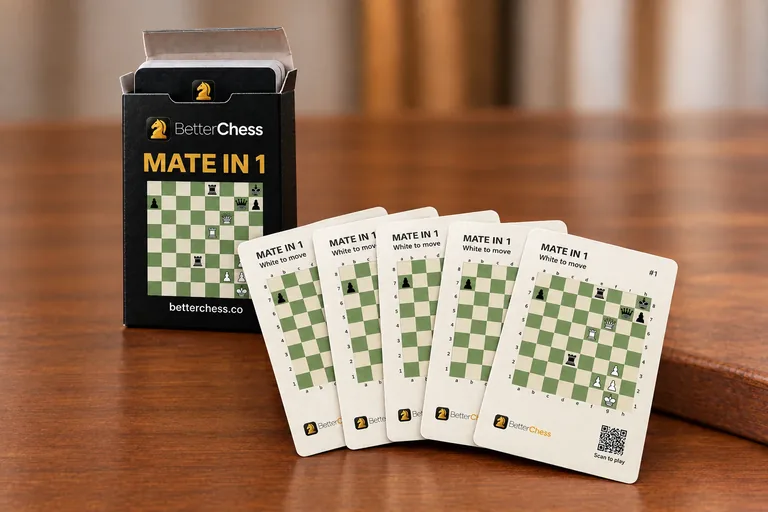
PRINTED CHESS PUZZLE CARDS
Chess puzzle playing card decks
54 poker-size cards in a tuck box. Puzzle on the front, solution on the back.