Danish Gambit
Starting position
Engine ready — step through to see live evals.
Press ▶ Watch to play the line out, or Next to step through it — the engine evaluates every position.
The Danish Gambit is 1.e4 e5 2.d4 exd4 3.c3 at full volume: White offers one pawn, often two, to plant bishops on c4 and b2 and aim every open line at Black's king. Attacking masters like Jacques Mieses terrorised opponents with it around 1900. Be clear about the fine print: modern theory and engines say Black equalizes by returning a pawn with Schlechter's ...d5, so treat the Danish as a sharp practical weapon and a masterclass in the initiative, not a lifetime main repertoire.
The idea in one line
Offer one or two pawns for the raking bishops on c4 and b2, then attack down the open lines before Black can develop; know that ...d5 is the honest equalizer.
Key ideas
- The point is the bishop pair on b2 and c4: together they rake both long diagonals straight into Black's kingside.
- White's lead in development is enormous in the accepted lines: by move five White has both bishops out and open files everywhere, while Black owns two extra pawns and nothing else moving.
- The honest engine verdict: Schlechter's 5...d5 gives a pawn back on the spot, blunts both bishops, and equalizes. The Danish thrives against everyone who does not know that move.
- It is the purest initiative-training opening there is: every White move must create a threat, because the material clock is always ticking against you.
Plans for each side
White: Develop with maximum violence: both bishops to b2 and c4, knights out fast, castle short, queen to b3 hitting b7 and f7. Every move a threat; the moment the attack stalls, the extra pawns start winning for Black.
Black: Take one pawn, or two, then give one straight back with Schlechter's 5...d5: it opens your own lines, trades into a calmer position and neutralizes both bishops. Grabbing material and hiding is exactly what the Danish is built to punish.
Common mistakes to avoid
- As White, cashing out early is fatal: trade queens or stop to regain a pawn and you are simply worse. The bishops and the initiative are the whole investment.
- As Black, 5...d5 is the move to remember; natural developing moves that ignore the two diagonals walk straight into the attack.
- As White, if two pawns feels like one too many, 4.Nxc3 is the saner one-pawn version of the same idea; know both before you wheel it out.
The main line, explained
2. d4d4 opens the centre on move two, sharing a start with the Center Game; White's next move shows the difference.
3. c3c3 is the Danish Gambit: White invites ...dxc3, giving up a pawn (and soon a second) for open lines and speed.
3… dxc3...dxc3 accepts. The calm decline 3...d5 is fine too, but taking is the critical test.
4… cxb2...cxb2 grabs pawn number two; theoretically fine, but every capture is a tempo spent not developing.
5. Bxb2Bxb2 completes the tableau: two pawns gone, two monster bishops raking the board, and every White piece about to develop with threats.
5… d5...d5 is Schlechter's cold shower: Black returns a pawn immediately to open lines of their own and blunt the bishops. After 6.Bxd5 Nf6 theory promises Black full equality.
Frequently asked
Is the Danish Gambit refuted?
Refuted is too strong, but engines are unimpressed: Schlechter's 5...d5, returning one pawn to blunt the bishops, equalizes comfortably. In practice most club players have never seen that move, and the Danish keeps scoring devastating miniatures.
What is the difference between the Danish Gambit and the Center Game?
Both begin 1.e4 e5 2.d4 exd4. The Center Game recaptures with 3.Qxd4 and keeps material level; the Danish plays 3.c3, offering one or two pawns for development and open diagonals.
How many pawns does White sacrifice in the Danish Gambit?
Up to two. After 3.c3 dxc3 4.Bc4 cxb2 5.Bxb2 White is two pawns down with both bishops aimed at the kingside. White can also settle for one pawn with 4.Nxc3, a calmer version of the same attack.
More openings to explore
Center Game
King's Pawn (1.e4 e5) · C22
Learn & play ›King's Gambit
King's Pawn (1.e4 e5) · C30–C39
Learn & play ›Knowing the moves of the Danish Gambit is not the same as knowing why they work. Use Claude? BetterChess gives it a real engine, so it explains this opening from the board in front of you instead of from memory.
BetterChess is a practice tool — we make no guarantee you'll reach 1800 or any rating. The lines here are standard, well-established opening theory, and every move is checked legal with the same engine the board runs.
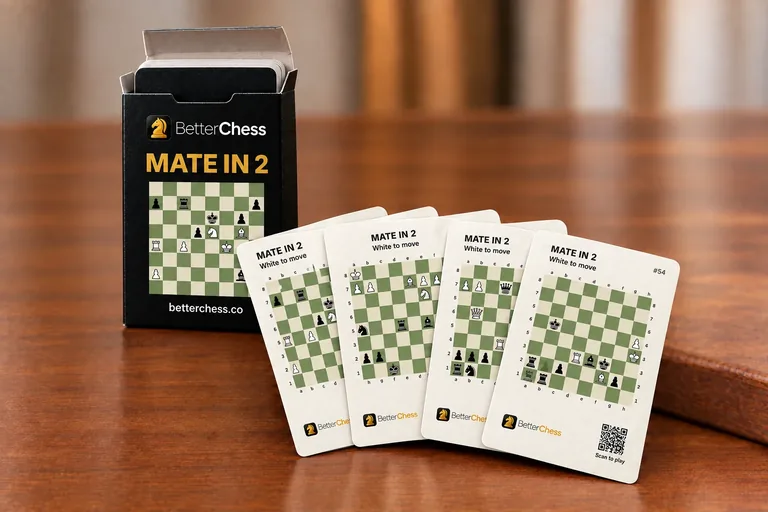
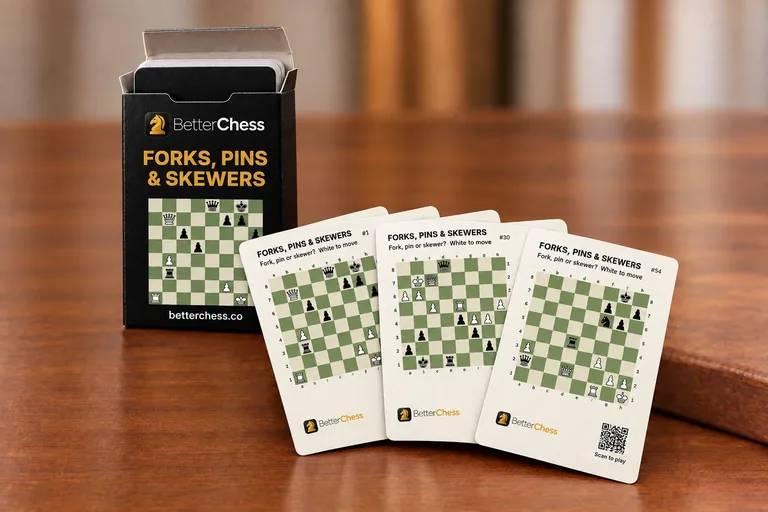
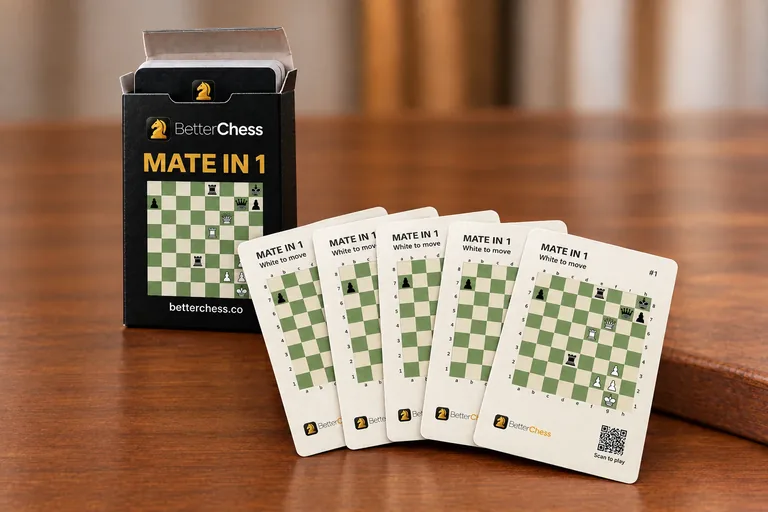
PRINTED CHESS PUZZLE CARDS
Chess puzzle playing card decks
54 poker-size cards in a tuck box. Puzzle on the front, solution on the back.