Sicilian Taimanov
Starting position
Engine ready — step through to see live evals.
Press ▶ Watch to play the line out, or Next to step through it — the engine evaluates every position.
The Taimanov is the piece-play Sicilian: Black combines ...e6 with a quick ...Nc6, pressuring d4 immediately while keeping the kingside flexible. Named after Mark Taimanov, it is a modern favourite at every level because the queen comes to c7, the pawns stay healthy, and Black can steer the game toward a Scheveningen, a hedgehog, or direct queenside play. It is sound, rich, and much lighter on forced theory than the Najdorf.
The idea in one line
Develop ...Nc6 and ...Qc7 early, add ...a6 to shut White's pieces out of b5, and keep the f8-bishop flexible: Black chooses between ...Bb4 ideas, ...d6 setups, and a quick ...b5.
Key ideas
- 4...Nc6 puts a piece on d4's case at once: White must constantly reckon with exchanges and with ...Nxd4 followed by dark-square play.
- ...Qc7 is the signature move: the queen sits on the half-open c-file, covers e5, supports ...b5, and keeps an eye on h2 for later.
- ...a6 pairs with ...Qc7: it stops Nb5 hitting the queen and prepares the thematic ...b5 expansion.
- The f8-bishop stays uncommitted: depending on White's setup it goes to b4 with pressure on c3 and e4, or to e7 and d6 in Scheveningen style.
Plans for each side
White: The modern main test is 6.Be3 with Qd2 or Qf3 and long castling, the English Attack treatment: f3, g4 and a pawn storm at Black's king. Quieter players choose 6.Be2 or 6.g3 and settle for a small space edge and play against d6 and b6.
Black: Finish the queenside scheme (...Qc7, ...a6, often ...b5 and ...Bb7), then decide on the kingside: ...Nf6 with ...Bb4 pressure, or ...d6 and ...Be7 for a solid Scheveningen shell. Against long castling, race with ...b5-b4 and open the c-file before White's storm arrives.
Common mistakes to avoid
- ...Qc7 without ...a6 invites Nb5 hitting the queen; play the two moves as a pair and watch White's knight jumps every move.
- Do not pawn-grab on the queenside while your king still sits in the centre: Taimanov positions punish greed with open central files.
- Against the English Attack, castling short into a ready-made g4-g5 storm without starting ...b5 counterplay first is asking to be mated: in this line the queenside race is your defence.
The main line, explained
2… e6...e6 opens the bishop and announces a Paulsen-family Sicilian: flexible structure first.
4… Nc6...Nc6, the Taimanov move: immediate piece pressure on d4 instead of the Kan's quieter ...a6.
5. Nc3Nc3 defends e4 and develops; the main tabiya is now a move away.
5… Qc7...Qc7 takes the queen to its ideal Sicilian square: c-file pressure, control of e5, support for ...b5.
6. Be3Be3 signals White's most ambitious plan, the English Attack with Qd2 or Qf3 and O-O-O.
6… a6...a6 completes the scheme: b5 is denied to White's knights and the ...b5 break is ready.
Frequently asked
Is the Sicilian Taimanov sound?
Completely. It is a respected main-line Sicilian played regularly at elite level. Black's structure stays healthy and the piece activity is real, which is why it has never been close to a refutation.
Taimanov or Najdorf: which should I learn?
The Najdorf carries far more forced theory. The Taimanov gives similar counterattacking chances from a scheme you can understand: ...Nc6, ...Qc7, ...a6, then choose your setup. For most club players that is the better deal.
What is White's most dangerous plan?
The English Attack setup with Be3, Qd2 or Qf3, long castling and a kingside pawn storm. Black must know the antidote: rapid ...b5-b4 play and pressure down the c-file rather than passive defence.
More openings to explore
Sicilian Kan
Sicilian Defence (1.e4 c5) · B41-B43
Learn & play ›Sicilian Defense
Black vs 1.e4 · B20–B99
Learn & play ›Knowing the moves of the Sicilian Taimanov is not the same as knowing why they work. Use Claude? BetterChess gives it a real engine, so it explains this opening from the board in front of you instead of from memory.
BetterChess is a practice tool — we make no guarantee you'll reach 1800 or any rating. The lines here are standard, well-established opening theory, and every move is checked legal with the same engine the board runs.
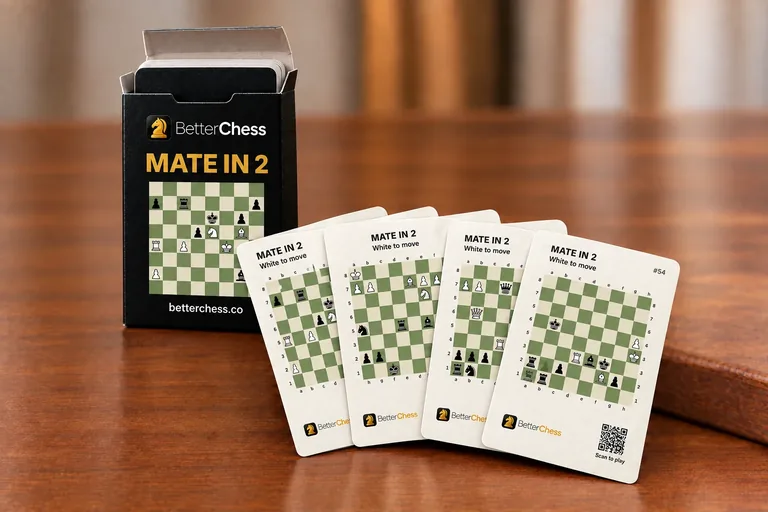
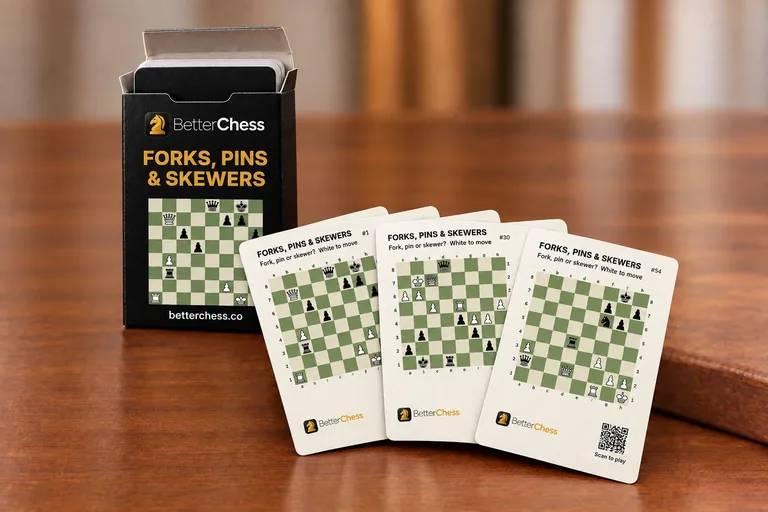
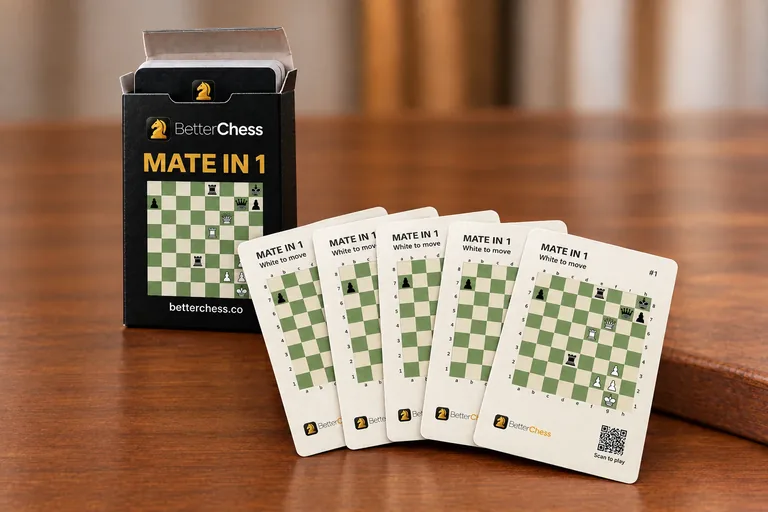
PRINTED CHESS PUZZLE CARDS
Chess puzzle playing card decks
54 poker-size cards in a tuck box. Puzzle on the front, solution on the back.