Sicilian Najdorf
Starting position
Engine ready — step through to see live evals.
Press ▶ Watch to play the line out, or Next to step through it — the engine evaluates every position.
The Najdorf is the most respected fighting defence in chess: Fischer and Kasparov built careers on it. After the Open Sicilian moves, Black plays the quiet-looking 5...a6, taking b5 away from White's pieces and keeping every plan available: ...e5, ...e6, ...b5 with queenside play. It is sharp and theory-heavy at the top, but the core ideas are learnable, and at club level understanding those ideas beats memorizing twenty moves.
The idea in one line
Trade the c-pawn for White's d-pawn, control b5 with 5...a6, then counterattack: ...e5 to stake the centre, ...b5 and ...Bb7 for queenside pressure, and use the half-open c-file all game.
Key ideas
- 5...a6 is prophylaxis: it stops Nb5 and Bb5+ ideas, so Black can play ...e5 or ...e6 next without tactical problems, and prepares ...b5 gaining space.
- The half-open c-file is Black's inheritance from the cxd4 trade; a rook or queen lands on c8 and pressures c2 and c3 for the rest of the game.
- ...e5 (after 6.Be3 or 6.Be2) kicks the d4-knight and grabs central space; the cost is a backward d6-pawn and a hole on d5, which Black covers with pieces.
- The middlegame is often a race: White attacks the king (f3, g4, Qd2, O-O-O in the English Attack), Black storms the queenside with ...b5-b4. Tempo counts more than material.
Plans for each side
White: Choose a system against the Najdorf wall: the English Attack with Be3, f3, Qd2 and opposite-side castling for a pawn-storm race, the classical Be2 with calm development, or the sharp 6.Bg5. In every case fight for the d5-square and attack before Black's queenside play arrives.
Black: Play ...e5 to claim the centre (or ...e6 in Scheveningen style), develop with ...Be7, ...Be6 and ...Nbd7, castle short, then push ...b5 and ...b4 to open the queenside. Keep a piece covering d5 and use the c-file for counterplay.
Common mistakes to avoid
- Do not play ...e5 when White can occupy d5 favourably or before a6 has removed the Nb5 tricks; move order in the Najdorf is not decoration.
- The d6-pawn is the structural bill for ...e5: leave it defended (...Be7, a rook on d8) or White's pressure down the d-file wins it.
- Castling short into a ready-made g4-g5 storm without starting your own ...b5 counterplay loses the race; in opposite-side castling positions, speed is safety.
The main line, explained
1… c5...c5 fights for d4 from the side. Black avoids symmetry and plays for a win from move one.
3… cxd4...cxd4 is the trade that defines the Open Sicilian: Black gives a wing pawn for a centre pawn and gets the half-open c-file.
4… Nf6...Nf6 develops with tempo against e4, forcing Nc3 and fixing White's setup slightly.
5… a6...a6 is the Najdorf move: it takes b5 from White's knight and bishop and prepares ...e5 and ...b5.
6. Be3Be3 heads for the English Attack with f3, Qd2 and long castling, the most popular modern try.
6… e5...e5 hits the d4-knight and stakes out the centre; Black accepts the d5 hole and covers it with pieces.
Frequently asked
Is the Najdorf too theoretical for club players?
The full theory is huge, but you do not need it. Learn the first eight moves, the point of 5...a6, and the three plans (...e5, ...b5, c-file pressure) and you will outplay most club opponents who only know the moves.
What is the point of 5...a6?
It controls b5. White's knights and light-squared bishop lose their best invasion square, so Black can follow with ...e5 or ...e6 without getting hit by Nb5 or Bb5+ tricks. It also prepares ...b5 to gain queenside space.
Najdorf or Dragon: which Sicilian should I learn?
The Dragon gives you one clear plan (fianchetto and attack the c-file) but faces the ferocious Yugoslav Attack. The Najdorf is more flexible and more respected at every level, at the cost of a little more move-order care. Try both against the engine and keep the one whose middlegames you enjoy.
More openings to explore
Sicilian Defense
Black vs 1.e4 · B20–B99
Learn & play ›Sicilian Dragon
Sicilian Defence (1.e4 c5) · B70-B79
Learn & play ›Knowing the moves of the Sicilian Najdorf is not the same as knowing why they work. Use Claude? BetterChess gives it a real engine, so it explains this opening from the board in front of you instead of from memory.
BetterChess is a practice tool — we make no guarantee you'll reach 1800 or any rating. The lines here are standard, well-established opening theory, and every move is checked legal with the same engine the board runs.
PRINTED CHESS PUZZLE CARDS
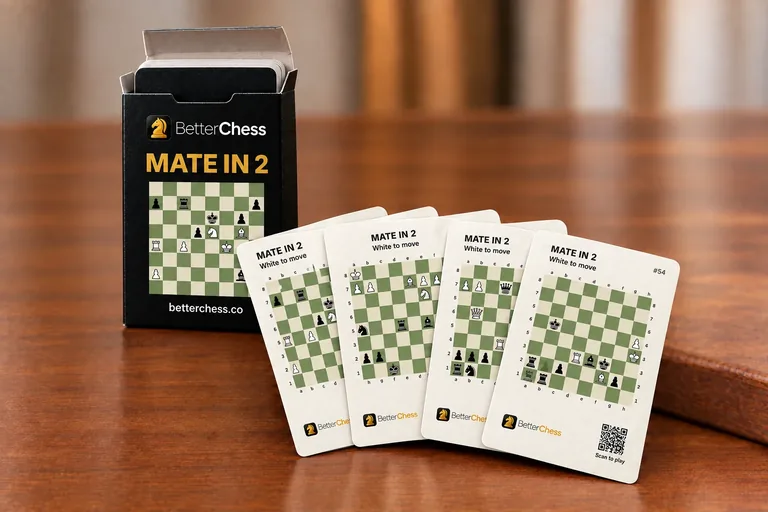
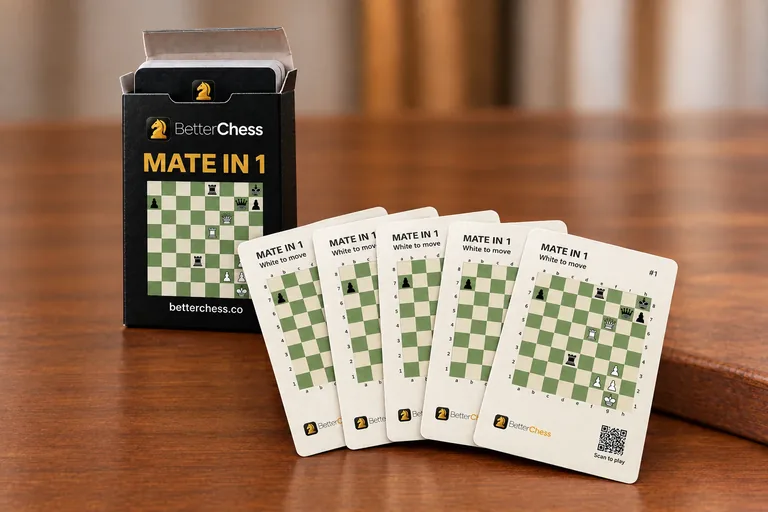
Chess puzzle playing card decks
54 poker-size cards in a tuck box. Puzzle on the front, solution on the back.