Sicilian Dragon
Starting position
Engine ready — step through to see live evals.
Press ▶ Watch to play the line out, or Next to step through it — the engine evaluates every position.
The Dragon is the Sicilian at its most direct: Black fianchettoes the king's bishop on g7 and points it down the long diagonal at White's queenside. Every Black piece knows its job, which makes the opening wonderfully easy to plan with. The catch is the Yugoslav Attack, where White castles long and throws the h-pawn at Black's king; both sides attack at full speed and one tempo often decides.
The idea in one line
Fianchetto with ...g6 and ...Bg7, castle short, then attack down the half-open c-file with ...Rc8 and a rook or exchange sacrifice on c3 while the dragon bishop rakes the long diagonal.
Key ideas
- The g7-bishop is the soul of the opening: it defends the king and attacks b2 and c3 at the same time. Trading it off is almost always a concession.
- Black's attack runs down the c-file: ...Rc8, ...Ne5-c4 or ...Qa5, and the thematic exchange sacrifice ...Rxc3 to wreck White's pawns and expose the long diagonal.
- In the Yugoslav Attack (Be3, f3, Qd2, O-O-O, h4) both kings are targets; Black meets h4-h5 with ...h5 or races on with ...b5 and ...Rxc3.
- If White castles short instead, the position calms down and the Dragon bishop plus c-file pressure give Black comfortable, easy-to-play equality.
Plans for each side
White: The critical test is the Yugoslav Attack: Be3, f3, Qd2, Bc4 or O-O-O, then h4-h5 to open the h-file and trade the dark-squared bishops with Bh6. Slower plans with Be2 and short castling are solid but let Black equalize comfortably.
Black: Develop ...Bg7, ...O-O, ...Nc6 and ...Bd7, put a rook on c8, and generate queenside play with ...Ne5-c4, ...Qa5 and ...b5. Against the Yugoslav, counterattack immediately; the exchange sacrifice on c3 is a standard weapon, not a desperation move.
Common mistakes to avoid
- Never drift in the Yugoslav race: if you answer h4-h5 and Bh6 with quiet developing moves, you get mated down the h-file on schedule.
- Do not allow Bh6 to trade the g7-bishop cheaply; without the dragon bishop the black king is suddenly the weakest piece on the board.
- The ...Rxc3 sacrifice needs follow-up (queenside pawns rolling, pressure on the long diagonal); played without those, it is just a lost exchange.
The main line, explained
3… cxd4...cxd4 opens the c-file, the highway for Black's future rooks.
4… Nf6...Nf6 develops with a hit on e4 before the fianchetto starts.
5… g6...g6 is the Dragon move: Black will put the bishop on g7 where it defends the king and attacks the queenside in one gesture.
6. Be3Be3 signals the Yugoslav Attack setup with f3 and Qd2 to follow, the sternest test of the Dragon.
6… Bg7...Bg7 completes the fianchetto; the bishop eyes d4, c3 and b2 for the rest of the game.
Frequently asked
Is the Sicilian Dragon refuted?
No. The Yugoslav Attack is dangerous and Black must know the defensive setup, but with accurate play the Dragon is sound; it still appears in strong grandmaster practice. At club level the attacking chances run both ways.
Why is it called the Dragon?
The name is usually credited to the pawn structure d6-e7-f7-g6-h7 resembling the constellation Draco, coined by the Russian master Fyodor Duz-Khotimirsky. The fire-breathing g7-bishop makes the name feel right either way.
What is the difference between the Dragon and the Accelerated Dragon?
Move order. The Accelerated Dragon plays ...g6 before ...d6, hoping to achieve ...d5 in one move and dodge the Yugoslav Attack. The price is allowing the Maroczy Bind with c4. The classical Dragon commits to ...d6 first and meets the Yugoslav head-on.
More openings to explore
Sicilian Najdorf
Sicilian Defence (1.e4 c5) · B90-B99
Learn & play ›Accelerated Dragon
Sicilian Defence (1.e4 c5) · B34-B39
Learn & play ›Knowing the moves of the Sicilian Dragon is not the same as knowing why they work. Use Claude? BetterChess gives it a real engine, so it explains this opening from the board in front of you instead of from memory.
BetterChess is a practice tool — we make no guarantee you'll reach 1800 or any rating. The lines here are standard, well-established opening theory, and every move is checked legal with the same engine the board runs.
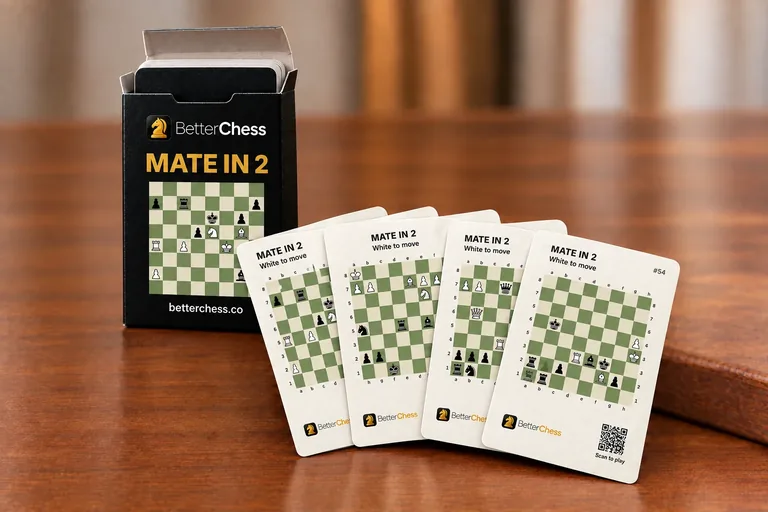
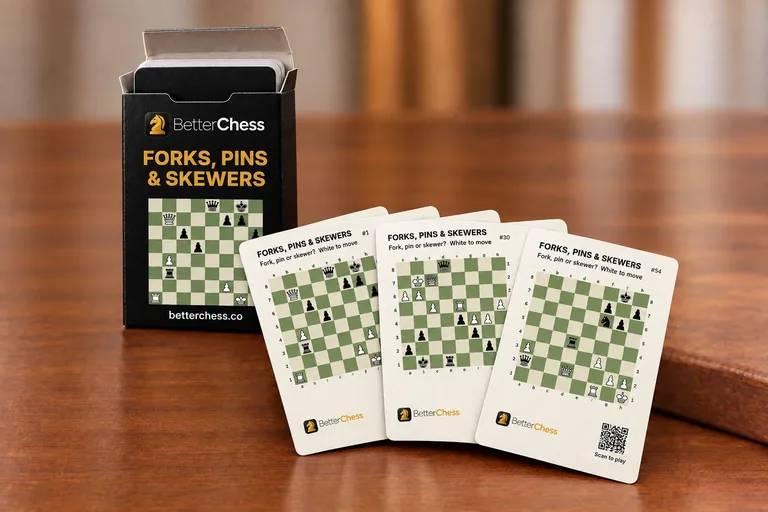
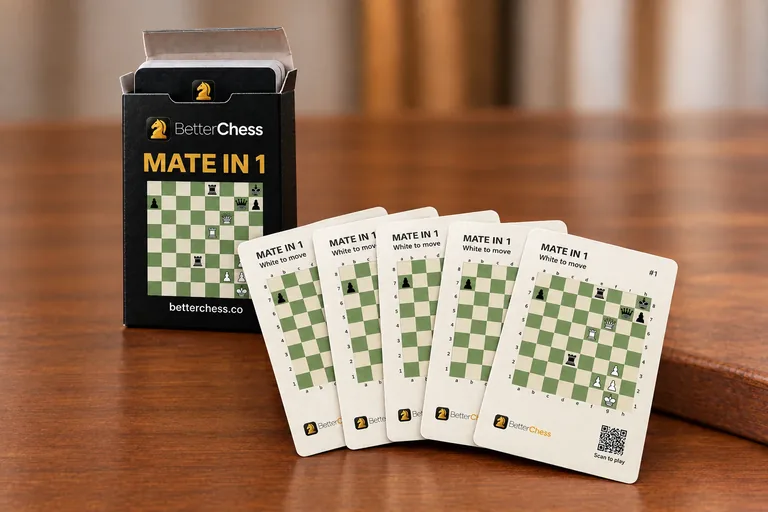
PRINTED CHESS PUZZLE CARDS
Chess puzzle playing card decks
54 poker-size cards in a tuck box. Puzzle on the front, solution on the back.