Accelerated Dragon
Starting position
Engine ready — step through to see live evals.
Press ▶ Watch to play the line out, or Next to step through it — the engine evaluates every position.
The Accelerated Dragon is the Dragon with better manners: Black fianchettoes immediately, skipping ...d6, and hopes to free the game with ...d5 in a single move. That move order sidesteps the Yugoslav Attack entirely, because f3 and Qd2 setups lose their sting when Black has not spent a tempo on ...d6. White's most testing reply is not an attack but a squeeze: the Maroczy Bind with c4, clamping down on d5 and betting that space beats activity.
The idea in one line
Fianchetto at once with 4...g6, keep ...d6 in reserve, and strike with ...d5 in one move when possible; against the Maroczy Bind, trade pieces patiently and hit the clamp with ...b5 or ...f5 breaks.
Key ideas
- Skipping ...d6 saves a whole tempo if Black achieves ...d5; in many lines that break equalizes on the spot.
- The Yugoslav Attack does not work here: White's Qd2 and Bh6 plans run into ...Nxd4 tricks and a quick ...Qa5, so the Dragon's scariest enemy never shows up.
- The Maroczy Bind (an early c4) is the real test: White takes d5 and b5 away and plays for a long squeeze; Black counters by trading minor pieces and preparing ...b5 or ...f5.
- Watch the tactical difference from the classical Dragon: with the knight already on c6, Nxc6 followed by e5 hitting a knight on f6 is a recurring White resource Black must respect.
Plans for each side
White: Either clamp with the Maroczy Bind (c4 before Nc3 fixes the structure, then Be2, O-O and patient space play) or develop classically with Nc3 and Be3, meet ...d5 breaks with accurate timing, and use the extra central influence for a small, safe edge.
Black: Complete the fianchetto and castle, then time the ...d5 break; if White forbids it with the Bind, manoeuvre with ...Nxd4 and ...Bd7-c6 style trades, keep the position compact, and strike at the clamp with ...b5 (after ...a6) or ...f5 at the right moment.
Common mistakes to avoid
- Do not sleepwalk into a bad Dragon: if you play an early ...d6 anyway, you have simply lost the move-order point and invited the Yugoslav after all.
- In the Bind, avoid random pawn moves; your position has less space, so every trade helps you and every loosening pawn push helps White.
- Beware the e5 fork trick: after Nxc6 bxc6, e5 can hit a knight on f6 and win material if you were not watching the centre.
The main line, explained
2… Nc6...Nc6 first: Black develops and keeps the d-pawn at home, the point of the accelerated move order.
4… g6...g6 immediately, without ...d6. Black wants ...Bg7 and a possible ...d5 in one move rather than two.
5. Nc3Nc3 is the main classical choice; 5.c4 instead would announce the Maroczy Bind, the other main branch.
5… Bg7...Bg7 puts the dragon bishop on its diagonal; note Black still has not touched the d-pawn.
6. Be3Be3 develops and guards d4; White keeps options of Qd2 or c4-style plans depending on Black's setup.
6… Nf6...Nf6 completes natural development and pressures e4; ...O-O and the ...d5 break are next on the list.
Frequently asked
What is the point of the Accelerated Dragon over the normal Dragon?
One tempo. By delaying ...d6, Black keeps the option of playing ...d5 in a single move, which often equalizes instantly, and defuses the Yugoslav Attack because White's f3-Qd2 setup has no bite without the extra tempo.
Is the Maroczy Bind winning for White?
No, it is a squeeze, not a refutation. Black trades a pair of minor pieces, stays patient, and breaks with ...b5 or ...f5. Plenty of grandmasters happily defend the Bind; it is a matter of taste whether you enjoy that kind of game.
Can White force the Accelerated Dragon into the classical Dragon?
Only if Black cooperates by playing ...d6 early. With accurate move order Black either gets ...d5 in one go or a Maroczy structure, both different games from the classical Dragon.
Traps in the Accelerated Dragon
- Fischer Trap: wins the queen
More openings to explore
Sicilian Dragon
Sicilian Defence (1.e4 c5) · B70-B79
Learn & play ›Sicilian Defense
Black vs 1.e4 · B20–B99
Learn & play ›Knowing the moves of the Accelerated Dragon is not the same as knowing why they work. Use Claude? BetterChess gives it a real engine, so it explains this opening from the board in front of you instead of from memory.
BetterChess is a practice tool — we make no guarantee you'll reach 1800 or any rating. The lines here are standard, well-established opening theory, and every move is checked legal with the same engine the board runs.
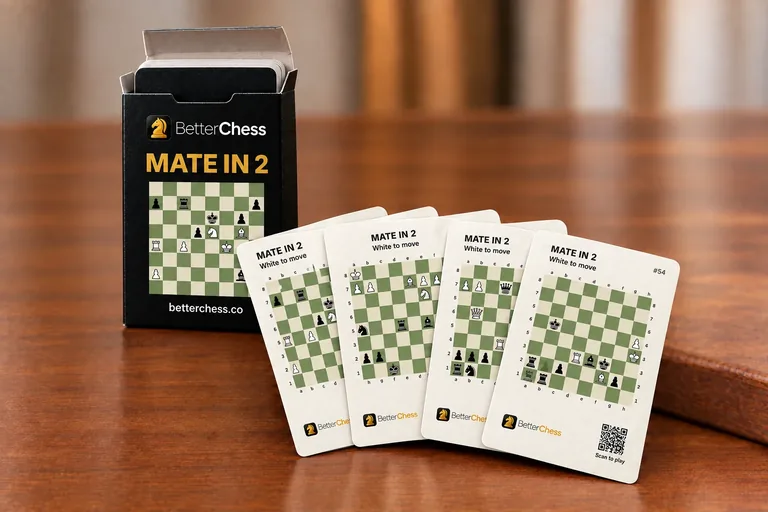
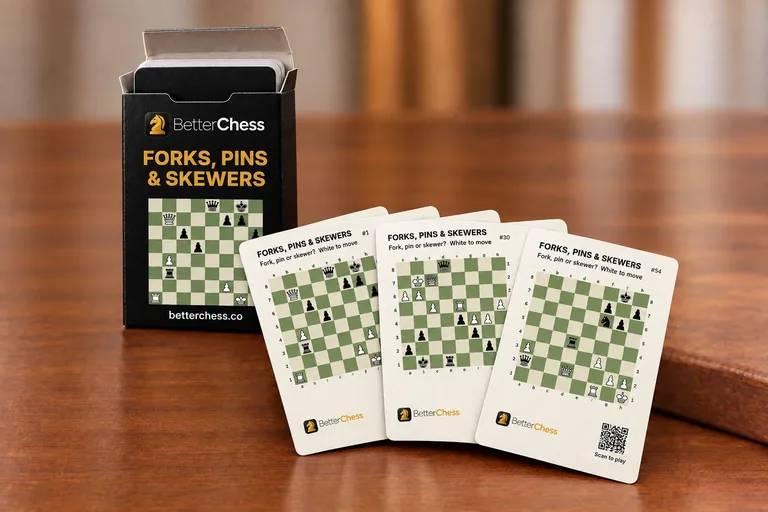
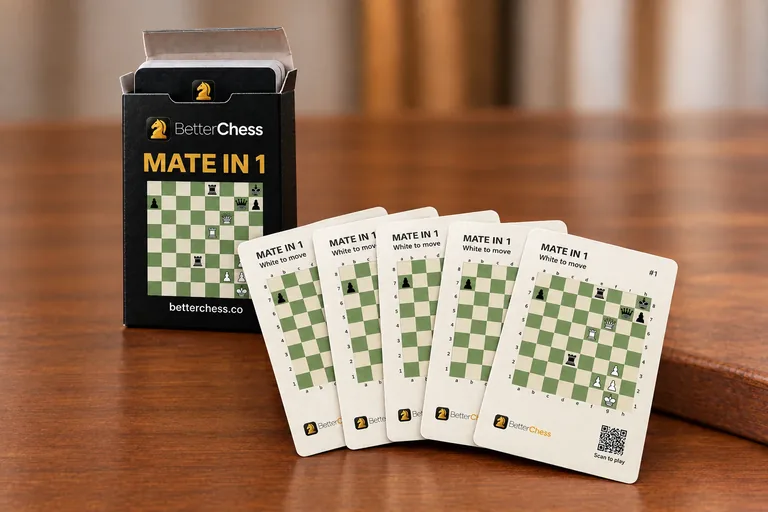
PRINTED CHESS PUZZLE CARDS
Chess puzzle playing card decks
54 poker-size cards in a tuck box. Puzzle on the front, solution on the back.