Max Lange Attack
Starting position
Engine ready — step through to see live evals.
Press ▶ Watch to play the line out, or Next to step through it — the engine evaluates every position.
The Max Lange Attack is one of the sharpest openings in chess: White meets the Two Knights setup with d4 and e5, rips open the e-file with Re1+, and drags Black's king into a forcing storm that has been analysed since the 1850s. Named after the German master Max Lange, it rewards the player who knows the sequence and punishes the one improvising. If you enjoy learning one forcing line really well and cashing it in for years, this is the one.
The idea in one line
Open the centre with d4, castle, and after ...Bc5 hit back with e5, exf6 and Re1+, dragging Black's king into a long forcing sequence that White knows better.
Key ideas
- The whole opening is one idea executed with force: open the e-file while Black's king is still on e8, then develop with checks and threats.
- 5.O-O first, attack second: the rook must reach e1 for the combination to work, so White banks the king before lighting the fuse.
- After 6.e5 d5 7.exf6 dxc4 8.Re1+ Be6 9.Ng5 material is level but the position is on fire: fxg7 hangs over the h8-rook and Black must find precise only-moves just to reach a middlegame.
- Honest theory: with a series of accurate only-moves Black holds the balance, but one slip in the first ten moves usually loses on the spot, and the burden of memory falls hardest on the defender.
Plans for each side
White: Play d4 and castle, then answer ...Bc5 with e5 and exf6, check on e1, and pile on the pinned e6-bishop with Ng5. Use the f6-pawn as a wedge: fxg7 tricks against the h8-rook are a constant motif while Black untangles.
Black: Know the antidote or avoid the line: the critical defence runs ...d5 and ...dxc4 followed by ...Be6, ...Qd5 and ...Qf5, holding everything with only-moves. Or sidestep a move earlier: 5...Nxe4 6.Re1 d5 leads to calmer, well-mapped Two Knights waters where memory matters less.
Common mistakes to avoid
- As White, move order is everything: playing e5 before castling lets Black off the hook, because Re1+ is the engine of the whole attack.
- As Black, 9...Qxf6 is the famous losing move: 10.Nxe6 fxe6 11.Qh5+ picks up the c5-bishop next. The queen belongs on d5.
- Don't wander in without the map: this is the one opening where natural moves fail for both sides. Unsure as Black? Steer for 5...Nxe4. Unsure as White? Play a quiet Italian instead.
The main line, explained
4. d4d4 blows the centre open while Black's king still sits on e8; the pawn is offered for time and lines.
5. O-OO-O looks quiet but is the sharpest move on the board: the rook heads for e1, where the whole attack lives.
6. e5e5 turns the screw: the f6-knight is attacked, and 6...d5 is the only good answer.
6… d5...d5 counterattacks the bishop, and now the forcing sequence begins in earnest.
7. exf6exf6 takes the knight and lets the c4-bishop go; White is buying open lines toward the king, not collecting pieces.
8. Re1+Re1+ is the point of everything since move five: the check drags Black into a pin on the open e-file.
8… Be6...Be6 is forced in practice; after 9.Ng5 Qd5 10.Nc3 Qf5 both sides walk a razor's edge, with fxg7 tricks in the air.
Frequently asked
Is the Max Lange Attack sound?
Yes. Theory has tested it for 170 years and White's attack is real: best play leads to wild, balanced positions, and anything less than best play from Black tends to lose quickly. The practical burden sits on the defender.
How do you reach the Max Lange Attack?
Several move orders arrive at the same position. The common one is 1.e4 e5 2.Nf3 Nc6 3.Bc4 Nf6 4.d4 exd4 5.O-O Bc5 6.e5; it also arises from the Scotch Gambit order 3.d4 exd4 4.Bc4 Bc5 5.O-O Nf6 6.e5.
What should Black play against the Max Lange?
Either learn the main defence cold (...d5 and ...dxc4, then ...Be6, ...Qd5 and ...Qf5 through the checks) or avoid it a move earlier: 5...Nxe4 6.Re1 d5 leads to a well-mapped, far calmer position where Black is fine.
More openings to explore
Italian Game
King's Pawn (1.e4 e5) · C50–C54
Learn & play ›Scotch Gambit
King's Pawn (1.e4 e5) · C44
Learn & play ›Knowing the moves of the Max Lange Attack is not the same as knowing why they work. Use Claude? BetterChess gives it a real engine, so it explains this opening from the board in front of you instead of from memory.
BetterChess is a practice tool — we make no guarantee you'll reach 1800 or any rating. The lines here are standard, well-established opening theory, and every move is checked legal with the same engine the board runs.
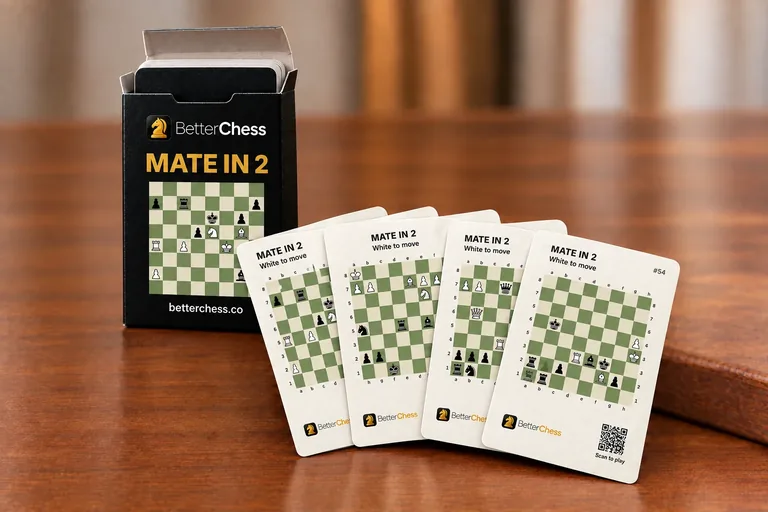
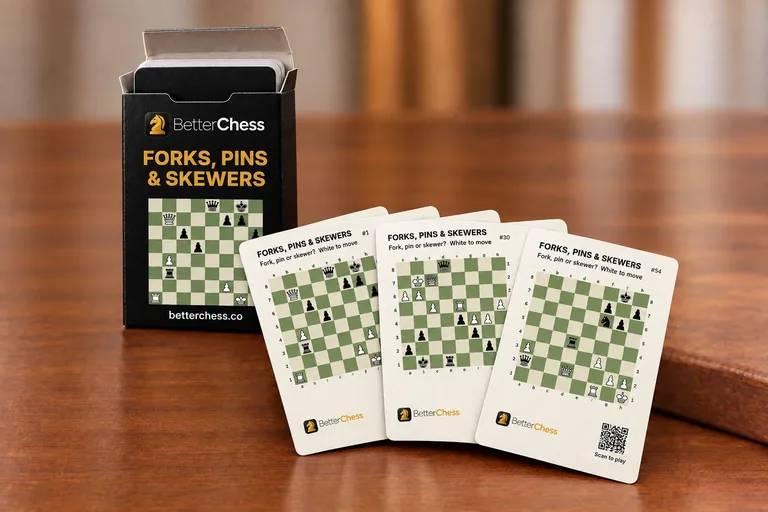
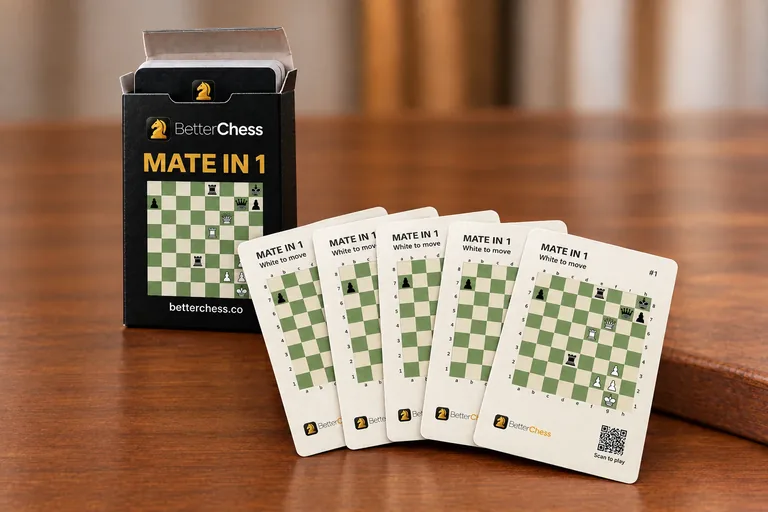
PRINTED CHESS PUZZLE CARDS
Chess puzzle playing card decks
54 poker-size cards in a tuck box. Puzzle on the front, solution on the back.