Réti Opening
Starting position
Engine ready — step through to see live evals.
Press ▶ Watch to play the line out, or Next to step through it — the engine evaluates every position.
The Réti Opening starts 1.Nf3 and usually follows with c4 and a kingside fianchetto, attacking Black's centre from a distance rather than occupying it. It's the classic hypermodern approach: let Black build a big pawn centre, then undermine it with c4, the g2-bishop, and pieces. Flexible and transposition-friendly, it lets White avoid early commitments and steer the game toward set-ups they know well.
The idea in one line
Open 1.Nf3, add c4 and a g3/Bg2 fianchetto, castle, and pressure Black's d5 centre from the flank — often transposing into the English, Catalan, or Queen's Gambit.
Key ideas
- Hypermodern idea: don't grab the centre with pawns, attack it from afar with c4 and the g2-bishop on the long diagonal.
- 1.Nf3 is supremely flexible — it controls e5, avoids early targets, and keeps every transposition open.
- c4 levers Black's d5 pawn just like the Queen's Gambit, but with the king's bishop already heading to g2.
- Because it transposes so readily into the English, Catalan and Queen's Gambit, learning plans matters far more than memorizing one fixed line.
Plans for each side
White: Play 1.Nf3 and c4 to pressure d5, fianchetto with g3 and Bg2, castle, and pile up on the centre and long diagonal — recapturing or undermining d5 at the right moment.
Black: Support the d5 pawn solidly (with ...e6 or ...c6), develop comfortably with ...Nf6 and ...Be7, castle, and aim to neutralize the g2-bishop's pressure and free the position.
Common mistakes to avoid
- Don't let the opening become aimless: the c4 lever and pressure on d5 are what give the Réti its bite.
- Trading or burying the g2-bishop without compensation surrenders your main source of pressure.
- Be alert to transpositions — drifting into a Catalan or Queen's Gambit unaware can leave you without a plan.
The main line, explained
1. Nf3Nf3 — the Réti. A flexible, non-committal first move that controls e5 and keeps options open.
2. c4c4 challenges Black's d5 pawn from the flank, the heart of the Réti's hypermodern plan.
3. g3g3 prepares the fianchetto, putting the bishop on its best diagonal.
4. Bg2Bg2 eyes d5 and b7 along the long diagonal — White's key piece.
5. O-OO-O — White castles; the set-up mirrors the Catalan and is rock-solid.
5… O-OO-O — both sides are developed and safe; White will press the centre with moves like d4, Nc3 or cxd5.
Frequently asked
What is the Réti Opening?
It's a flank opening beginning 1.Nf3, usually with c4 and a g3/Bg2 fianchetto. Instead of occupying the centre, White attacks it from a distance — the classic hypermodern idea.
How is the Réti different from the English?
They overlap a lot and often transpose. The English starts 1.c4; the Réti starts 1.Nf3. The Réti keeps slightly more flexibility early and frequently steers into English or Catalan structures.
Is the Réti hard to learn?
It's more about understanding than memorization. Grasp the c4 lever, the g2-bishop's pressure on d5, and the common transpositions, and you can play it well without deep theory.
Famous games in the Réti Opening
- Réti vs Bogoljubov (1924): Richard Réti vs Efim Bogoljubov
- Réti vs Alekhine (1925): Richard Réti vs Alexander Alekhine
More openings to explore
English Opening
Flank opening (1.c4) · A10–A39
Learn & play ›Catalan Opening
Queen's Pawn (1.d4) · E00–E09
Learn & play ›Knowing the moves of the Réti Opening is not the same as knowing why they work. Use Claude? BetterChess gives it a real engine, so it explains this opening from the board in front of you instead of from memory.
BetterChess is a practice tool — we make no guarantee you'll reach 1800 or any rating. The lines here are standard, well-established opening theory, and every move is checked legal with the same engine the board runs.
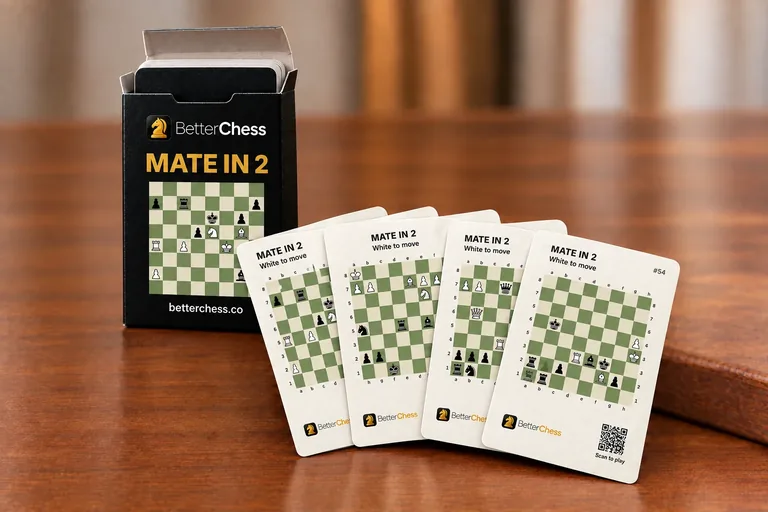
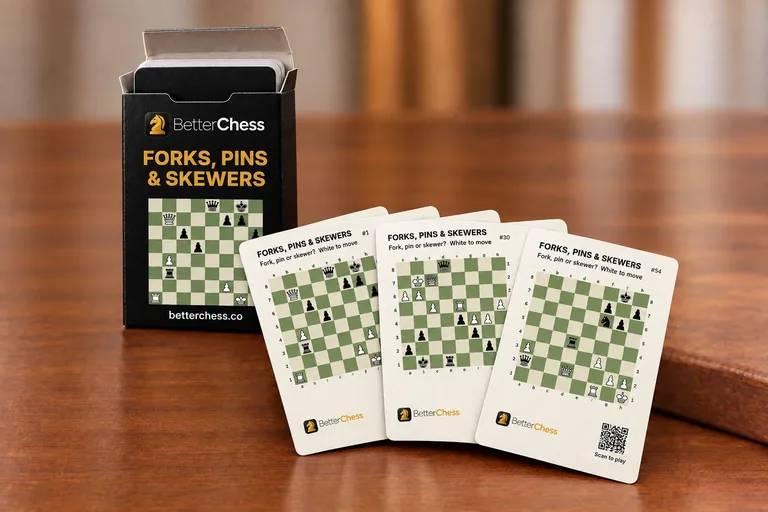
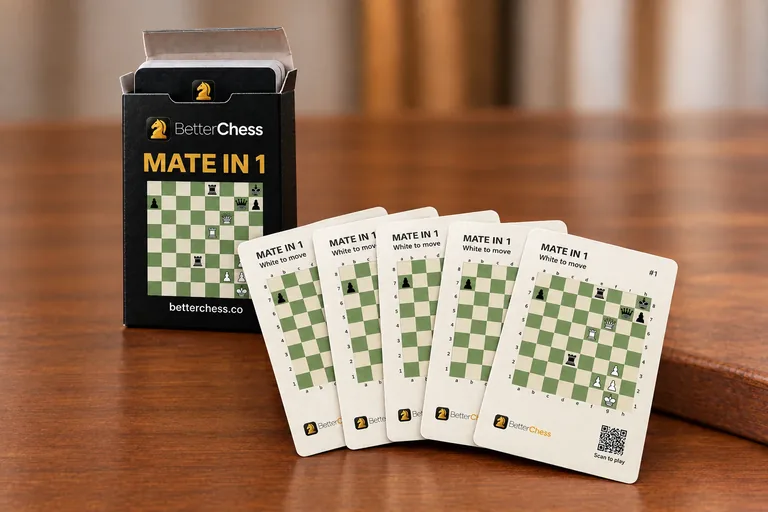
PRINTED CHESS PUZZLE CARDS
Chess puzzle playing card decks
54 poker-size cards in a tuck box. Puzzle on the front, solution on the back.