Queen's Gambit Accepted
Starting position
Engine ready — step through to see live evals.
Press ▶ Watch to play the line out, or Next to step through it — the engine evaluates every position.
The Queen's Gambit Accepted is Black's most direct answer to the Queen's Gambit: take the c4-pawn, let White have the centre for a moment, then hit back at it with pieces and the ...c5 break. Black is not trying to keep the pawn; the capture trades a static centre for quick, free development. It suits players who want Queen's Gambit solidity without the Declined's cramped light-squared bishop.
The idea in one line
Take on c4 to unbalance the Queen's Gambit, give the pawn back at the right moment, and counter in the centre with ...c5 for free piece play and easy development.
Key ideas
- ...dxc4 is a trade, not a pawn grab: Black gives up the d5 strongpoint so every piece develops freely, above all the light-squared bishop that the Declined shuts in.
- The ...c5 break is the heart of the opening: hit d4 before White converts the temporary centre into a permanent pawn duo.
- 3.Nf3 is White's main move because it stops the freeing ...e5 break; that is exactly why Black switches to the ...e6 and ...c5 plan instead.
- Typical middlegames feature an isolated d-pawn for White or near-symmetry: White gets activity, Black gets clear targets and comfortable equality with accurate play.
Plans for each side
White: Regain the c4-pawn with Bxc4, castle quickly, and use the slight lead in development: push d4-d5 at the right moment, or accept an isolated d-pawn and attack with the extra piece activity it buys.
Black: Return the pawn without a fight, blunt White's centre with ...e6 and ...c5, then expand with ...a6, ...b5 and ...Bb7: the freed bishop and queenside space give Black a full share of the play.
Common mistakes to avoid
- Don't try to keep the extra pawn: holding c4 with ...b5 and ...c6 loses time, and after a4 White rips the queenside open with a big lead in development.
- Play ...c5 on schedule: without it White builds e4 plus d4 and Black ends up passive, which is exactly what the capture on c4 was supposed to avoid.
- White's edge is temporary: after regaining the pawn, routine moves let Black finish ...b5, ...Bb7 and ...Nbd7 and the position is simply level.
The main line, explained
2… dxc4...dxc4 takes the gambit pawn. Black won't keep it; the point is to swap the d5 strongpoint for free development and a quick ...c5 strike.
3. Nf3Nf3 develops and rules out the freeing ...e5 push; White will collect the c4-pawn back at a moment of his choosing.
4. e3e3 opens the path for the bishop to recapture on c4. Quiet, but the most reliable way to restore material equality.
5. Bxc4Bxc4 regains the pawn with a developed piece. Material is level again and White has slightly freer play, for now.
5… c5...c5 is the move the whole opening is built around: Black strikes at d4 before White can set up a broad centre.
6… a6...a6 prepares ...b5 and ...Bb7: queenside space, and the light-squared bishop finally gets the long diagonal it never sees in the Declined.
Frequently asked
Is the Queen's Gambit Accepted good for club players?
Yes. It avoids the cramped light-squared bishop of the Declined, the plans are clear (give the pawn back, hit d4 with ...c5), and there is far less theory than in the sharpest Slav and Semi-Slav main lines.
Can Black keep the extra pawn in the QGA?
Not safely. Attempts with ...b5 and ...c6 are met by a4, and Black's queenside collapses while White develops. Treat the capture as a temporary trade, not a gambit White forgot about.
Should I play the QGA or the QGD?
The Declined keeps the centre and is more solid; the Accepted trades central space for free development and the ...c5 counter. If your problem in the Declined is the passive c8-bishop, the Accepted fixes it.
More openings to explore
Queen's Gambit
Queen's Pawn (1.d4) · D06–D69
Learn & play ›Queen's Gambit Declined
Black vs 1.d4 · D30–D69
Learn & play ›Knowing the moves of the Queen's Gambit Accepted is not the same as knowing why they work. Use Claude? BetterChess gives it a real engine, so it explains this opening from the board in front of you instead of from memory.
BetterChess is a practice tool — we make no guarantee you'll reach 1800 or any rating. The lines here are standard, well-established opening theory, and every move is checked legal with the same engine the board runs.
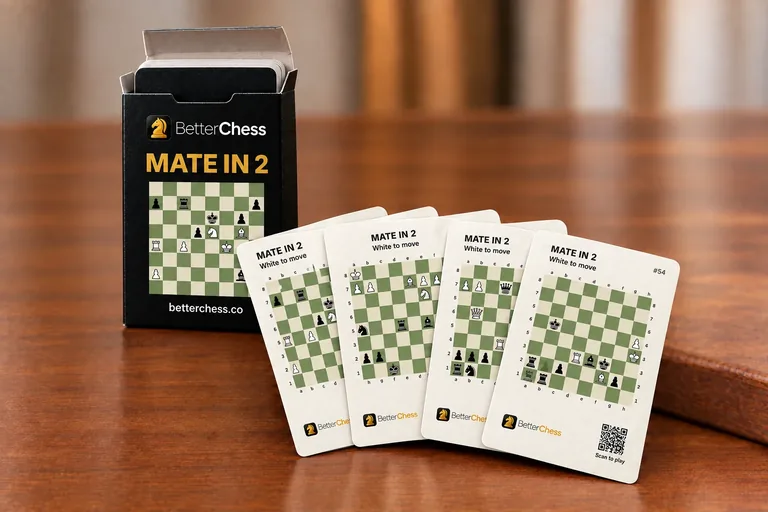
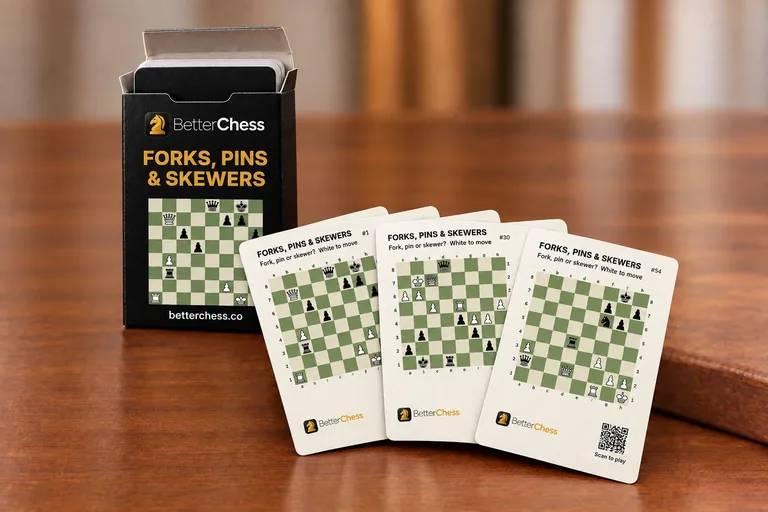
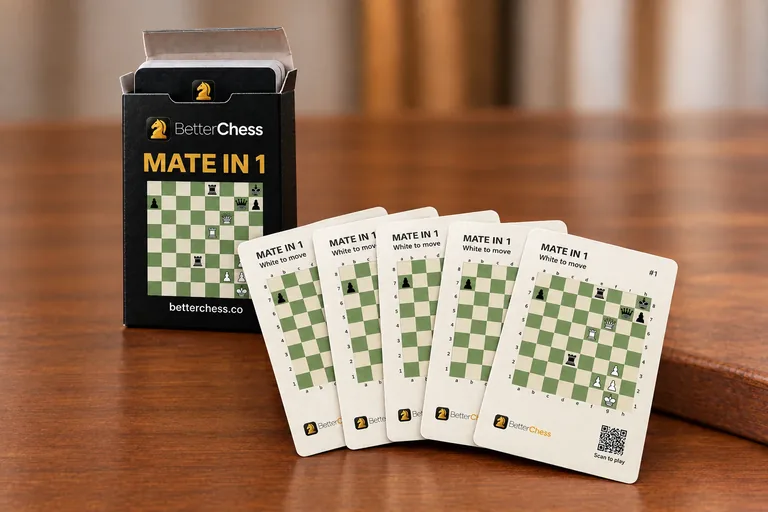
PRINTED CHESS PUZZLE CARDS
Chess puzzle playing card decks
54 poker-size cards in a tuck box. Puzzle on the front, solution on the back.