Ponziani Opening
Starting position
Engine ready — step through to see live evals.
Press ▶ Watch to play the line out, or Next to step through it — the engine evaluates every position.
The Ponziani is one of the oldest recorded openings: White plays 3.c3 to prepare a quick d4 and grab a big pawn centre. It's offbeat at the top level but a genuine surprise weapon at club level — opponents are rarely booked up against it. The trade-off is that 3.c3 doesn't develop a piece, so Black gets active replies, the sharpest being the immediate central counter 3...d5.
The idea in one line
Play c3 to support an early d4 and build a broad pawn centre — an old surprise weapon that trades quick development for central space, where knowing the main replies (especially 3...d5) is everything.
Key ideas
- 3.c3 has one job: prepare d4 so White can build a big centre with pawns on e4 and d4.
- It's a true surprise weapon — far less common than the Italian or Ruy Lopez, so club opponents are often out of book by move three.
- Because c3 doesn't develop a piece, Black gets active counterplay; the critical try is 3...d5, hitting the centre at once.
- After 3...d5 4.Qa4, White pins the c6-knight against the d5-pawn and keeps the tension — accurate play by both sides is required, so know the line before you wheel it out.
Plans for each side
White: Support and play d4 to seize a broad pawn centre; against 3...d5 use Qa4 to pin the c6-knight and pressure the centre, then develop, castle, and use the central space.
Black: Counter in the centre immediately with 3...d5 (or hold solidly with 3...Nf6), develop with tempo against White's slightly exposed queen, and exploit the fact that 3.c3 didn't develop a piece.
Common mistakes to avoid
- Don't play the Ponziani unprepared: 3.c3 is harmless if you don't know the follow-ups, especially the critical 3...d5.
- After Qa4, the queen is committed early — be ready for Black to gain time hitting it, and don't leave it stranded.
- Chasing the big centre while neglecting development can rebound; remember c3 already cost you a tempo on piece play.
The main line, explained
2. Nf3Nf3 develops and attacks e5 — the familiar, principled start shared with the Italian and Ruy Lopez.
2… Nc6...Nc6 defends e5 and develops, the standard reply before White reveals the Ponziani idea.
3. c3c3 — the Ponziani move. It develops nothing but prepares the central push d4 and a broad pawn centre.
3… d5...d5! — the critical counter. Black strikes the centre at once rather than letting White play d4 in comfort.
4. Qa4Qa4 pins the c6-knight against the d5-pawn and keeps the central tension — the main theoretical try.
4… Bd7...Bd7 unpins by defending the knight and develops; the position stays sharp and concrete.
Frequently asked
Is the Ponziani Opening any good?
It's offbeat and rarely seen at the top, but it's a fine surprise weapon at club level. If you know the main lines — especially the answer to 3...d5 — you can reach playable positions and catch unprepared opponents.
What is the point of 3.c3 in the Ponziani?
It prepares d4. With c3 supporting it, White can push d4 to build a big pawn centre on e4 and d4. The downside is that c3 doesn't develop a piece, which is why Black gets active counter-chances.
What's the best reply to the Ponziani?
The most testing answer is the immediate central strike 3...d5. The solid 3...Nf6 (hitting e4) is also fully reliable. Both exploit the fact that White's third move developed no pieces.
More openings to explore
Italian Game
King's Pawn (1.e4 e5) · C50–C54
Learn & play ›Scotch Game
King's Pawn (1.e4 e5) · C45
Learn & play ›Knowing the moves of the Ponziani Opening is not the same as knowing why they work. Use Claude? BetterChess gives it a real engine, so it explains this opening from the board in front of you instead of from memory.
BetterChess is a practice tool — we make no guarantee you'll reach 1800 or any rating. The lines here are standard, well-established opening theory, and every move is checked legal with the same engine the board runs.
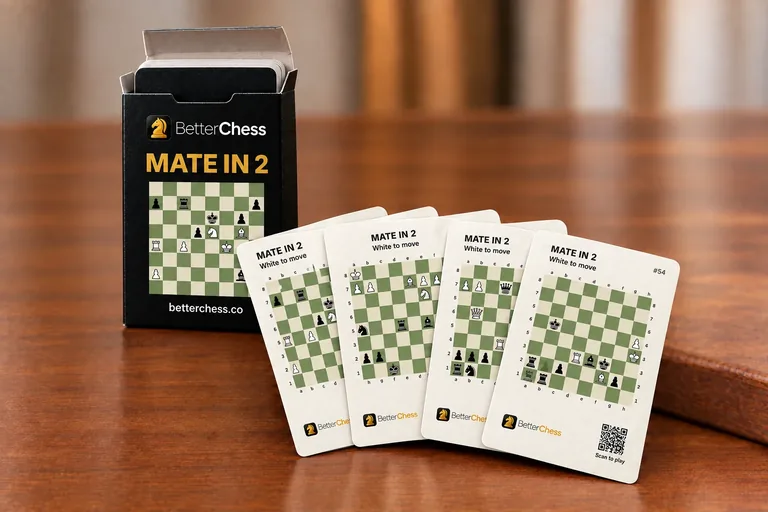
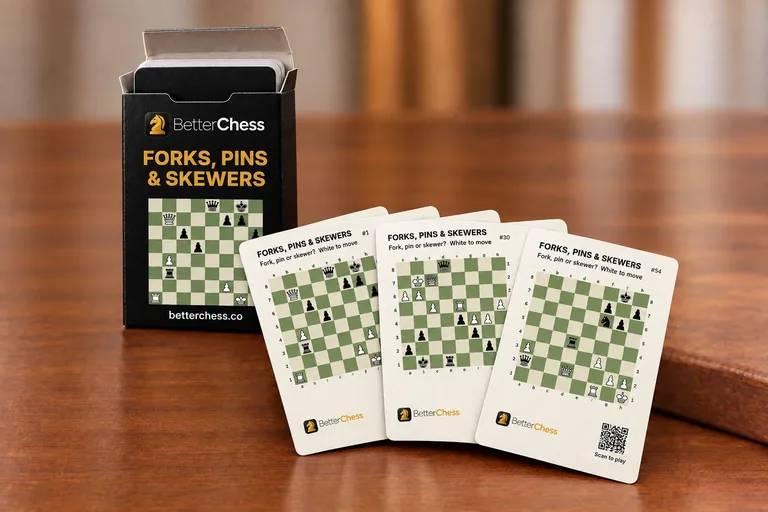
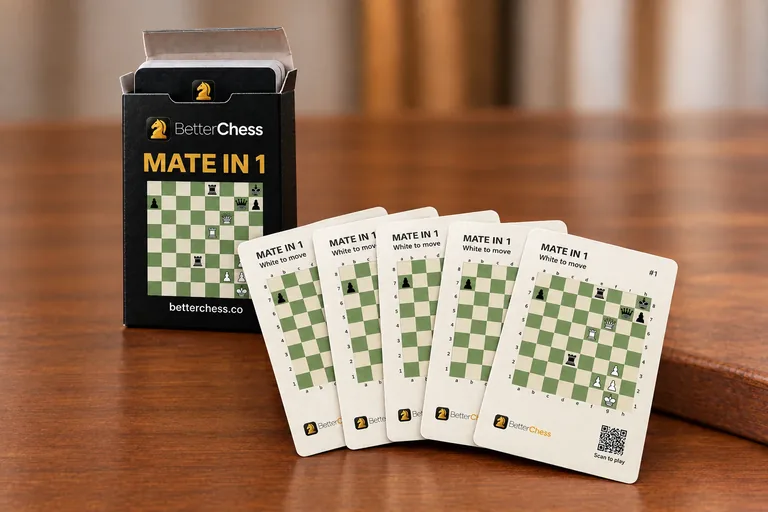
PRINTED CHESS PUZZLE CARDS
Chess puzzle playing card decks
54 poker-size cards in a tuck box. Puzzle on the front, solution on the back.