Panov Attack
Starting position
Engine ready — step through to see live evals.
Press ▶ Watch to play the line out, or Next to step through it — the engine evaluates every position.
The Panov Attack (often called the Panov-Botvinnik Attack) is White's way of denying Caro-Kann players the quiet game they signed up for. With 3.exd5 and 4.c4 White turns the solid Caro structure into an open, piece-driven fight, usually around an isolated queen's pawn. If you enjoy active development, open files and attacking chances, this is the most principled anti-Caro weapon at club level.
The idea in one line
Exchange on d5 and hit back with c4: White accepts an isolated d-pawn in return for open lines, fast development, and the classic IQP attacking machine aimed at Black's king.
Key ideas
- 4.c4 is the point: it attacks d5 immediately and guarantees open lines, the opposite of the slow Advance and Classical Caro-Kann structures.
- White usually ends up with an isolated queen's pawn on d4. That pawn is a middlegame asset: it grants the e5 outpost, open files, and free piece play.
- The standard attacking scheme is textbook IQP chess: Bd3 or Bg5, O-O, Re1, a knight to e5, and pressure building toward Black's kingside.
- The d4-d5 break is White's trump card: timed well it rips the position open while White's pieces are better placed; timed badly it just trades into a level endgame.
Plans for each side
White: Develop fast (Nc3, Nf3, Bg5 or Bd3), castle short, and use the IQP dynamically: plant a knight on e5, mass pieces against the king, and keep the d5 break loaded. Keep pieces on the board; your pawn structure gets worse the more material comes off.
Black: Black plays ...e6 and ...Bb4 or ...Be7, castles, and heads for exchanges: blockade the d-pawn with a knight on d5, trade minor pieces, and steer for an endgame where the isolated pawn becomes a target instead of a weapon.
Common mistakes to avoid
- Do not trade pieces without a reason: every exchange favours the side playing against the isolated pawn. The Panov is an initiative opening, so keep attackers on the board.
- Watch ...Qb6 and ...Nc6 hits against b2 and d4; the IQP needs concrete defence, not autopilot development.
- Do not push d5 just because you can. The break is your one-time weapon: play it when it opens lines for better-placed pieces, not to simplify the position.
The main line, explained
3. exd5exd5 releases the central tension on White's terms; the Caro-Kann's usual slow structures are off the table.
4. c4c4, the Panov move: White attacks d5 again and turns the game into an open, Queen's-Gambit-style fight.
4… Nf6...Nf6 develops and holds d5, the natural and best reply.
5. Nc3Nc3 piles onto d5 and develops toward the centre.
5… e6...e6 shores up d5 and opens the bishop; the main line continues to sharpen.
6… Bb4...Bb4 pins the c3-knight, Nimzo-Indian style. The position now resembles main-line queen's pawn openings more than a Caro-Kann.
Frequently asked
Why play the Panov against the Caro-Kann?
Because it takes Caro players out of their comfort zone. Instead of the solid, slow structures they know, they must defend an open position against an IQP attack, where one inaccuracy matters far more.
Is the isolated queen's pawn weak or strong?
Both, depending on the phase. In the middlegame it gives White the e5 outpost, open lines and attacking chances; in the endgame it is a target. That is why White keeps pieces on and Black trades everything in sight.
Does the Panov transpose to other openings?
Constantly. With ...e6 and ...Bb4 it echoes the Nimzo-Indian; other lines reach positions from the Queen's Gambit family. Learning the Panov teaches you IQP structures that pay off across your whole repertoire.
More openings to explore
Caro-Kann Defense
Black vs 1.e4 · B10–B19
Learn & play ›Queen's Gambit
Queen's Pawn (1.d4) · D06–D69
Learn & play ›Knowing the moves of the Panov Attack is not the same as knowing why they work. Use Claude? BetterChess gives it a real engine, so it explains this opening from the board in front of you instead of from memory.
BetterChess is a practice tool — we make no guarantee you'll reach 1800 or any rating. The lines here are standard, well-established opening theory, and every move is checked legal with the same engine the board runs.
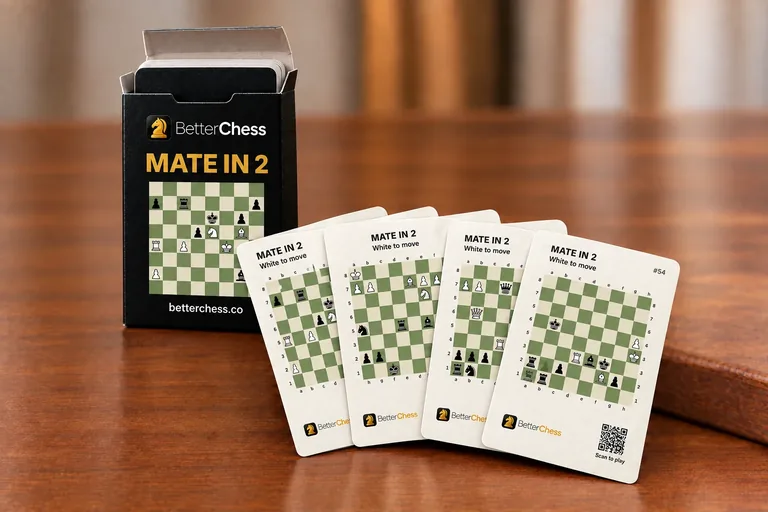
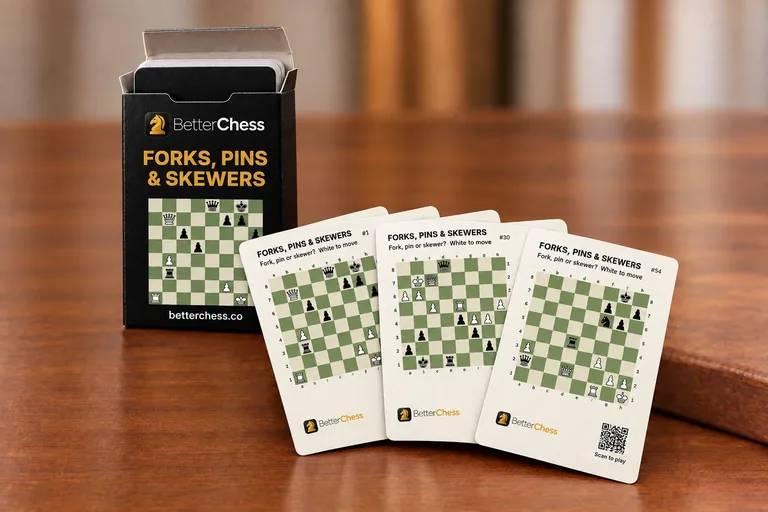
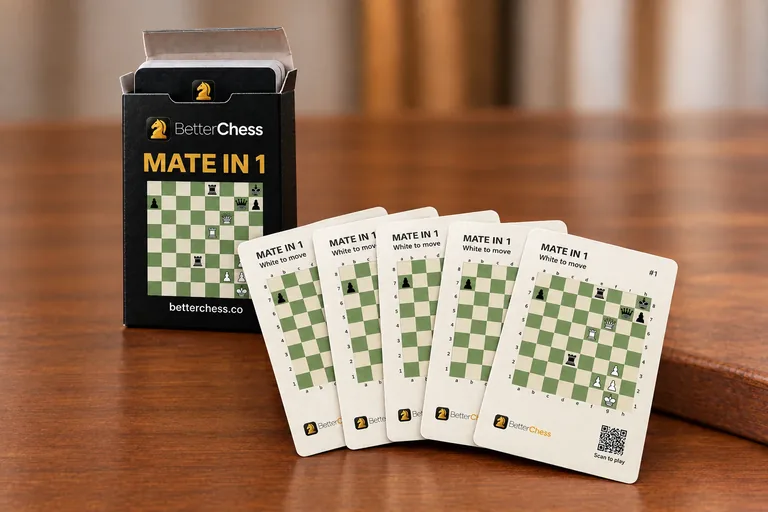
PRINTED CHESS PUZZLE CARDS
Chess puzzle playing card decks
54 poker-size cards in a tuck box. Puzzle on the front, solution on the back.