Owen's Defense
Starting position
Engine ready — step through to see live evals.
Press ▶ Watch to play the line out, or Next to step through it — the engine evaluates every position.
Owen's Defense answers 1.e4 with 1...b6, fianchettoing the queen's bishop to snipe at e4 from long range. Let's be honest up front: engines and theory agree that White gets a comfortable edge with the free big centre, which is why you will not see 1...b6 in world championship matches. What you get in exchange is a fresh, flexible game on your own terms, against opponents who left their preparation on move one. As a surprise weapon it has real practical teeth.
The idea in one line
Fianchetto with ...b6 and ...Bb7 to pressure e4 from distance, concede the big centre, then chip at it with ...c5 and ...Nf6 and play a fresh, hypermodern middlegame.
Key ideas
- ...b6 and ...Bb7 attack e4 from the flank: pure hypermodern chess, inviting White to build a centre and promising to undermine it.
- The honest assessment: White's centre is real and engines prefer White clearly. Owen's is a practical weapon, not a theoretical argument.
- ...c5 is Black's main strike, hitting d4 and opening the c-file; combined with ...Nf6 against e4 it forces White to make real decisions early.
- Familiarity is the equalizer: you will know the typical squares (bishop b7, knight f6, breaks with ...c5 and ...d5) while most opponents improvise from move two.
Plans for each side
White: White takes the centre with d4, guards e4 with Bd3 (the main line), develops naturally with Nf3 and O-O, and keeps space. The healthiest plan is to restrain ...c5 and ...d5, complete development, and only then expand, letting the b7-bishop stare at a wall.
Black: Complete the scheme (...Bb7, ...e6, ...c5, ...Nf6, then ...Be7 and ...O-O), keep the position flexible, and choose the right break: ...cxd4 with c-file play, or a prepared ...d5 to challenge the centre head-on. Piece activity, not material, is the currency.
Common mistakes to avoid
- Never grab with the early ...f5 pawn lunge: after 3.Bd3 f5 White has a famous queen-sacrifice refutation known since Greco's time, and Black's position collapses on the light squares.
- Passivity is the real risk: without the ...c5 strike (and often a later ...d5) the b7-bishop bites on granite and White attacks at leisure.
- Watch White's d4-d5 and e4-e5 advances; each one can shut your bishop out of the game, so meet them with immediate pawn challenges rather than quiet moves.
The main line, explained
1… b6...b6 declares the plan: pressure e4 from b7 instead of occupying the centre.
2… Bb7...Bb7 completes the point of the opening; from here every White decision about e4 is made under surveillance.
3. Bd3Bd3 is the main line: the bishop shields e4 against the b7-sniper while keeping natural development.
3… e6...e6 opens the f8-bishop and keeps the structure flexible; the immediate fight is postponed, not declined.
4… c5...c5 is the thematic strike at White's centre, gaining queenside play and asking d4 the question.
5. c3c3 keeps the pawn duo intact; White accepts a slower game to preserve the space advantage.
5… Nf6...Nf6 adds a second attacker on e4 and completes the core Owen's setup.
Frequently asked
Is Owen's Defense sound?
It is playable but objectively second-tier: engines give White a comfortable plus with the big centre, and no elite player uses it as a main defence. At club level, where surprise and familiarity decide games, it scores far better than its reputation.
What is Black's main plan in Owen's Defense?
Pressure e4 with ...Bb7 and ...Nf6, strike at d4 with ...c5, and pick the moment for ...d5. Black plays against White's centre rather than for immediate equality, so patience and timing matter more than memorized lines.
How is Owen's different from the English Defense?
The English Defense arises after 1.d4 e6 2.c4 b6, where White's c-pawn is already committed and Black gets extra tactical resources against the centre. Owen's, against 1.e4, is the tougher version for Black, which is why honesty about the engine verdict matters.
More openings to explore
Hippopotamus Defense
Black vs 1.e4 · B06
Learn & play ›Modern Defense
Black vs 1.e4 · B06
Learn & play ›Knowing the moves of the Owen's Defense is not the same as knowing why they work. Use Claude? BetterChess gives it a real engine, so it explains this opening from the board in front of you instead of from memory.
BetterChess is a practice tool — we make no guarantee you'll reach 1800 or any rating. The lines here are standard, well-established opening theory, and every move is checked legal with the same engine the board runs.
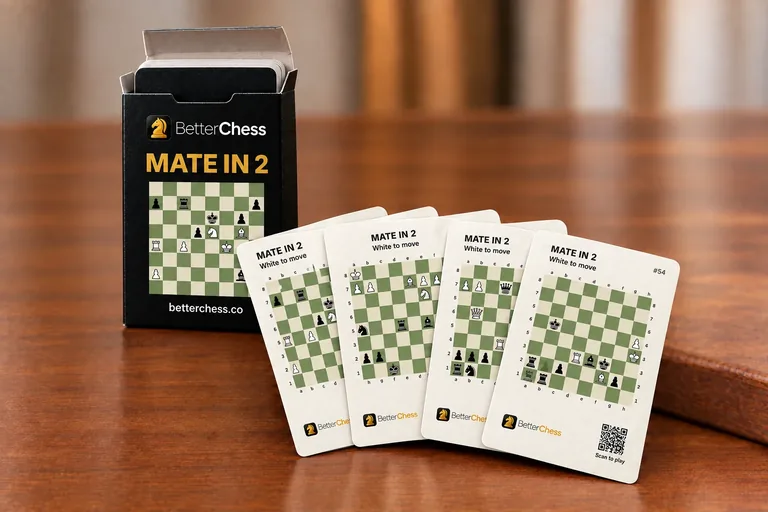
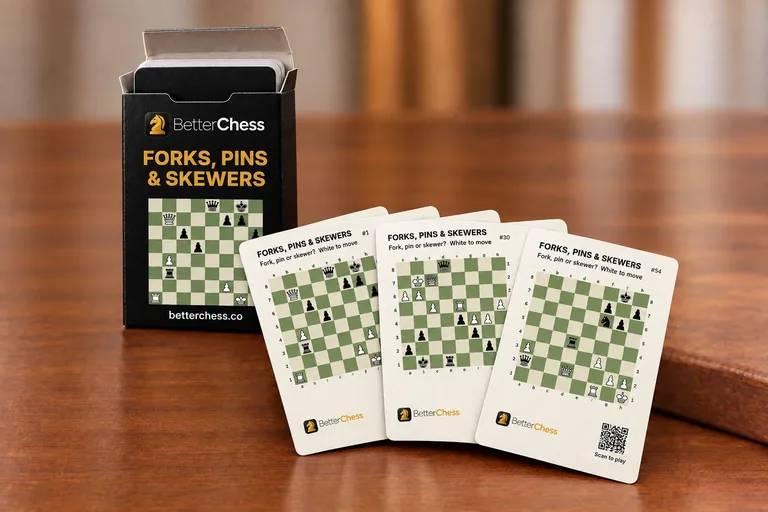
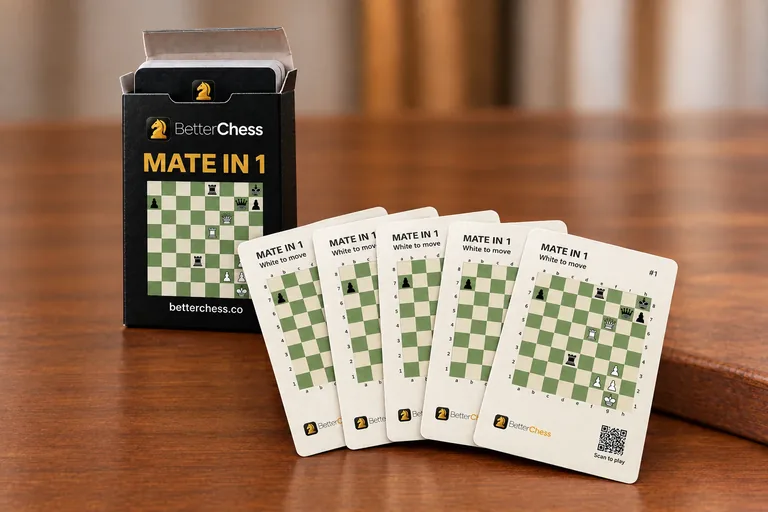
PRINTED CHESS PUZZLE CARDS
Chess puzzle playing card decks
54 poker-size cards in a tuck box. Puzzle on the front, solution on the back.