Modern Defense
Starting position
Engine ready — step through to see live evals.
Press ▶ Watch to play the line out, or Next to step through it — the engine evaluates every position.
The Modern Defence is the most flexible hypermodern reply to 1.e4: Black fianchettoes the dark-squared bishop with ...g6 and ...Bg7 right away, before committing the knights or central pawns. Like the Pirc it invites White to build a big centre, then attacks it — but by delaying ...Nf6, Black keeps more options open and can transpose between many setups. It rewards understanding over memorization.
The idea in one line
Fianchetto the bishop to g7 immediately, stay flexible with the knights and centre, let White occupy the middle, then counter-attack the centre with ...c5, ...e5 or queenside expansion at the best moment.
Key ideas
- Black fianchettoes the g7-bishop first and keeps everything else flexible — the Modern's calling card is delaying commitments to react to White's setup.
- It's hypermodern: invite White's big pawn centre, then strike at it with ...c5, ...e5 or ...Nc6/...e5 once the target is clear.
- The g7-bishop on the long diagonal is the engine of Black's counterplay, pressing on d4 and e5 and supporting central and queenside breaks.
- Move-order flexibility lets the Modern transpose into the Pirc, King's Indian set-ups, or independent ...a6/...b5 queenside expansion plans.
Plans for each side
White: Seize the centre with e4 and d4 (often adding f4 for a kingside pawn storm), develop the pieces actively, and use the extra space to attack before Black's flexible setup generates counterplay.
Black: Fianchetto to g7, castle, and choose a break — ...c5 or ...e5 in the centre, or ...a6 and ...b5 on the queenside — to challenge White's centre and open lines for the g7-bishop.
Common mistakes to avoid
- Flexibility isn't passivity: without a timely ...c5 or ...e5, Black can simply be smothered by White's bigger centre and space.
- Against an early f4 (a Three/Four Pawns setup), watch for a fast e5–f5 pawn storm aimed at your king — meet it with central counterplay, not waiting moves.
- Don't neglect king safety while expanding on the queenside; castling and then breaking is usually safer than grabbing space with the king still in the centre.
The main line, explained
1… g6...g6 — the Modern. Black prepares an immediate fianchetto and keeps the knights and centre uncommitted for maximum flexibility.
2… Bg7...Bg7 fianchettoes the bishop onto the long diagonal at once — the bishop is Black's main weapon against White's centre.
3… d6...d6 supports a later ...e5 and keeps the centre flexible while Black completes development.
4. f4f4 grabs more space and signals a kingside pawn storm — an aggressive, critical try against the Modern.
4… Nf6...Nf6 finally develops the knight, hitting e4 and putting the question to White's broad centre; the game now resembles a sharp Pirc.
Frequently asked
Is the Modern Defense good for club players?
Yes for players who like flexible, counter-attacking chess and prefer understanding plans over memorizing lines. It's adaptable and hard to prepare against, but it does require active, well-timed central breaks rather than passive shuffling.
Modern vs Pirc?
Both fianchetto the dark-squared bishop and invite White's centre. The Pirc commits to an early ...Nf6, while the Modern delays it (starting 1...g6) to stay more flexible and keep more move-order options, often transposing between systems.
Why delay developing the knight to f6?
Keeping the knight home longer preserves flexibility: Black can wait to see White's setup, choose between ...c5 and ...e5 breaks, and even meet certain lines with ...c5 or ...a6/...b5 plans before deciding where the knight belongs.
More openings to explore
Pirc Defense
Black vs 1.e4 · B07–B09
Learn & play ›Alekhine Defense
Black vs 1.e4 · B02–B05
Learn & play ›Knowing the moves of the Modern Defense is not the same as knowing why they work. Use Claude? BetterChess gives it a real engine, so it explains this opening from the board in front of you instead of from memory.
BetterChess is a practice tool — we make no guarantee you'll reach 1800 or any rating. The lines here are standard, well-established opening theory, and every move is checked legal with the same engine the board runs.
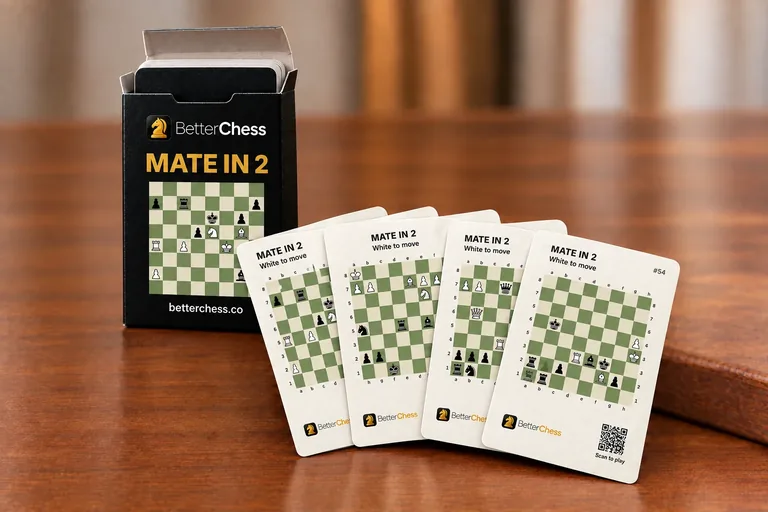
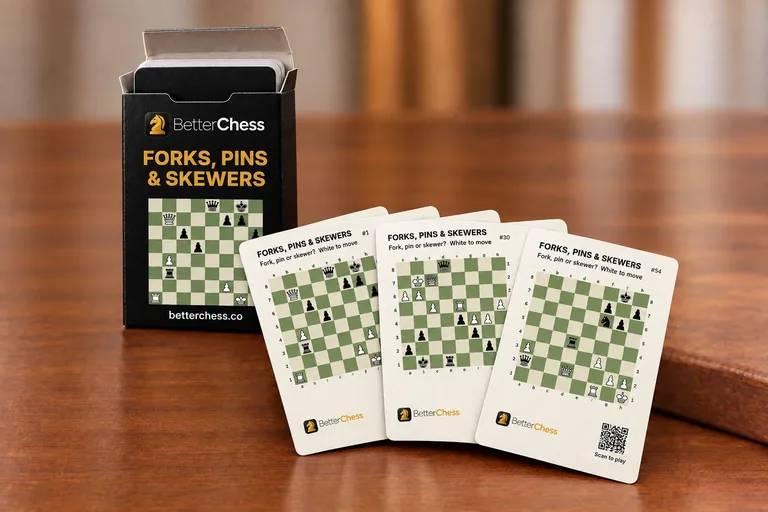
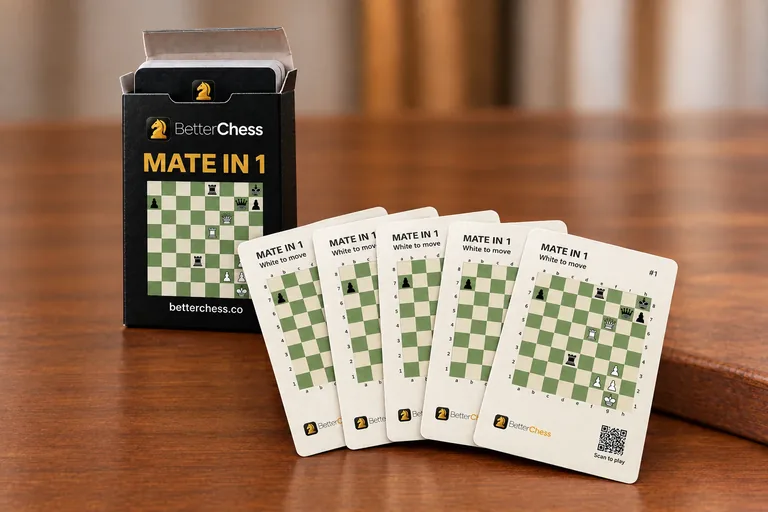
PRINTED CHESS PUZZLE CARDS
Chess puzzle playing card decks
54 poker-size cards in a tuck box. Puzzle on the front, solution on the back.