Hippopotamus Defense
Starting position
Engine ready — step through to see live evals.
Press ▶ Watch to play the line out, or Next to step through it — the engine evaluates every position.
The Hippopotamus is the ultimate system defence: Black arranges pawns on the third rank (g6, d6, e6, b6, later a6 and h6), fianchettoes both bishops, and posts the knights on e7 and d7. Nothing crosses the middle of the board until Black is fully coiled. Boris Spassky used it twice in his 1966 World Championship match against Petrosian and drew both games. It concedes space, and engines prefer White, but it is famously hard to attack and needs almost no move-order memory.
The idea in one line
Build the fence: pawns on the third rank, bishops on g7 and b7, knights on e7 and d7, castle short, and only then counterpunch with ...c5, ...d5 or ...f5 against White's stretched centre.
Key ideas
- The Hippo is a shape, not a move order: the same twelve-move setup appears against almost any White scheme, so preparation against you barely works.
- Black's position has no targets: no pawn crosses the fourth rank early, so White's usual attacking hooks simply are not there.
- The counterattack is built in: once the setup is complete, Black picks the break that fits White's commitments, ...c5 against a d4 centre, ...d5 or ...f5 against an e4-heavy one.
- Honesty first: White gets extra space and a free hand, and the engine's preference is real. The Hippo trades objective ambition for solidity, flexibility and familiarity.
Plans for each side
White: White takes the space on offer, builds a broad centre, and must then make the hardest decision in the opening: when to advance. Correct play keeps the structure flexible and prepares a well-timed d5, e5 or f4-f5 break; overextending is exactly what the Hippo invites.
Black: Finish the fence before fighting: both fianchettoes, knights to e7 and d7, castle short, often ...a6 and ...h6 as useful waiting moves. Then strike where White has stretched: ...c5 or ...d5 in the centre, ...f5 against the kingside, opening the board only once your pieces stand better than theirs.
Common mistakes to avoid
- The Hippo is a coiled spring, not a bunker: if you never counterpunch, White's space slowly suffocates you. The setup earns the right to strike, so strike.
- Keep the knight on e7, not f6: an early ...Nf6 turns the game into a normal Pirc or Modern where mainstream theory applies and your flexibility is gone.
- Do not let the position open before your setup is complete: with every Black piece on the first three ranks, a premature central break by either side favours the better-developed player, and that is White.
The main line, explained
1… g6...g6 starts the first fianchetto; the g7-bishop will be the fence's watchtower.
2… Bg7...Bg7 completes it. So far this could be a Modern Defense; the next moves reveal the Hippo.
3… d6...d6 restrains e4-e5 and keeps every pawn modestly placed, the Hippo's trademark.
4… e6...e6 is the signal: both centre pawns stay home on the third rank, and White is invited to overreach.
5… Ne7...Ne7 is the key square: the knight keeps the f-pawn free for ...f5 and stays out of the g7-bishop's way.
6… b6...b6 prepares the second fianchetto; the fence is nearly complete.
7… Bb7...Bb7 finishes the core shape. ...Nd7, ...a6 and ...h6 typically follow, and only then does Black counterattack.
Frequently asked
Is the Hippopotamus Defense sound?
It is playable and remarkably resilient, but not ambitious: engines give White a pleasant space edge. Its practical strengths are real, though: no forced lines to memorize, no early targets, and opponents must beat you with their own ideas rather than preparation.
Has the Hippo been played at top level?
Yes. Spassky used Hippopotamus setups twice against Petrosian in their 1966 World Championship match and drew both games, the opening's most famous endorsement. It remains an occasional surprise weapon rather than a main-line choice.
How does Black actually win from such a passive setup?
By counterattacking an overextended centre. White's space must eventually be defended; when the pawns advance, Black hits them with the prepared breaks (...c5, ...d5 or ...f5) and the fianchettoed bishops suddenly rake an opening board.
More openings to explore
Knowing the moves of the Hippopotamus Defense is not the same as knowing why they work. Use Claude? BetterChess gives it a real engine, so it explains this opening from the board in front of you instead of from memory.
BetterChess is a practice tool — we make no guarantee you'll reach 1800 or any rating. The lines here are standard, well-established opening theory, and every move is checked legal with the same engine the board runs.
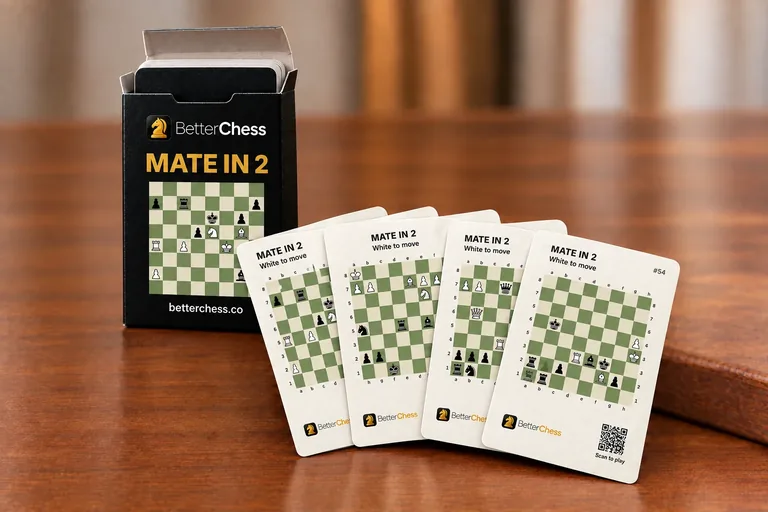
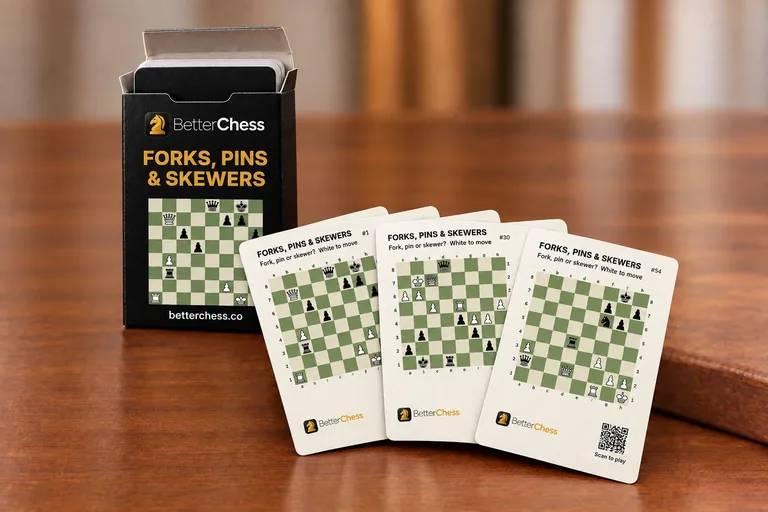
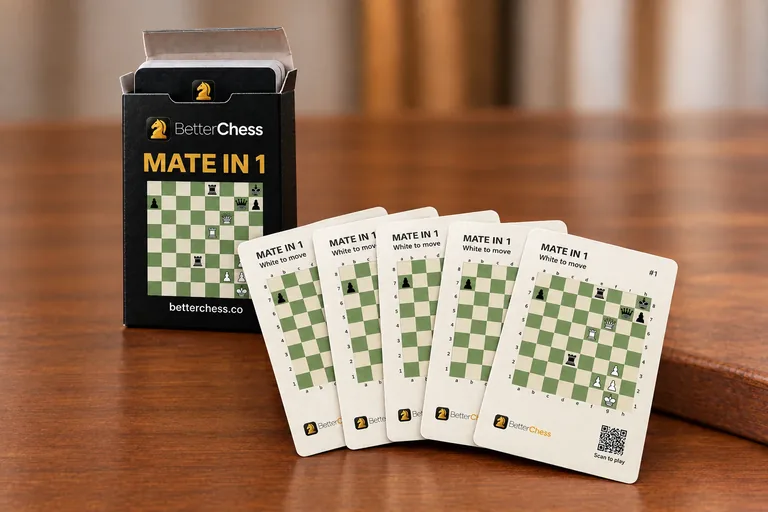
PRINTED CHESS PUZZLE CARDS
Chess puzzle playing card decks
54 poker-size cards in a tuck box. Puzzle on the front, solution on the back.