Old Indian Defense
Starting position
Engine ready — step through to see live evals.
Press ▶ Watch to play the line out, or Next to step through it — the engine evaluates every position.
The Old Indian is the King's Indian's quieter ancestor: Black claims a share of the centre with ...d6 and ...e5 but develops the bishop to e7 instead of g7. It is 'old' because it predates the fianchetto revolution, and it survives for a good reason: the setup is compact, nearly theory-free, and gives Black a permanent strongpoint on e5 to build around. If you want King's Indian structures without King's Indian theory, this is the move order.
The idea in one line
Set up ...d6 and ...e5 to plant a permanent stake in the centre, develop behind it with ...Nbd7 and ...Be7, castle, and play patiently around the e5 strongpoint.
Key ideas
- ...d6 followed by ...e5 claims the centre immediately: the stake goes in on move three, and White can never fully evict it.
- The queen trade after dxe5 holds no terror: Black recaptures on d8 with the king, follows with ...c6 and ...Kc7, and the sound structure makes the endgame comfortable.
- The e7-bishop is the honest difference from the King's Indian: less dynamic than on g7, but Black avoids the sharpest theory and the kingside pawn cover stays intact.
- The thematic regroup is ...c6 and ...Qc7, then ...Re8 and ...Bf8: a coiled-spring formation aimed at a later ...exd4 or gradual kingside expansion.
Plans for each side
White: Take the extra space with e4, develop with Nf3 and Be2, castle, and either keep the central tension or close with d5 and expand on the queenside with c5 and b4, the standard space-grabbing plan.
Black: Reinforce e5 with ...Nbd7, castle, then regroup with ...c6, ...Qc7 and ...Re8; wait for White to overextend and use the e5 strongpoint as the anchor for counterplay in the centre or on the kingside.
Common mistakes to avoid
- Know the queen-trade line before playing ...e5: after dxe5 dxe5 and the swap on d8 Black is fine, but only if you know the king strolls to c7 in comfort; panic here and the endgame plays itself for White.
- Don't drift into pure passivity: the Old Indian is solid but cramped, and without a plan (the ...Re8 and ...Bf8 regroup, a timely ...exd4, or ...a5 against White's expansion) Black just stands worse in less space.
- As White, the automatic d5 push isn't free: it concedes the c5 square to Black's knights and closes your own central play; keep the tension until releasing it gains something.
The main line, explained
2… d6...d6 supports the coming ...e5 stake while keeping every Black piece flexible.
3… e5...e5 is the point of the Old Indian: Black grabs a permanent share of the centre on move three.
4. Nf3Nf3 keeps the tension. The trade on e5 followed by the queen swap on d8 wins nothing: Black's king is safe and the structure is sound.
4… Nbd7...Nbd7 reinforces e5 the Old Indian way: the knight supports the strongpoint while ...c6 stays available.
5… Be7...Be7 is modest where the King's Indian bishop is fierce; in exchange, Black's kingside stays solid and the theory stays thin.
6… O-O...O-O completes the setup. The plan from here: ...c6, ...Qc7, ...Re8 and patient play around the e5 strongpoint.
Frequently asked
What is the difference between the Old Indian and the King's Indian?
The King's Indian fianchettos with ...g6 and ...Bg7 and plays for a kingside storm; the Old Indian puts the bishop on e7, keeps the structure tighter, and needs a fraction of the theory. Less dynamism, more solidity.
Isn't the early queen trade bad for Black?
No. After dxe5 dxe5 and the exchange on d8, Black has lost castling rights but the king walks to c7 in two moves and stands perfectly safe. The endgame is level, and White players hoping for a free edge are usually disappointed.
Who should play the Old Indian?
Players who like solid, strategic positions with clear plans and minimal memorization. If you enjoy King's Indian structures but not the razor-sharp main lines, the Old Indian gives you the skeleton without the theory.
More openings to explore
King's Indian Defense
Black vs 1.d4 · E60–E99
Learn & play ›Philidor Defense
King's Pawn (1.e4 e5) · C41
Learn & play ›Knowing the moves of the Old Indian Defense is not the same as knowing why they work. Use Claude? BetterChess gives it a real engine, so it explains this opening from the board in front of you instead of from memory.
BetterChess is a practice tool — we make no guarantee you'll reach 1800 or any rating. The lines here are standard, well-established opening theory, and every move is checked legal with the same engine the board runs.
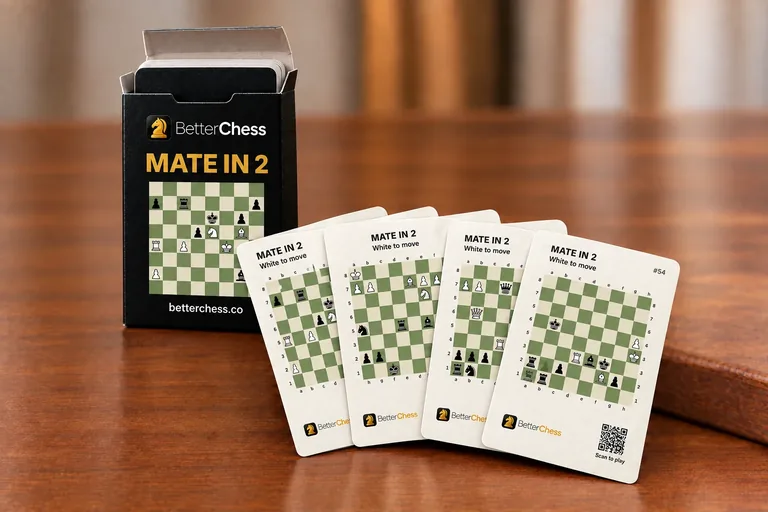
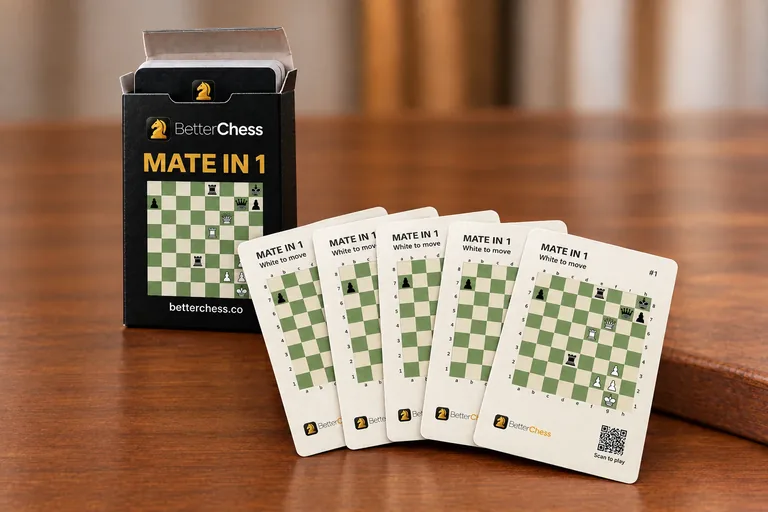
PRINTED CHESS PUZZLE CARDS
Chess puzzle playing card decks
54 poker-size cards in a tuck box. Puzzle on the front, solution on the back.