Grünfeld Defense
Starting position
Engine ready — step through to see live evals.
Press ▶ Watch to play the line out, or Next to step through it — the engine evaluates every position.
The Grünfeld is the hypermodern defence that lets White build a giant pawn centre — then sets out to destroy it. Black challenges with ...d5, trades on c3, and uses the fianchettoed g7-bishop and the ...c5 break to pressure that centre from the wings. It's a dynamic, double-edged choice trusted by World Champions and ideal for players who want sharp, active counterplay.
The idea in one line
Strike with ...d5 against White's centre, trade the knight on c3 to give White an imposing but targetable pawn front, then aim the g7-bishop and ...c5 straight at it.
Key ideas
- Black invites White to build a big e4/d4 centre on purpose — then treats it as a target, not a strength, with the g7-bishop and ...c5.
- The ...Nxc3 trade leaves White with a broad pawn centre and doubled c-pawns: impressive-looking, but a long-term object of attack.
- The fianchettoed bishop on g7 bears down the long diagonal at d4 and c3 — it's the engine of Black's whole counterattack.
- The thematic break is ...c5 (often backed by ...Qa5, ...Bg4 and ...Nc6), hammering White's centre before it can roll forward.
Plans for each side
White: Occupy the centre with pawns on d4 and e4, develop the pieces to support and advance it, and try to use the space and the bishop pair to attack before Black's pressure tells.
Black: Fianchetto and castle, then pile onto White's centre with the g7-bishop, ...c5, ...Nc6, ...Bg4 and ...Qa5 — provoke it to advance, then win it or blockade it.
Common mistakes to avoid
- Don't go passive once White has the big centre — the Grünfeld only works if you actively attack it with ...c5 and piece pressure; sit still and you'll simply be squeezed.
- Mind White's central pawn pushes (d5 and e5 advances): if you let the centre roll forward unopposed, those pawns cramp you and cut your pieces off.
- Trading or shutting in the g7-bishop throws away your main attacker and leaves the long diagonal — and your king — weak.
The main line, explained
1… Nf6...Nf6 — the flexible Indian start, controlling e4 without a central pawn commitment.
2… g6...g6 — preparing the fianchetto, the hypermodern way to fight the centre from a distance.
3… d5...d5 — the Grünfeld break. Black strikes at White's centre instead of allowing a free e4.
4… Nxd5...Nxd5 — recapturing and centralising; this knight will trade itself on c3 to damage White's structure.
5… Nxc3...Nxc3 — the key trade. White gets a big pawn centre but with doubled c-pawns — exactly the target Black wants.
6… Bg7...Bg7 — the fianchettoed bishop takes aim down the long diagonal at d4 and c3. The counterattack is loaded.
Frequently asked
Grünfeld vs King's Indian — what's the difference?
Both fianchetto to g7 and let White take the centre, but the Grünfeld challenges it immediately with ...d5 and trades on c3, leading to open, dynamic play against White's pawns. The King's Indian keeps the centre closed with ...d6 and ...e5 and aims for a kingside pawn storm. The Grünfeld is more concrete and tactical.
Why let White have such a big centre?
Because in the Grünfeld a big centre is a target, not a trophy. Black uses the g7-bishop, ...c5, and piece pressure to provoke the centre forward and then break it down. The whole strategy is built on attacking those pawns.
Is the Grünfeld too sharp for club players?
It's double-edged and concrete, so a little theory helps. But the guiding idea is clear and repeatable — fianchetto, hit ...c5, attack the centre — and it rewards active players with real winning chances and a clear plan against 1.d4.
Famous games in the Grünfeld Defense
- The Game of the Century (1956): Donald Byrne vs Bobby Fischer
- Kramnik Cracks the Grünfeld (2000, Game 2): Vladimir Kramnik vs Garry Kasparov
More openings to explore
King's Indian Defense
Black vs 1.d4 · E60–E99
Learn & play ›Nimzo-Indian Defense
Black vs 1.d4 · E20–E59
Learn & play ›Knowing the moves of the Grünfeld Defense is not the same as knowing why they work. Use Claude? BetterChess gives it a real engine, so it explains this opening from the board in front of you instead of from memory.
BetterChess is a practice tool — we make no guarantee you'll reach 1800 or any rating. The lines here are standard, well-established opening theory, and every move is checked legal with the same engine the board runs.
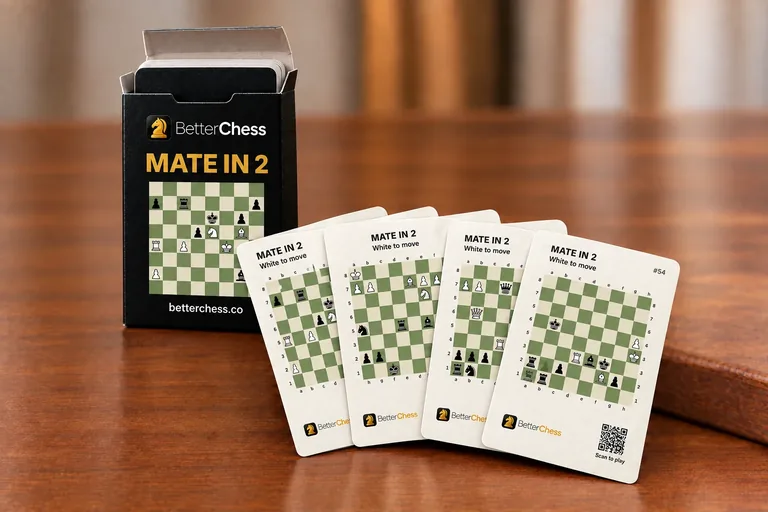
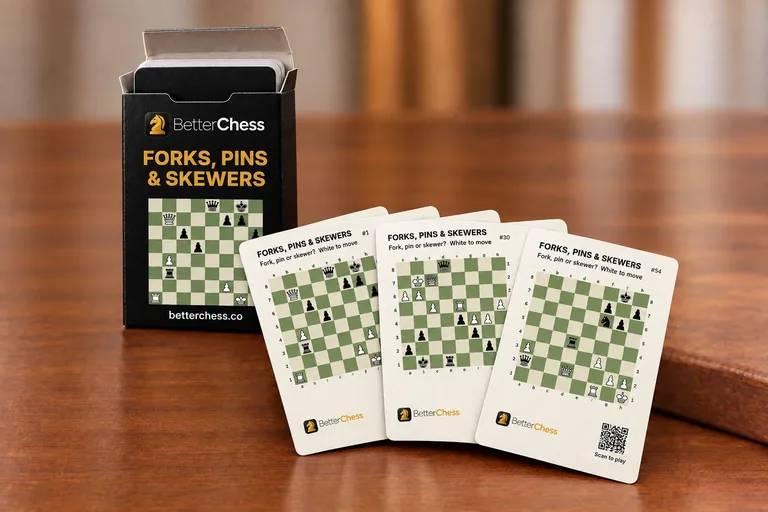
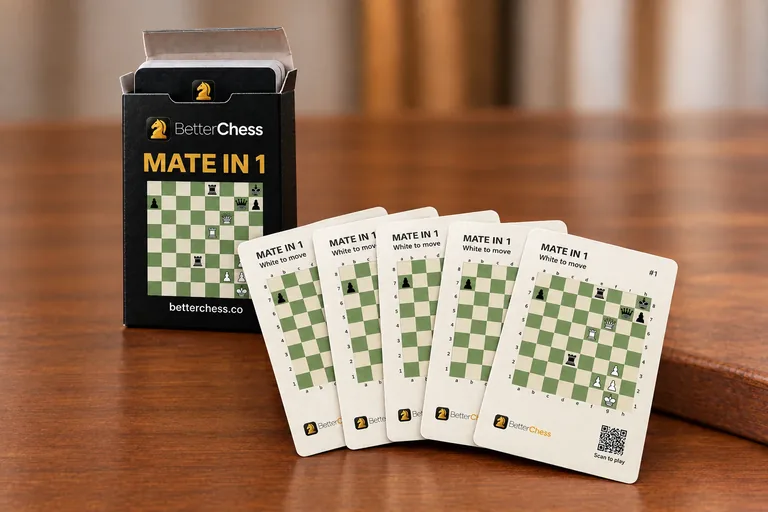
PRINTED CHESS PUZZLE CARDS
Chess puzzle playing card decks
54 poker-size cards in a tuck box. Puzzle on the front, solution on the back.