King's Indian Attack
Starting position
Engine ready — step through to see live evals.
Press ▶ Watch to play the line out, or Next to step through it — the engine evaluates every position.
The King's Indian Attack is a system, not a sequence: White plays Nf3, g3, Bg2, O-O, d3, Nbd2 and e4 in almost any order against almost anything. It is the King's Indian Defense with an extra tempo, and it was a devastating weapon in Bobby Fischer's early career. For club players it solves the opening problem in one purchase: one structure, clear middlegame plans, and very little memorization.
The idea in one line
Set up the same seven-move scheme regardless of Black's reply, then play e4 and e5 to wedge the centre and attack the castled king while Black seeks queenside counterplay.
Key ideas
- One setup against everything: Nf3, g3, Bg2, O-O, d3, Nbd2, e4. You study plans and pawn breaks instead of dozens of openings.
- It is a reversed King's Indian Defense: every idea Black uses there works for you a tempo up.
- The signature plan is the e5 wedge: once the pawn lands on e5 it cramps Black's kingside and fixes a target, and White's pieces flow to the attack behind it.
- The typical attacking scheme after e5 is Re1, h4, knights swinging via f1 and h2 toward g4 and g5, and the h-pawn softening Black's castled position.
Plans for each side
White: Complete the scheme, play e4, and when Black's pawns allow it, push e5 to gain space and split the board. Then attack on the kingside with h4, Nf1-h2-g4 style regrouping and piece pressure at f6 and h6, accepting that Black will make progress on the queenside in the meantime.
Black: Black grabs queenside space with ...c5, ...b5 and ...a5, opens files there, and tries to break through before White's kingside attack lands. The classic KIA middlegame is a pure race on opposite wings.
Common mistakes to avoid
- It is a plan, not a script: against setups where Black fianchettoes on the kingside or delays ...e6, the automatic e5 attack loses its bite, so be ready to play in the centre instead.
- Do not start the h4 attack before the e5 wedge and your regrouping are in place; a premature demonstration just loosens your own king.
- When Black's queenside play comes, do not switch to passive defence. Trading your attack for their attack is the losing strategy in a race; keep pushing where you are stronger.
The main line, explained
1. Nf3Nf3 commits to nothing: White can still choose almost any structure, which is the KIA's whole philosophy.
2. g3g3 begins the fianchetto; the bishop on g2 will support the coming e4-e5 expansion.
3. Bg2Bg2 puts the bishop on the long diagonal, the most valuable piece in most KIA middlegames.
4. O-OO-O first: the king is safe before the central play begins, so the later attack carries no risk at home.
5. d3d3 looks modest, but it is the point: the pawn supports e4, and the centre will advance on White's schedule.
6. Nbd2Nbd2 supports e4 as well; later this knight swings via f1 toward the kingside attack, the classic KIA regrouping.
6… c5...c5 is Black's standard counter: queenside space and the race that defines this opening.
Frequently asked
Is the King's Indian Attack a real opening or just a setup?
Both. It is a genuine opening with its own ECO codes, but its strength is that the same setup works against the French, the Sicilian with ...e6, the Caro-Kann and queen's pawn defences, so your preparation compounds.
Can I reach the KIA from 1.e4?
Yes, and Fischer often did: 1.e4 e6 2.d3 against the French, or 1.e4 c5 2.Nf3 e6 3.d3 against the Sicilian, both flow into the same structure with e4 already played.
Is the KIA strong against everything?
It is playable against nearly everything, but it bites hardest when Black has committed to ...e6 and short castling, the classic French-style targets. Against a kingside fianchetto by Black it is solid but less ambitious, and some players keep a second option for those games.
Famous games in the King's Indian Attack
- Petrosian's Queen Sacrifice (1961): Tigran Petrosian vs Ludek Pachman
More openings to explore
Réti Opening
Flank opening (1.Nf3) · A04–A09
Learn & play ›King's Indian Defense
Black vs 1.d4 · E60–E99
Learn & play ›Knowing the moves of the King's Indian Attack is not the same as knowing why they work. Use Claude? BetterChess gives it a real engine, so it explains this opening from the board in front of you instead of from memory.
BetterChess is a practice tool — we make no guarantee you'll reach 1800 or any rating. The lines here are standard, well-established opening theory, and every move is checked legal with the same engine the board runs.
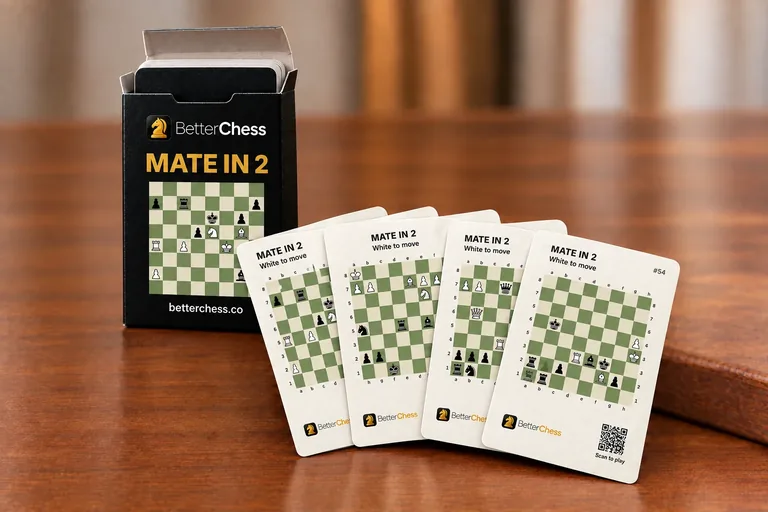
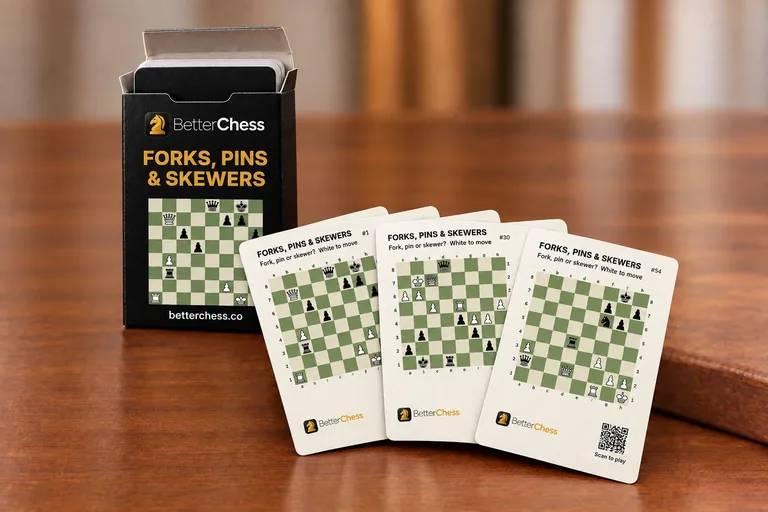
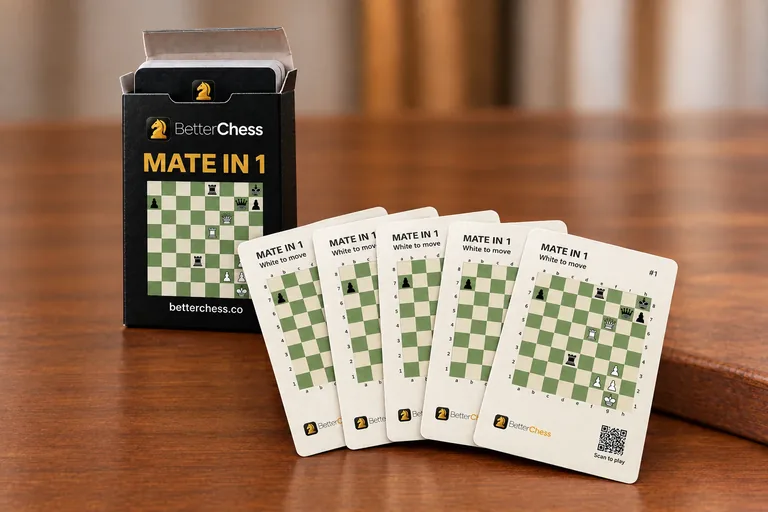
PRINTED CHESS PUZZLE CARDS
Chess puzzle playing card decks
54 poker-size cards in a tuck box. Puzzle on the front, solution on the back.