Center Game
Starting position
Engine ready — step through to see live evals.
Press ▶ Watch to play the line out, or Next to step through it — the engine evaluates every position.
The Center Game looks like a beginner's opening: White opens the centre on move two and recaptures with the queen on move three. The modern interpretation is anything but naive: the queen drops back to e3, White develops Nc3 and Bd2 and castles long by move seven, and the game becomes an opposite-side attacking race. Alexander Morozevich used it as a surprise weapon at the top level. Honesty first: with accurate play Black's free developing moves add up to comfortable equality, so this is a practical system that trades a little objective standing for positions you will know far better than your opponent.
The idea in one line
Open with 2.d4 and recapture with the queen, park it on e3, castle long quickly, and race against Black's king: a playable surprise system where knowing the plans matters more than the eval bar.
Key ideas
- The queen on e3 is the system's hub: it clears the way for lightning queenside castling and later swings to g3 to stare at the kingside.
- White castles long by move seven with the rook landing on d1, instant central pressure for an opening that supposedly loses time.
- Opposite-side castling sets the agenda: White storms the kingside with pieces and pawns while Black counterattacks e4 and the queenside; every tempo counts double.
- Engines shade it toward Black: the early queen moves donate development, and ...Nc6, ...Nf6 and ...Bb4 all arrive with tempo. Treat the Center Game as a surprise system you know cold, not a claim to an opening edge.
Plans for each side
White: Recapture on d4, retreat the queen to e3, then Nc3, Bd2 and O-O-O as fast as the moves allow. From there swing the queen to g3, pressure g7 and the e-file, and push kingside pawns at Black's castled king. The setup pays for itself only if you attack: develop with threats and go straight for the king.
Black: Punish the queen with development: 3...Nc6 hits it, then ...Nf6, ...Bb4, ...O-O and ...Re8 pile up on e4 and c3, with a well-timed ...d5 break to open the centre. Theory is on Black's side; the recipe is active piece play, not fear of the storm.
Common mistakes to avoid
- As White, the opening fails on autopilot: recapture on d4 and then play slowly and you are simply worse. The system only makes sense with fast long castling and a concrete attacking plan.
- After 3...Nc6, the retreat 4.Qe3 is the system; random queen squares just lose more time and the thread of the setup.
- As Black, don't mirror White's slow start: the punishment for the early queen is active development, and timid moves let White castle long and attack with a clean conscience.
The main line, explained
2. d4d4 opens the centre on move two; unlike the Danish Gambit, White intends simply to recapture.
3. Qxd4Qxd4 breaks the rule about early queens on purpose: White accepts the coming tempo hit as the entry fee for quick queenside castling.
3… Nc6...Nc6 develops with tempo, the automatic and best punishment; White expected it.
4. Qe3Qe3 is the modern square: out of the knights' reach, supporting Bd2 and O-O-O, with a later Qg3 swing in mind.
5… Bb4...Bb4 develops with a pin on the c3-knight, another tempo-gaining blow; Black's play is quick and easy.
7. O-O-OO-O-O is the payoff: castled by move seven, rook on d1, attack ready. This position is the whole point of the Center Game.
7… Re8...Re8 completes the tabiya: the rook eyes e4, and theory calls Black at least equal, so White must attack with real energy.
Frequently asked
Is the Center Game good?
It is playable and dangerous, not ambitious: engines say Black equalizes comfortably because 3.Qxd4 donates developing tempi. In practice White gets a fast attack, a clear plan and positions the opponent rarely studies, which is why grandmasters like Morozevich have wheeled it out as a surprise.
Why does White recapture with the queen in the Center Game?
It is a system decision: the queen recaptures, drops back to e3, and White castles long by move seven with the rook already on the d-file. The lost tempo is the entry fee for quick opposite-side castling and a ready-made attack.
How should Black meet the Center Game?
Develop with threats: 3...Nc6 hits the queen, then ...Nf6, ...Bb4, ...O-O and ...Re8 pressure e4 and c3. Theory gives Black full equality or a shade more; the only way to lose quickly is to play passively and let the kingside storm arrive first.
More openings to explore
Danish Gambit
King's Pawn (1.e4 e5) · C21
Learn & play ›Scotch Game
King's Pawn (1.e4 e5) · C45
Learn & play ›Knowing the moves of the Center Game is not the same as knowing why they work. Use Claude? BetterChess gives it a real engine, so it explains this opening from the board in front of you instead of from memory.
BetterChess is a practice tool — we make no guarantee you'll reach 1800 or any rating. The lines here are standard, well-established opening theory, and every move is checked legal with the same engine the board runs.
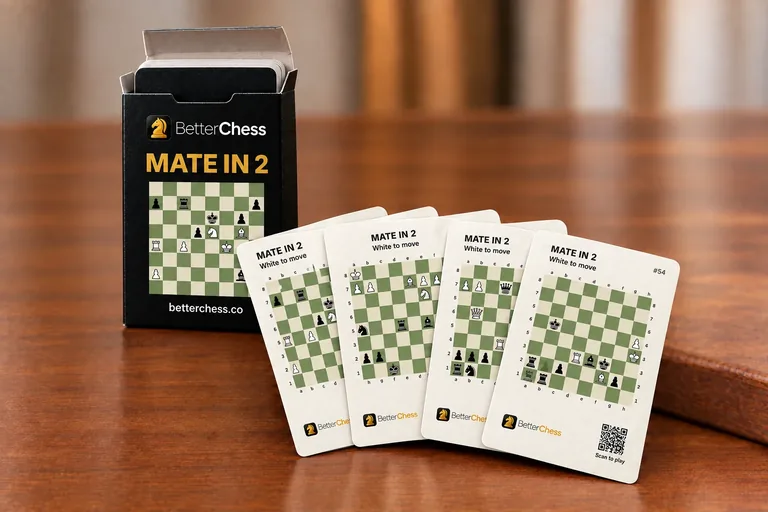
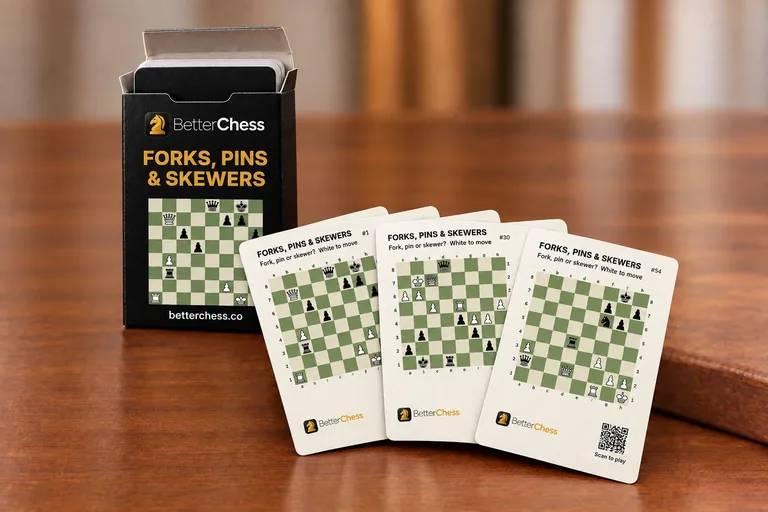
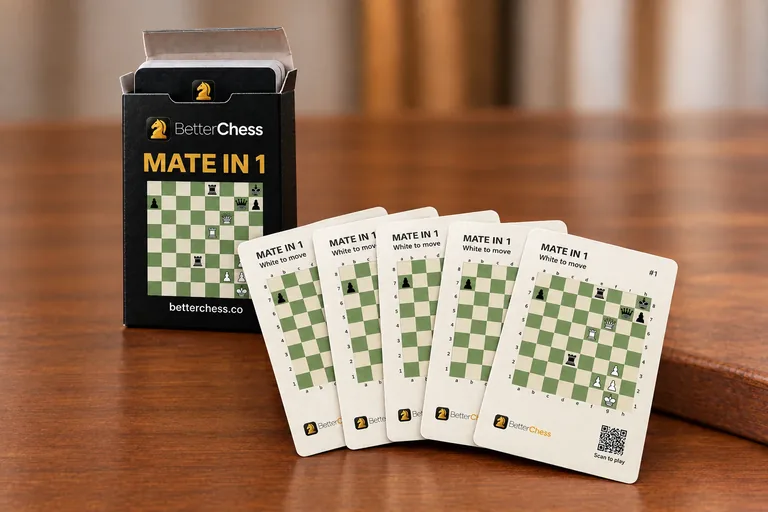
PRINTED CHESS PUZZLE CARDS
Chess puzzle playing card decks
54 poker-size cards in a tuck box. Puzzle on the front, solution on the back.