Blackmar-Diemer Gambit
Starting position
Engine ready — step through to see live evals.
Press ▶ Watch to play the line out, or Next to step through it — the engine evaluates every position.
The Blackmar-Diemer Gambit is 1.d4's answer to the King's Gambit: White offers a pawn on move two, then a second tempo with f3, to rip open the centre and get every piece out fast. Named after Armand Blackmar and its tireless evangelist Emil Josef Diemer, it is not fully sound (engines side with Black), but at club level it is a dangerous practical weapon that punishes slow, greedy defence and teaches attacking chess faster than almost any opening.
The idea in one line
Sacrifice a pawn with 2.e4 and 4.f3 to open the e- and f-files, develop every piece at top speed, and attack the black king before Black finishes development.
Key ideas
- 2.e4 turns a closed queen's pawn game into an open gambit fight: White gives the pawn to win time and open lines.
- 4.f3 is the point: White offers to open the f-file, and after Nxf3 and short castling the f1-rook already stares toward f7.
- Development is everything: bishops come to c4 or d3 and g5, the queen to d2 or e1, and every piece should be in play by move ten.
- Be honest with yourself about the verdict: with accurate, developing defence Black keeps the pawn and stands better, which is why you will not see the BDG in elite play.
Plans for each side
White: Give the pawn, recapture with 5.Nxf3, then develop at full speed: Bd3 or Bc4, Bg5, castle short and use the half-open f-file. Avoid trades, keep the initiative, and aim the attack at f7 and h7 before Black completes development.
Black: Return to sound principles: develop quickly (...e6 and ...Be7, or a ...g6 fianchetto), castle, and be willing to give the pawn back at the right moment if it buys safety. Accurate, unhurried defence leaves Black simply better.
Common mistakes to avoid
- Do not play the BDG and then trade pieces: every exchange drains the attack and leaves you a clean pawn down.
- The Ryder Gambit (5.Qxf3, offering a second pawn) is fun but even more dubious; treat it as a blitz experiment, not a repertoire choice.
- Know the declining lines too: Black can sidestep with 3...e5 (the Lemberger) or 4...e3; have a simple developing recipe against each rather than forcing the gambit.
The main line, explained
2. e4e4, the gambit. White converts a queen's pawn opening into an open, attacking fight at the cost of a pawn.
3. Nc3Nc3 develops with tempo against e4 and prepares f3, the move the whole gambit is built around.
3… Nf6...Nf6 develops and holds e4 for now, Black's most solid choice.
4. f3f3, the Blackmar-Diemer proper: White insists on opening the f-file even at the cost of a second tempo.
4… exf3...exf3 accepts again, the main line. Now White gets a big lead in development for the pawn.
5. Nxf3Nxf3, the sound recapture. 5.Qxf3, the Ryder Gambit, throws a second pawn on the fire and is best kept for blitz.
Frequently asked
Is the Blackmar-Diemer Gambit sound?
Not fully. Engines and masters prefer Black after accurate defence, so you will not see it at grandmaster level. At club level it is genuinely dangerous: one slow defensive move and White's development lead becomes a real attack.
What does White get for the pawn?
Time and open lines. White develops every piece quickly, gets a half-open f-file pointing at f7, and keeps the initiative. If Black defends carelessly or greedily, the attack often crashes through.
How should Black defend against it?
Develop, castle, and do not hoard. Solid setups with ...e6 and ...Be7, or a kingside fianchetto, blunt the attack, and returning the pawn at the right moment often leads to a comfortable, slightly better game.
Traps in the Blackmar-Diemer Gambit
- Halosar Trap: checkmate
More openings to explore
Scandinavian Defense
Black vs 1.e4 · B01
Learn & play ›King's Gambit
King's Pawn (1.e4 e5) · C30–C39
Learn & play ›Knowing the moves of the Blackmar-Diemer Gambit is not the same as knowing why they work. Use Claude? BetterChess gives it a real engine, so it explains this opening from the board in front of you instead of from memory.
BetterChess is a practice tool — we make no guarantee you'll reach 1800 or any rating. The lines here are standard, well-established opening theory, and every move is checked legal with the same engine the board runs.
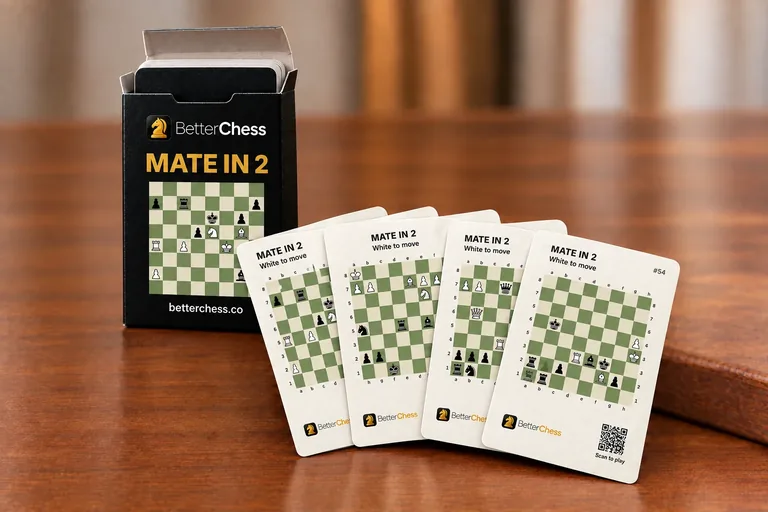
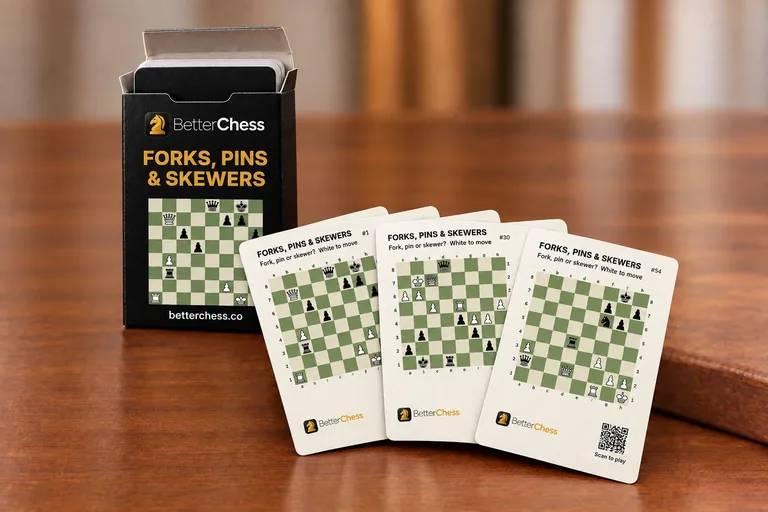
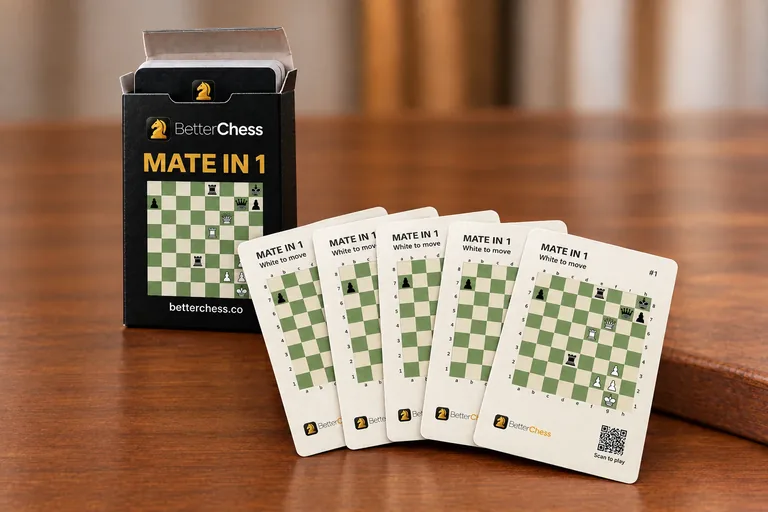
PRINTED CHESS PUZZLE CARDS
Chess puzzle playing card decks
54 poker-size cards in a tuck box. Puzzle on the front, solution on the back.