Benoni Defense
Starting position
Engine ready — step through to see live evals.
Press ▶ Watch to play the line out, or Next to step through it — the engine evaluates every position.
The Modern Benoni is one of the most combative answers to 1.d4: Black hands White extra space and a strong d5-pawn in exchange for two dynamic trumps, a queenside pawn majority ready to roll and a monster bishop on g7. Tal and Fischer both used it in the biggest games of their lives, and it remains the choice of players who want to win with Black, not just equalize.
The idea in one line
Strike at d4 with ...c5, trade your e-pawn for White's c-pawn to unbalance the game, then fianchetto, castle and race: your queenside majority and g7-bishop against White's central pawn mass.
Key ideas
- The structure defines everything: White gets a central majority with e4 and d5, Black gets a queenside majority that advances with ...b5 and ...c4.
- The fianchettoed g7-bishop rakes the long diagonal at d4, c3 and b2, supporting every queenside plan Black has.
- The half-open e-file belongs to Black: ...Re8 pressures e4 and makes White's central advance harder to arrange.
- It is a race, not a grind: if White achieves e5 under good conditions it can be crushing, so Black plays concretely, always with an eye on ...b5.
Plans for each side
White: Build the broad centre with e4, develop with Nf3 and Be2, or the more critical Bd3 and h3 setup, castle short, and prepare the central break e5, sometimes backed by f4. Space plus a well-timed e5 is White's whole story.
Black: Complete the kingside setup with ...g6, ...Bg7 and ...O-O, put a rook on e8 to restrain e4, then generate queenside play with ...a6, ...Nbd7 and ...b5 while the g7-bishop eats into White's queenside.
Common mistakes to avoid
- Move order is serious business: many strong players enter the Modern Benoni only after White has committed to Nf3, because the f4 and Bb5+ setups (the Taimanov Attack) are White's most dangerous try.
- Never drift: if the queenside majority never moves, White's space advantage slowly squeezes you off the board.
- Respect the e5 break: allowing it when your pieces are misplaced can end the game, so keep e5 firmly covered by the d6-pawn, your knights and the e8-rook.
The main line, explained
2… c5...c5 throws the first punch. Black invites d5, accepting less space in return for clear targets and an unbalanced fight.
3. d5d5 is the ambitious reply, gaining space and setting the Benoni structure.
3… e6...e6 attacks the d5 spearhead at once, forcing matters before White consolidates.
4… exd5...exd5, the defining trade: Black swaps the e-pawn for White's c-pawn, creating the rival majorities that drive both sides' plans.
5… d6...d6 controls e5, the square White's whole plan runs through, and completes the pawn skeleton.
6… g6...g6: the bishop is heading for g7, the piece that justifies Black's entire setup.
Frequently asked
Is the Modern Benoni sound?
It is sharp and theoretically demanding, but sound enough that Tal, Fischer and Gashimov trusted it at the very highest level. White keeps a small edge in the main lines, as in most defences; in return Black gets real winning chances.
What is the point of giving White the big centre?
Counterplay. The exchange on d5 gives Black a queenside pawn majority, a half-open e-file and the g7-bishop. White's centre is strong but also a target, and if it ever stalls, Black's ...b5 and ...c4 plan wins the long game.
Should I worry about the Taimanov Attack with f4 and Bb5+?
Yes, it is White's most dangerous setup. Many Benoni players use a move order that commits to ...e6 and ...exd5 only after White has played Nf3, precisely to rule it out. If you allow it, study the critical lines first.
More openings to explore
Benko Gambit
Black vs 1.d4 · A57-A59
Learn & play ›King's Indian Defense
Black vs 1.d4 · E60–E99
Learn & play ›Knowing the moves of the Benoni Defense is not the same as knowing why they work. Use Claude? BetterChess gives it a real engine, so it explains this opening from the board in front of you instead of from memory.
BetterChess is a practice tool — we make no guarantee you'll reach 1800 or any rating. The lines here are standard, well-established opening theory, and every move is checked legal with the same engine the board runs.
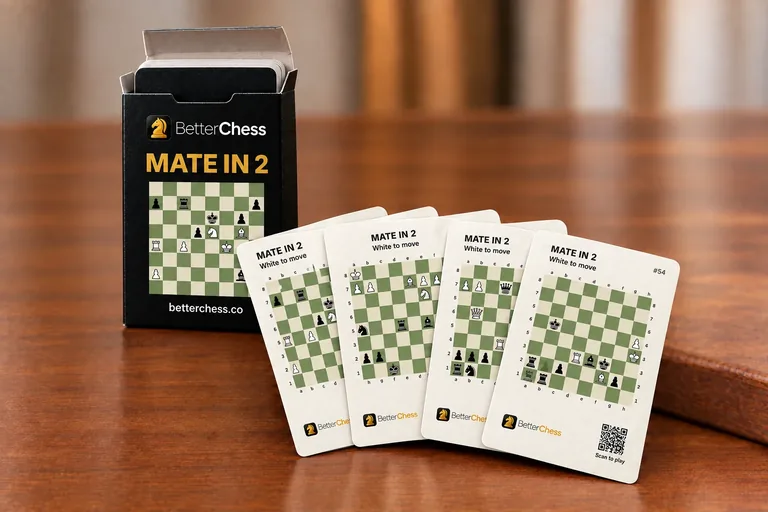
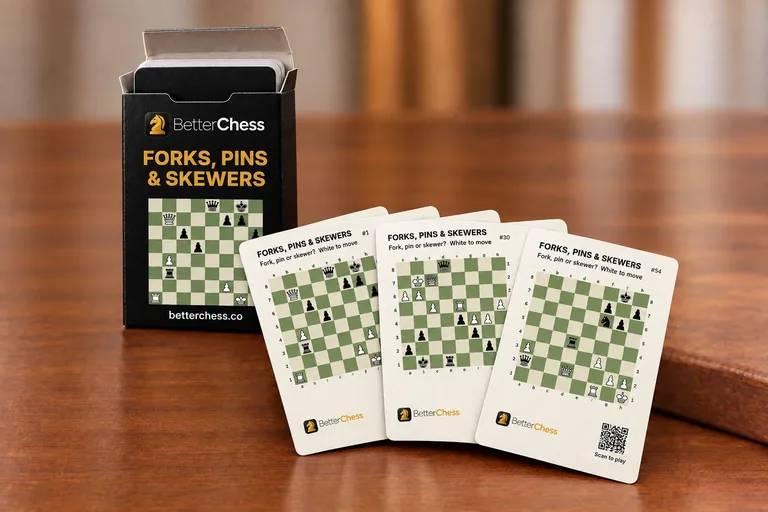
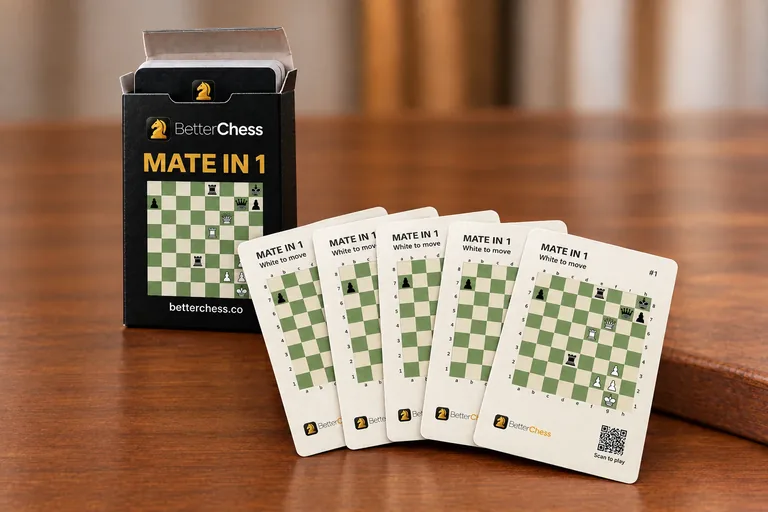
PRINTED CHESS PUZZLE CARDS
Chess puzzle playing card decks
54 poker-size cards in a tuck box. Puzzle on the front, solution on the back.