Benko Gambit
Starting position
Engine ready — step through to see live evals.
Press ▶ Watch to play the line out, or Next to step through it — the engine evaluates every position.
The Benko Gambit (called the Volga Gambit in much of Europe) is the most strategic gambit in chess: Black gives up the b-pawn on move three not for a mating attack but for lasting queenside pressure that persists deep into the endgame. Named after Hungarian-American grandmaster Pal Benko, it hands Black clear plans, easy development and an initiative that practically runs itself.
The idea in one line
Offer the b-pawn with 3...b5, recapture on a6 with the bishop, then pile the heavy pieces on the open a- and b-files and let the g7-bishop and queenside pressure grind White down, even after the queens come off.
Key ideas
- The compensation is structural, not tactical: open a- and b-files for the rooks, a chronic target on b2, and the g7-bishop hitting the same queenside.
- Endgames are often fine for Black despite the pawn: the file pressure does not trade off, while White's extra queenside pawn is hard to advance.
- Black's play is easy to find: ...d6, ...g6, ...Bg7 and ...O-O, then ...Nbd7, a queen to a5 or b6 and rooks to the a- and b-files.
- White's biggest problem is psychological as much as chess-based: there is no attack to beat off, just pressure that never quite goes away.
Plans for each side
White: Accept the pawn, develop soundly (often letting the king walk to g2 after ...Bxf1), keep the queenside closed, and look for the e5 break or gradual simplification. Returning the pawn at the right moment to kill the pressure is a standard resource.
Black: Recapture with ...Bxa6, set up with ...d6, ...g6 and ...Bg7, castle, then press: queen to a5 or b6, rooks to a8 and b8, knights to d7 and toward c4. The plan barely changes from game to game, which is the gambit's great practical strength.
Common mistakes to avoid
- Do not play for cheap tactics: the Benko is a squeeze, not a mating attack, and if you abandon the files you are just a pawn down.
- As White, clinging to the extra pawn with passive moves is the classic way to suffer; fight for the initiative with e5 or timely simplification instead.
- Know White's sidesteps: 4.Nf3 and 4.a4 decline the gambit, and 5.b6 hands the pawn straight back. Have a simple recipe against each so you are not improvising on move five.
The main line, explained
3… b5...b5, the gambit. Black gives a wing pawn to blast open the queenside files where Black's rooks will live for the rest of the game.
4. cxb5cxb5 accepts; declining is playable, but taking is the critical test.
4… a6...a6, the follow-up that makes it a true gambit: Black insists on opening the files.
5. bxa6bxa6 accepts in full, the main line.
5… Bxa6...Bxa6 recaptures and eyes f1: if White ever plays e4, ...Bxf1 strips the castling rights, a small permanent tax.
6… d6...d6 completes the structure, controlling e5 and freeing the b8-knight for d7.
Frequently asked
Is the Benko Gambit sound?
About as sound as a gambit can be. The compensation is positional and permanent: open files, better structure and effortless piece play. Engines give White only a small pull with best play, and over the board Black's game is far easier to handle.
Why is the Benko good even in the endgame?
Because the compensation never expires. Most gambits rely on an attack that fades when the queens come off; here Black's rooks stay active on the a- and b-files and White's extra queenside pawn is hard to advance, so many endgames are completely fine for Black.
What if White declines the gambit?
Nothing to fear. After 4.Nf3 or 4.a4, the space gained by ...b5 is useful even without open files, and Black gets a comfortable Benoni-style game. Meet each decline with natural development and stick to the queenside plan.
More openings to explore
Benoni Defense
Black vs 1.d4 · A60-A79
Learn & play ›King's Indian Defense
Black vs 1.d4 · E60–E99
Learn & play ›Knowing the moves of the Benko Gambit is not the same as knowing why they work. Use Claude? BetterChess gives it a real engine, so it explains this opening from the board in front of you instead of from memory.
BetterChess is a practice tool — we make no guarantee you'll reach 1800 or any rating. The lines here are standard, well-established opening theory, and every move is checked legal with the same engine the board runs.
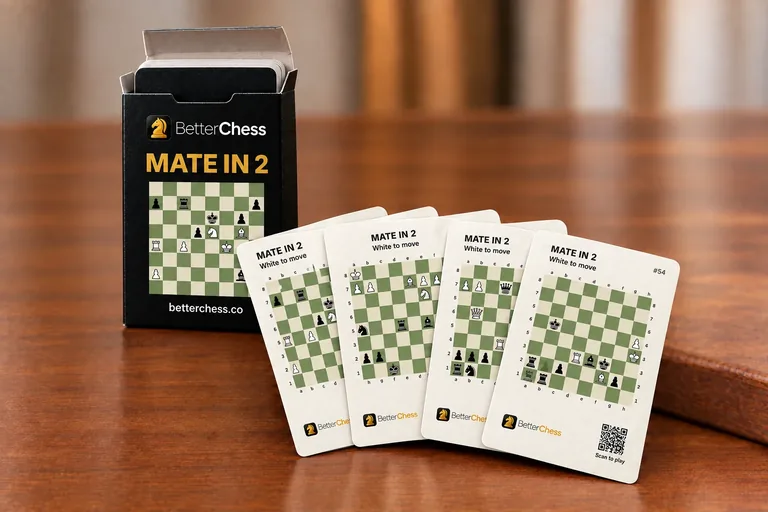
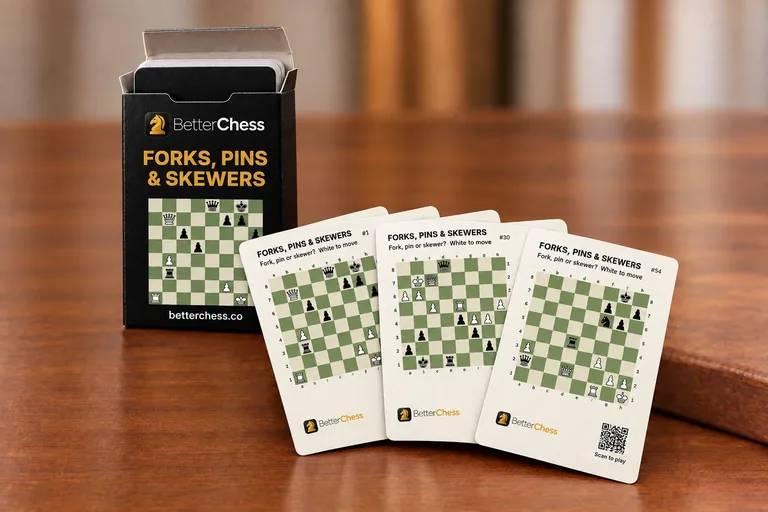
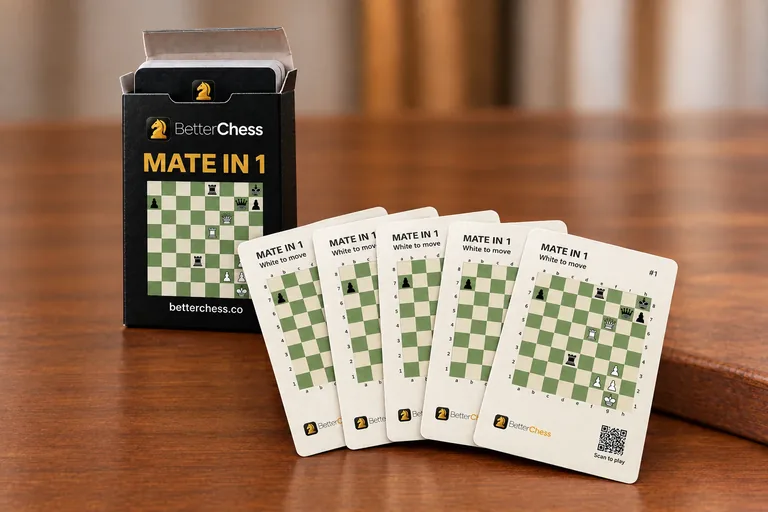
PRINTED CHESS PUZZLE CARDS
Chess puzzle playing card decks
54 poker-size cards in a tuck box. Puzzle on the front, solution on the back.