Veresov Attack
Starting position
Engine ready — step through to see live evals.
Press ▶ Watch to play the line out, or Next to step through it — the engine evaluates every position.
The Veresov Attack (often called the Richter-Veresov) is 1.d4's road less travelled: White develops with Nc3 and Bg5 and often prepares the central break e4, choosing quick piece activity over the usual c4 structures. Named after German master Kurt Richter and Soviet master Gavriil Veresov, it is perfectly playable and drags 1.d4 d5 players into positions they have rarely studied.
The idea in one line
Develop Nc3 and Bg5 quickly, then put the question to Black's centre: the sharp plan is f3 and e4, the calm plan is Nf3 and e3, and both come with far less theory than the main lines.
Key ideas
- Nc3 blocks the c-pawn on purpose: instead of Queen's Gambit structures, White wants fast development and the e4 break.
- Bg5 pressures the f6-knight, the piece holding up e4, so the central break comes with extra force.
- The signature plan is f3 followed by e4, opening the centre while Black is still getting organized.
- There is also a quieter face: Nf3 and e3 give a solid, Torre-like game when you would rather build than blast.
Plans for each side
White: Develop Nc3 and Bg5, then choose your weapon: the aggressive f3 and e4 break, often with Qd2 and long castling behind it, or the calm Nf3 and e3 setup. Either way, play actively and use your development lead before Black frees their game.
Black: Meet it classically: 3...Nbd7 supports the f6-knight so Bxf6 never doubles the pawns, then strike back in the centre with ...c5 or ...e5 once development is done. Solid moves and timely counterplay take the sting out of White's setup.
Common mistakes to avoid
- Blocking the c-pawn is a real concession: if you never achieve e4, Black equalizes comfortably, so play the opening with energy.
- Watch the g5-bishop: after ...h6 you must choose between Bh4, Bf4 and Bxf6 on the spot, and each leads to a different kind of game.
- As Black, castling short into a ready-made Qd2 and O-O-O attack without starting queenside play is asking for trouble.
The main line, explained
1… d5...d5 stakes the centre, the most natural reply and the one the Veresov is designed to meet.
2. Nc3Nc3, the Veresov move: development first, even at the cost of blocking the c-pawn.
3. Bg5Bg5 develops with pressure on f6, the piece guarding e4. White's central break is already in the air.
3… Nbd7...Nbd7, the classical answer: now Bxf6 can be met by ...Nxf6, keeping Black's structure healthy.
4. Nf3Nf3, the solid main road. The sharper 4.f3, aiming for an immediate e4, is the system's other main face.
Frequently asked
Is the Veresov Attack sound?
Yes, it is sound, just less ambitious than the main lines: Black has several comfortable equalizers. Its value is practical: opponents meet it rarely, the plans are easy to learn, and the sharp f3 and e4 lines carry real sting.
Veresov vs Jobava London: what is the difference?
Both begin with d4 and Nc3. The Jobava puts the bishop on f4 and leans on the Nb5 trick; the Veresov puts it on g5 and aims for the e4 break. The Veresov is the older, more committal cousin.
What should Black play against it?
3...Nbd7 is the classical recipe, keeping the pawn structure healthy. Developing the bishop first with 3...Bf5 is also fully respectable, and the immediate 3...c5 is a well-known active try. Principled development beats memorization here.
More openings to explore
Trompowsky Attack
Queen's Pawn (1.d4) · A45
Learn & play ›Jobava London System
Queen's Pawn (1.d4) · D00
Learn & play ›Knowing the moves of the Veresov Attack is not the same as knowing why they work. Use Claude? BetterChess gives it a real engine, so it explains this opening from the board in front of you instead of from memory.
BetterChess is a practice tool — we make no guarantee you'll reach 1800 or any rating. The lines here are standard, well-established opening theory, and every move is checked legal with the same engine the board runs.
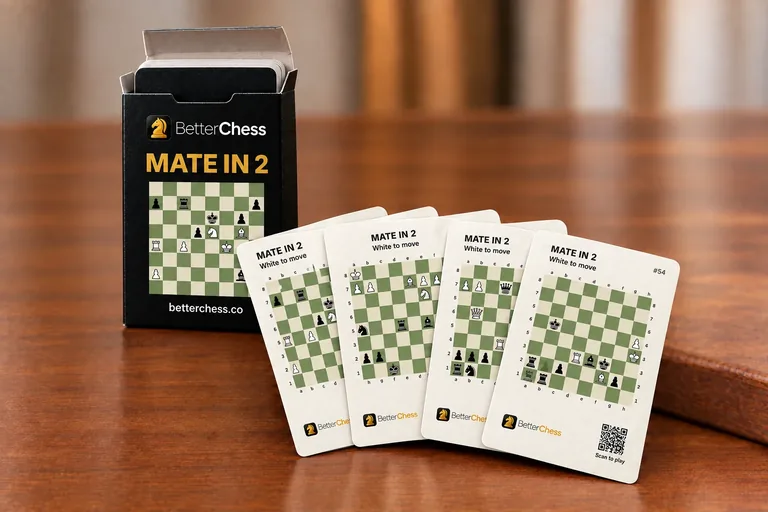
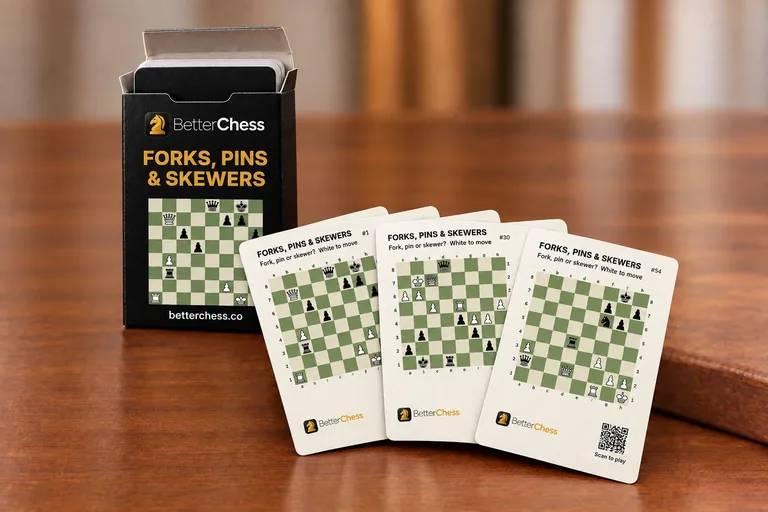
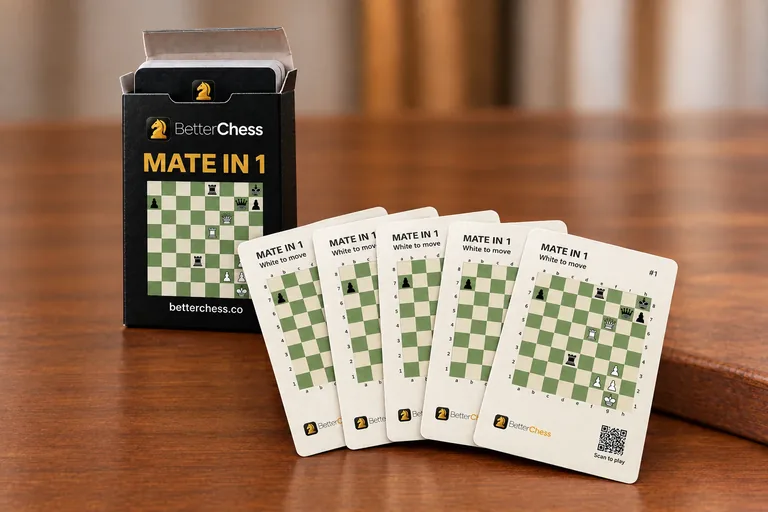
PRINTED CHESS PUZZLE CARDS
Chess puzzle playing card decks
54 poker-size cards in a tuck box. Puzzle on the front, solution on the back.