Grand Prix Attack
Starting position
Engine ready — step through to see live evals.
Press ▶ Watch to play the line out, or Next to step through it — the engine evaluates every position.
The Grand Prix Attack is the club player's flamethrower against the Sicilian: White plays an early f4 and goes straight for the black king. The name comes from the English weekend tournament circuit of the 1970s and 80s, where it terrorized the Grand Prix events. The modern move order starts 2.Nc3, avoiding 2.f4 d5, and follows with f4, Nf3 and either Bb5 or Bc4. The plans are direct: f5, Qe1-h4, and mate.
The idea in one line
Play 2.Nc3 then f4 and attack: develop Nf3 and Bb5 (or Bc4), castle short, swing the queen via e1 to h4, and break with f5 against Black's kingside.
Key ideas
- The f4-f5 break is the engine of the attack: it pries open the f-file or fixes a wedge on f5, and every White piece points at the black king.
- The queen lift Qe1-h4 is the signature manoeuvre; combined with f5, Bh6 and Ng5, it creates real mating threats out of natural moves.
- Modern move order matters: 2.Nc3 first, because the immediate 2.f4 allows 2...d5, Black's best equalizer, when 3.exd5 Qxd5 hits no knight on c3.
- Bb5 is the grown-up version of the attack: trading on c6 damages Black's structure and removes a defender before the storm starts; Bc4 keeps more pieces on but bites on granite if Black plays a timely ...e6.
Plans for each side
White: Develop with Nc3, f4, Nf3, then choose Bb5 (often taking on c6 to wreck the pawns) or Bc4 aiming at f7. Castle short, play Qe1-h4, push f5, and throw pieces at the king: Bh6, Ng5, and sacrifices on f5 or g6 are all standard fuel.
Black: Blunt the attack before it starts: fianchetto with ...g6 and ...Bg7, meet Bb5 with ...Nd4 offering a favourable trade, keep the e6 and d5 squares controlled, and counter in the centre with ...e6 and ...d5, the classic answer to a wing attack.
Common mistakes to avoid
- Do not play 2.f4 first: 2...d5 equalizes immediately and the whole attacking setup loses its point. The Nc3 move order exists for a reason.
- Do not autopilot the attack when Black breaks with ...d5: a wing attack against a successful central counter usually loses; sometimes you must switch to positional play.
- Against ...Nd4, do not drift: trade or retreat the b5-bishop with purpose, because leaving it hanging around lets ...Nxb5 and ...a6 gain time for Black's counterplay.
The main line, explained
2. Nc3Nc3 first, the modern move order: it rules out the freeing 2...d5 reply that the immediate 2.f4 would allow.
3. f4f4 declares the plan: kingside space, a future f5 break, and open lines toward the black king.
3… g6...g6 prepares the standard defensive fianchetto; the g7-bishop is Black's best defender in this structure.
4. Nf3Nf3 develops and keeps both Bb5 and Bc4 available; the knight also eyes g5 for the attack.
5. Bb5Bb5 is the modern main choice, threatening to take on c6 and damage the queenside pawns before the storm begins.
5… Nd4...Nd4 is Black's main answer, offering to resolve the pin question and asking White to commit.
Frequently asked
Is the Grand Prix Attack sound?
It is a legitimate practical weapon rather than a theoretical main line. Engines rate the resulting positions roughly equal with best play, but at club level the attack practically plays itself while the defence requires precision, which is a great trade.
Bb5 or Bc4 in the Grand Prix Attack?
Bb5 is the modern preference: it pressures the c6-knight, can inflict doubled pawns, and avoids the ...e6 and ...d5 setups that blunt the c4-bishop. Bc4 is sharper against slow play but gets neutralized more easily by a prepared opponent.
How should Black meet the Grand Prix Attack?
Fianchetto with ...g6 and ...Bg7, answer Bb5 with ...Nd4, and hit back in the centre with ...e6 and ...d5. A wing attack is best met by a central counter; Black who reacts with those breaks in time usually stands well.
More openings to explore
Closed Sicilian
Sicilian Defence (1.e4 c5) · B23-B26
Learn & play ›Sicilian Defense
Black vs 1.e4 · B20–B99
Learn & play ›Knowing the moves of the Grand Prix Attack is not the same as knowing why they work. Use Claude? BetterChess gives it a real engine, so it explains this opening from the board in front of you instead of from memory.
BetterChess is a practice tool — we make no guarantee you'll reach 1800 or any rating. The lines here are standard, well-established opening theory, and every move is checked legal with the same engine the board runs.
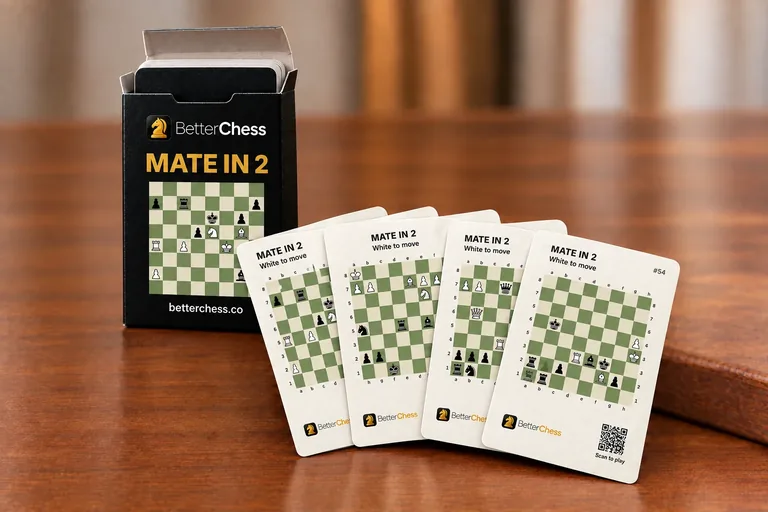
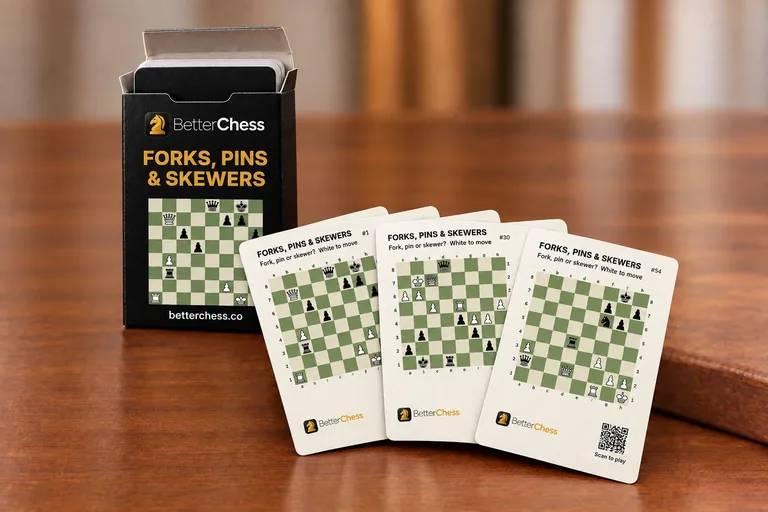
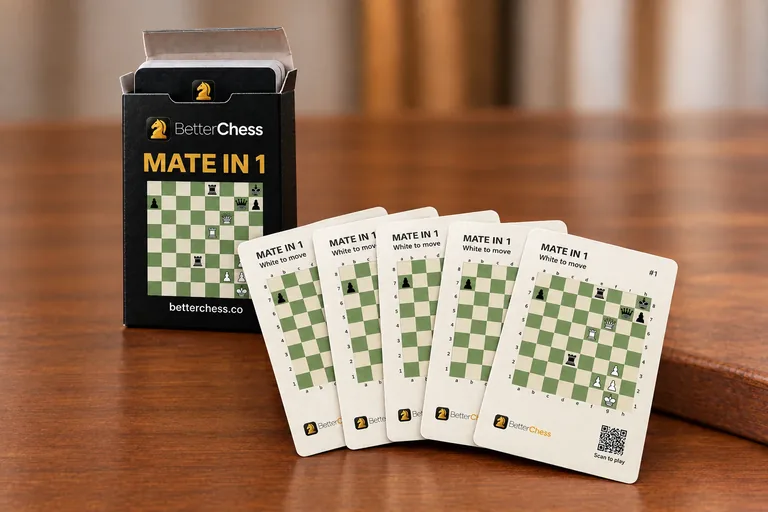
PRINTED CHESS PUZZLE CARDS
Chess puzzle playing card decks
54 poker-size cards in a tuck box. Puzzle on the front, solution on the back.