Englund Gambit
Starting position
Engine ready — step through to see live evals.
Press ▶ Watch to play the line out, or Next to step through it — the engine evaluates every position.
The Englund Gambit meets 1.d4 with the shocking 1...e5, giving up a pawn on move one to drag queen's pawn players into open water. Full honesty: this is an objectively dubious opening. Against accurate play White keeps the pawn, finishes development first, and engines assess the main line as close to winning for White. The Englund lives on anyway because it skips all 1.d4 theory, sets immediate concrete problems, and punishes one natural-looking mistake brutally. Treat it as a blitz surprise you play with open eyes, never as a main defence.
The idea in one line
Sacrifice the e-pawn to unbalance 1.d4 players from move one, then raid with ...Qe7, ...Qb4+ and ...Qxb2. Know the forced queen-escape line cold, and know that with best play White simply stands much better.
Key ideas
- The point is disruption: London, Colle and Queen's Gambit players are out of their systems after one move and must solve concrete problems immediately.
- The main line is a queen raid: ...Qe7 leans on e5, then ...Qb4+ forks threats along the rank and diagonal and ...Qxb2 grabs a pawn back at high cost.
- The honest verdict: after the correct 6.Nc3 White is far ahead in development with the safer king, and engines put the position near winning for White. There is no theoretical argument here, only practical venom.
- One famous trap (a queen mate on c1 if White defends b2 with the careless bishop move) wins many blitz games, but a prepared opponent avoids it by force; never build a repertoire on a hope.
Plans for each side
White: Accept the pawn, develop naturally (Nf3, Bf4), meet the queen raid with the accurate 6.Nc3, and answer ...Bb4 with Rb1 chasing the b2-queen to a3. White returns nothing, castles, and converts the huge lead in development.
Black: Play the raid precisely: ...Nc6 and ...Qe7 against e5, then ...Qb4+ and ...Qxb2 to restore material. Against 6.Nc3 the queen must escape via the forced ...Bb4, ...Qa3 route, after which Black is worse but on the board, hoping practical chances and unfamiliarity tell.
Common mistakes to avoid
- Grabbing b2 and improvising afterwards loses the queen or the game: after 6.Nc3 Bb4 7.Rb1 Qa3 is the only path, and you must know it before you ever play 1...e5.
- Do not make the Englund your main weapon in slow rated games: when the trap does not land, you are simply worse with no structural compensation.
- Relying on White blundering into the c1 mate is lottery chess; the whole line is refuted by one accurate knight move, so treat every game as if your opponent knows it.
The main line, explained
1… e5...e5, the Englund. Black offers a centre pawn on move one to force original play; objectively it should not fully work.
2. dxe5dxe5 is best: accepting punishes the gambit. Declining hands Black easy equality for free.
2… Nc6...Nc6 develops and attacks e5 at once, the only consistent follow-up.
3… Qe7...Qe7 adds a second attacker on e5 and prepares the raid with ...Qb4+.
4. Bf4Bf4 is the main line, defending e5 and developing, but it lets the queen raid begin.
4… Qb4+...Qb4+ is the point: the check also attacks the f4-bishop along the rank and the b2-pawn behind it.
5… Qxb2...Qxb2 restores material balance, but the queen is now deep in enemy territory with White to move.
6. Nc3Nc3! is the refutation move: it develops with threats and sidesteps the notorious losing alternative of blocking with the bishop on c3.
6… Bb4...Bb4 pins and starts the only viable escape plan: after Rb1 the queen must run to a3, and White stands clearly better.
Frequently asked
Is the Englund Gambit sound?
No. With the accurate 6.Nc3 White keeps the extra pawn, leads in development and stands close to winning according to engines. It is a practical surprise weapon for fast time controls, not a defence that survives correct play.
Why do people play the Englund at all?
It erases all 1.d4 theory in one move, forces opponents to think from move two, and contains a genuinely deadly trap that catches players who defend b2 carelessly. In blitz those practical factors win real games.
What must I know before trying it as Black?
The forced queen-escape line: after 5...Qxb2 6.Nc3 you must find ...Bb4 and then ...Qa3 when the rook comes to b1. Miss one move and the queen is trapped, so learn that sequence before your first game with it.
Traps in the Englund Gambit
- Englund Gambit Trap: checkmate
More openings to explore
Budapest Gambit
Black vs 1.d4 · A51-A52
Learn & play ›Albin Countergambit
Black vs 1.d4 · D08-D09
Learn & play ›Knowing the moves of the Englund Gambit is not the same as knowing why they work. Use Claude? BetterChess gives it a real engine, so it explains this opening from the board in front of you instead of from memory.
BetterChess is a practice tool — we make no guarantee you'll reach 1800 or any rating. The lines here are standard, well-established opening theory, and every move is checked legal with the same engine the board runs.
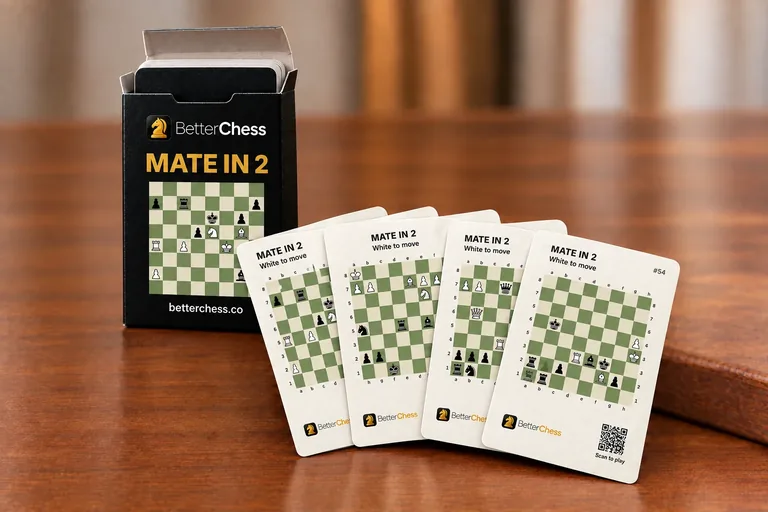
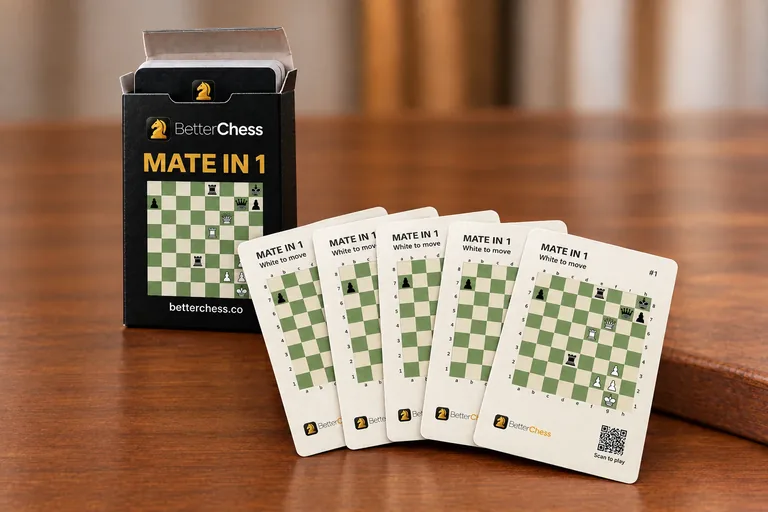
PRINTED CHESS PUZZLE CARDS
Chess puzzle playing card decks
54 poker-size cards in a tuck box. Puzzle on the front, solution on the back.